Smith-Cortinez Natalia, Yadak Rana, Hendriksen Ferry G J, Sanders Eefje, Ramekers Dyan, Stokroos Robert J, Versnel Huib, Straatman Louise V
Department of Otorhinolaryngology and Head & Neck Surgery, University Medical Center Utrecht, Utrecht, Netherlands.
UMC Utrecht Brain Center, University Medical Center Utrecht, Utrecht University, Utrecht, Netherlands.
Front Mol Neurosci. 2021 Oct 5;14:729625. doi: 10.3389/fnmol.2021.729625. eCollection 2021.
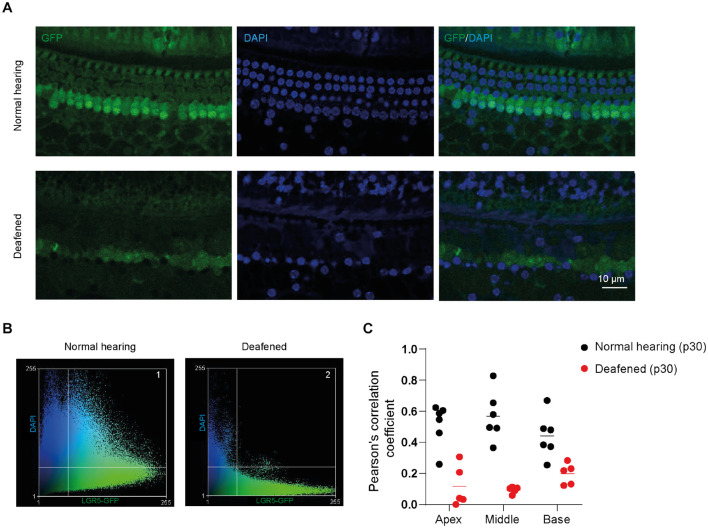
Sensorineural hearing loss is mainly caused by irreversible damage to sensory hair cells (HCs). A subgroup of supporting cells (SCs) in the cochlea express leucine-rich repeat-containing G-protein coupled receptor 5 (LGR5), a marker for tissue-resident stem cells. LGR5+ SCs could be used as an endogenous source of stem cells for regeneration of HCs to treat hearing loss. Here, we report long-term presence of LGR5+ SCs in the mature adult cochlea and survival of LGR5+ SCs after severe ototoxic trauma characterized by partial loss of inner HCs and complete loss of outer HCs. Surviving LGR5+ SCs (confirmed by GFP expression) were located in the third row of Deiters' cells. We observed a change in the intracellular localization of GFP, from the nucleus in normal-hearing to cytoplasm and membrane in deafened mice. These data suggests that the adult mammalian cochlea possesses properties essential for regeneration even after severe ototoxic trauma.
感音神经性听力损失主要由感觉毛细胞(HCs)的不可逆损伤引起。耳蜗中的一组支持细胞(SCs)表达富含亮氨酸重复序列的G蛋白偶联受体5(LGR5),这是组织驻留干细胞的标志物。LGR5+SCs可作为干细胞的内源性来源,用于HCs再生以治疗听力损失。在此,我们报告了LGR5+SCs在成年成熟耳蜗中的长期存在,以及在以部分内毛细胞丧失和全部外毛细胞丧失为特征的严重耳毒性损伤后LGR5+SCs的存活情况。存活的LGR5+SCs(通过绿色荧光蛋白表达证实)位于Deiters细胞的第三排。我们观察到绿色荧光蛋白的细胞内定位发生了变化,从听力正常小鼠的细胞核定位变为耳聋小鼠的细胞质和细胞膜定位。这些数据表明,即使在严重耳毒性损伤后,成年哺乳动物耳蜗仍具有再生所必需的特性。