Cherbuin Nicolas, Walsh Erin I, Shaw Marnie, Luders Eileen, Anstey Kaarin J, Sachdev Perminder S, Abhayaratna Walter P, Gaser Christian
Centre for Research on Ageing, Health and Wellbeing, Australian National University, Canberra, ACT, Australia.
College of Engineering & Computer Science, Australian National University, Canberra, ACT, Australia.
Front Aging Neurosci. 2021 Oct 5;13:694982. doi: 10.3389/fnagi.2021.694982. eCollection 2021.
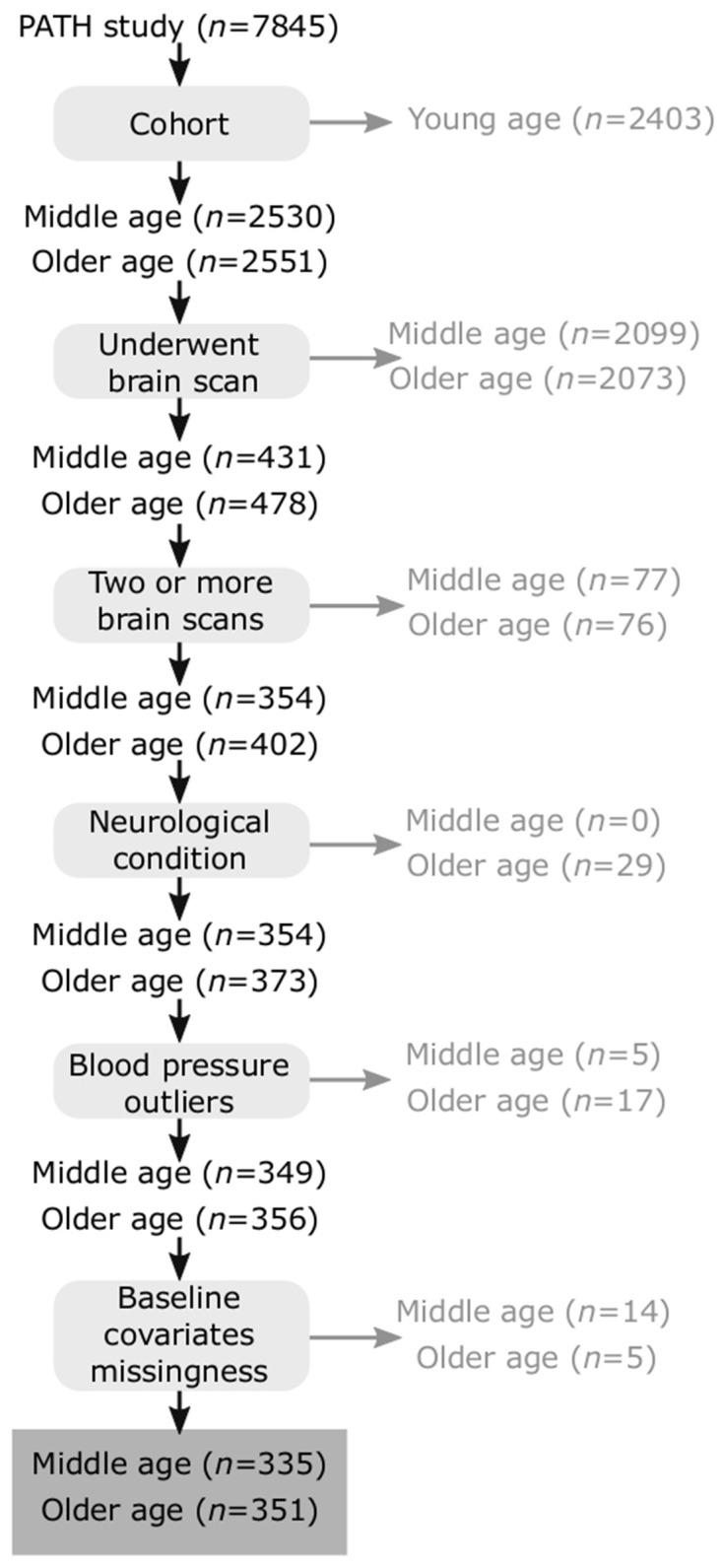
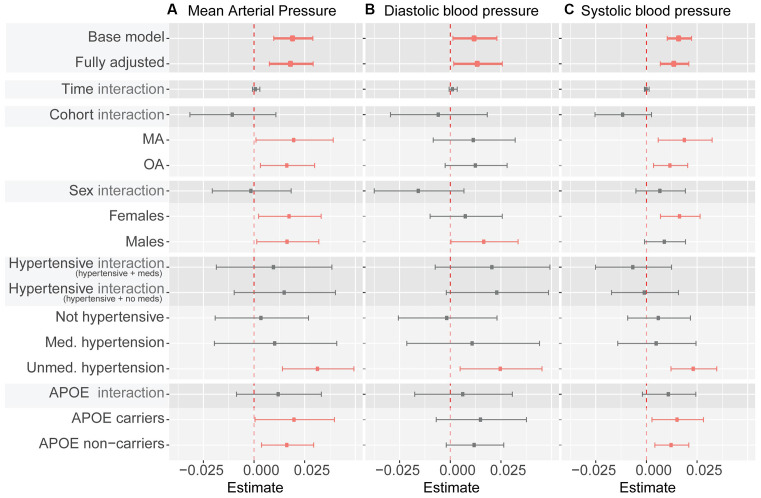
: Elevated blood pressure (BP) is a major health risk factor and the leading global cause of premature death. Hypertension is also a risk factor for cognitive decline and dementia. However, when elevated blood pressure starts impacting cerebral health is less clear. We addressed this gap by estimating how a validated measure of brain health relates to changes in BP over a period of 12 years. : Middle-age (44-46 years at baseline, = 335, 52% female) and older-age (60-64 years, = 351, 46% female) cognitively intact individuals underwent up to four brain scans. Brain health was assessed using a machine learning approach to produce an estimate of "observed" age (BrainAGE), which can be contrasted with chronological age. Longitudinal associations between blood pressures and BrainAGE were assessed with linear mixed-effects models. : A progressive increase in BP was observed over the follow up (MAP = 0.8 mmHg/year, SD = 0.92; SBP = 1.41 mmHg/year, SD = 1.49; DBP = 0.61 mmHg/year, SD = 0.78). In fully adjusted models, every additional 10 mmHg increase in blood pressure (above 90 for mean, 114 for systolic, and 74 for diastolic blood pressure) was associated with a higher BrainAGE by 65.7 days for mean, and 51.1 days for systolic/diastolic blood pressure. These effects occurred across the blood pressure range and were not exclusively driven by hypertension. : Increasing blood pressure is associated with poorer brain health. Compared to a person becoming hypertensive, somebody with an ideal BP is predicted to have a brain that appears more than 6 months younger at midlife.
血压升高是主要的健康风险因素,也是全球过早死亡的首要原因。高血压还是认知能力下降和痴呆症的风险因素。然而,血压升高何时开始影响大脑健康尚不清楚。我们通过评估一种经过验证的大脑健康指标与12年期间血压变化之间的关系来填补这一空白。
中年(基线时44 - 46岁,n = 335,52%为女性)和老年(60 - 64岁,n = 351,46%为女性)认知功能正常的个体接受了多达四次脑部扫描。使用机器学习方法评估大脑健康,以得出“观察到的”年龄估计值(BrainAGE),该值可与实际年龄进行对比。使用线性混合效应模型评估血压与BrainAGE之间的纵向关联。
在随访期间观察到血压呈逐渐上升趋势(平均动脉压 = 0.8 mmHg/年,标准差 = 0.92;收缩压 = 1.41 mmHg/年,标准差 = 1.49;舒张压 = 0.61 mmHg/年,标准差 = 0.78)。在完全调整的模型中,血压每额外升高10 mmHg(平均血压超过90 mmHg,收缩压超过114 mmHg,舒张压超过74 mmHg),平均BrainAGE会增加65.7天,收缩压/舒张压增加51.1天。这些影响在整个血压范围内都存在,并非仅由高血压驱动。
血压升高与较差的大脑健康状况相关。与患高血压的人相比,血压理想的人在中年时大脑看起来要年轻超过6个月。