Department of Pathology and Laboratory Medicine, Perelman School of Medicine, University of Pennsylvania, Philadelphia, PA, United States.
Front Immunol. 2021 Oct 5;12:750542. doi: 10.3389/fimmu.2021.750542. eCollection 2021.
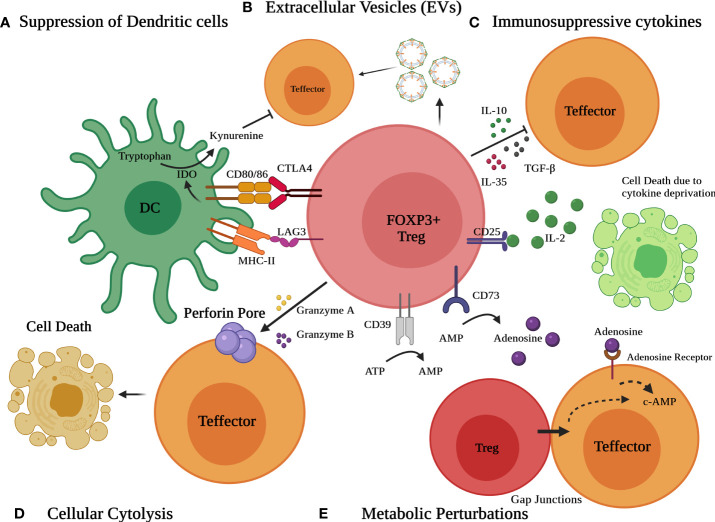
T regulatory cells suppress a variety of immune responses to self-antigens and play a role in peripheral tolerance maintenance by limiting autoimmune disorders, and other pathological immune responses such as limiting immune reactivity to oncoprotein encoded antigens. Forkhead box P3 (FOXP3) expression is required for Treg stability and affects functional activity. Mutations in the master regulator FOXP3 and related components have been linked to autoimmune diseases in humans, such as IPEX, and a scurfy-like phenotype in mice. Several lines of evidence indicate that Treg use a variety of immunosuppressive mechanisms to limit an immune response by targeting effector cells, including secretion of immunoregulatory cytokines, granzyme/perforin-mediated cell cytolysis, metabolic perturbation, directing the maturation and function of antigen-presenting cells (APC) and secretion of extracellular vesicles for the development of immunological tolerance. In this review, several regulatory mechanisms have been highlighted and discussed.
调节性 T 细胞抑制多种针对自身抗原的免疫反应,并通过限制自身免疫疾病和其他病理性免疫反应(如限制对癌蛋白编码抗原的免疫反应)来维持外周耐受。叉头框 P3(FOXP3)的表达对于 Treg 的稳定性和功能活性是必需的。FOXP3 及其相关成分的主调控因子的突变与人类自身免疫性疾病(如 IPEX)和小鼠的类 Scurfy 表型有关。有几条证据表明,Treg 通过靶向效应细胞,利用多种免疫抑制机制来限制免疫反应,包括分泌免疫调节细胞因子、颗粒酶/穿孔素介导的细胞细胞溶解、代谢扰动、指导抗原呈递细胞(APC)的成熟和功能以及分泌细胞外囊泡以发展免疫耐受。在这篇综述中,强调和讨论了几种调节机制。