Singh Mahavir, Kapoor Aniruddh, Bhatnagar Aruni
Eye and Vision Science Laboratory, Department of Physiology, School of Medicine, University of Louisville, Louisville, KY 40202, USA.
Internal Medicine-Critical Care, School of Medicine, Saint Louis University, St. Louis, MO 63141, USA.
Metabolites. 2021 Sep 27;11(10):655. doi: 10.3390/metabo11100655.
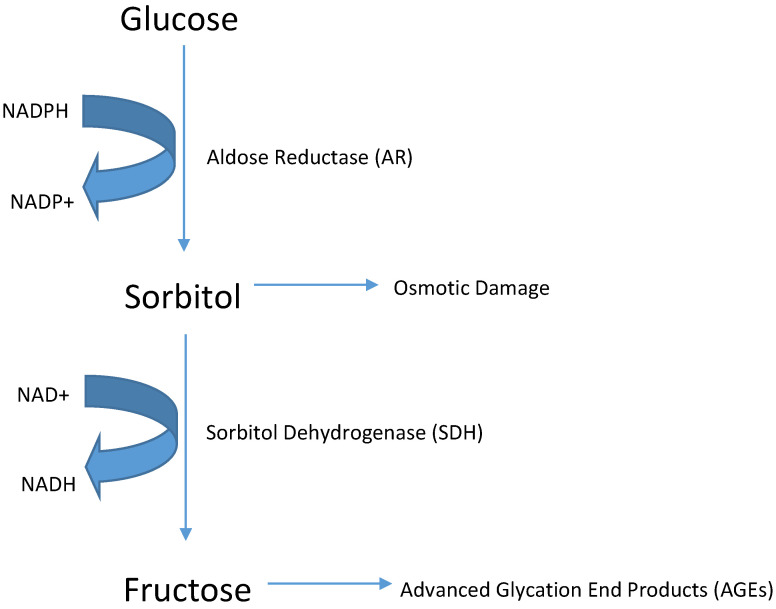
Aldose reductase (AR) is an aldo-keto reductase that catalyzes the first step in the polyol pathway which converts glucose to sorbitol. Under normal glucose homeostasis the pathway represents a minor route of glucose metabolism that operates in parallel with glycolysis. However, during hyperglycemia the flux of glucose via the polyol pathway increases significantly, leading to excessive formation of sorbitol. The polyol pathway-driven accumulation of osmotically active sorbitol has been implicated in the development of secondary diabetic complications such as retinopathy, nephropathy, and neuropathy. Based on the notion that inhibition of AR could prevent these complications a range of AR inhibitors have been developed and tested; however, their clinical efficacy has been found to be marginal at best. Moreover, recent work has shown that AR participates in the detoxification of aldehydes that are derived from lipid peroxidation and their glutathione conjugates. Although in some contexts this antioxidant function of AR helps protect against tissue injury and dysfunction, the metabolic transformation of the glutathione conjugates of lipid peroxidation-derived aldehydes could also lead to the generation of reactive metabolites that can stimulate mitogenic or inflammatory signaling events. Thus, inhibition of AR could have both salutary and injurious outcomes. Nevertheless, accumulating evidence suggests that inhibition of AR could modify the effects of cardiovascular disease, asthma, neuropathy, sepsis, and cancer; therefore, additional work is required to selectively target AR inhibitors to specific disease states. Despite past challenges, we opine that a more gainful consideration of therapeutic modulation of AR activity awaits clearer identification of the specific role(s) of the AR enzyme in health and disease.
醛糖还原酶(AR)是一种醛酮还原酶,它催化多元醇途径的第一步反应,即将葡萄糖转化为山梨醇。在正常的葡萄糖稳态下,该途径是葡萄糖代谢的一条次要途径,与糖酵解并行运作。然而,在高血糖期间,通过多元醇途径的葡萄糖通量显著增加,导致山梨醇过度生成。多元醇途径驱动的具有渗透活性的山梨醇积累与糖尿病继发性并发症如视网膜病变、肾病和神经病变的发生有关。基于抑制AR可以预防这些并发症的观点,已经开发并测试了一系列AR抑制剂;然而,发现它们的临床疗效充其量只是微不足道的。此外,最近的研究表明,AR参与了脂质过氧化衍生的醛及其谷胱甘肽共轭物的解毒过程。虽然在某些情况下,AR的这种抗氧化功能有助于防止组织损伤和功能障碍,但脂质过氧化衍生醛的谷胱甘肽共轭物的代谢转化也可能导致活性代谢物的产生,这些代谢物可以刺激有丝分裂或炎症信号事件。因此,抑制AR可能会产生有益和有害的结果。尽管如此,越来越多的证据表明,抑制AR可以改变心血管疾病、哮喘、神经病变、败血症和癌症的影响;因此,需要进一步的研究将AR抑制剂选择性地靶向特定疾病状态。尽管过去面临挑战,但我们认为,对AR活性进行治疗性调节的更有益的考虑有待更明确地确定AR酶在健康和疾病中的具体作用。