Verheyen Veerle J, Remy Sylvie, Govarts Eva, Colles Ann, Rodriguez Martin Laura, Koppen Gudrun, Voorspoels Stefan, Bruckers Liesbeth, Bijnens Esmée M, Vos Stijn, Morrens Bert, Coertjens Dries, De Decker Annelies, Franken Carmen, Den Hond Elly, Nelen Vera, Covaci Adrian, Loots Ilse, De Henauw Stefaan, Van Larebeke Nicolas, Teughels Caroline, Nawrot Tim S, Schoeters Greet
VITO Health, Flemish Institute for Technological Research (VITO), Boeretang 200, 2400 Mol, Belgium.
Department of Biomedical Sciences, University of Antwerp, Universiteitsplein 1, 2610 Wilrijk, Belgium.
Toxics. 2021 Oct 1;9(10):245. doi: 10.3390/toxics9100245.
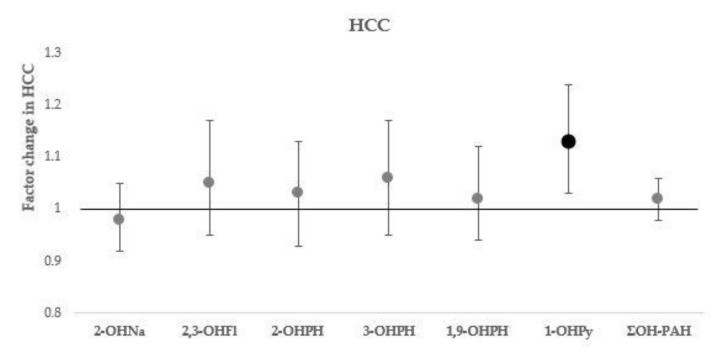
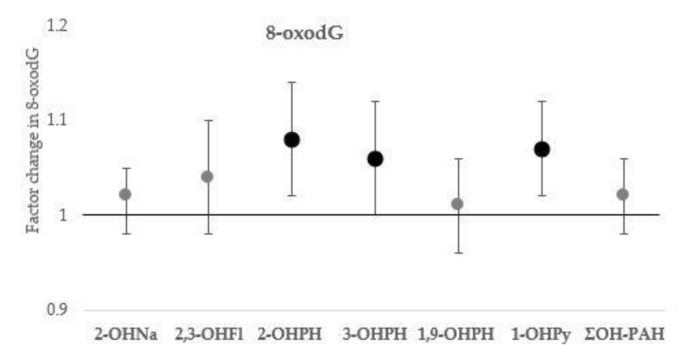
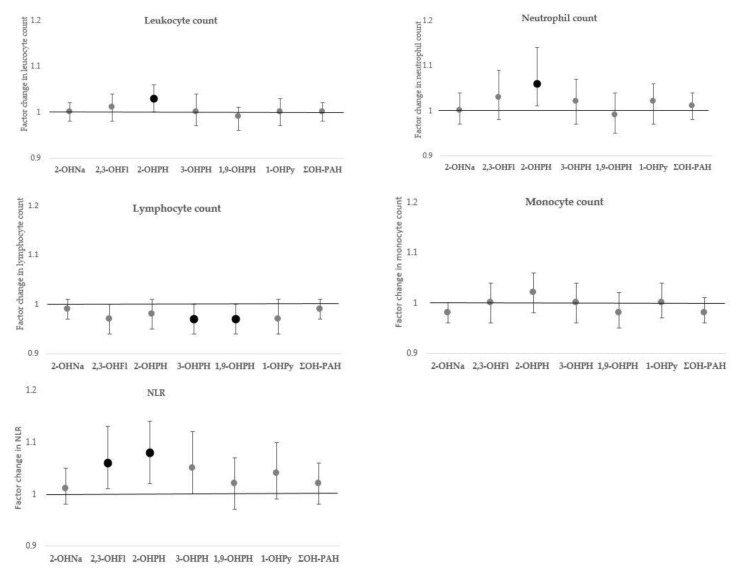
Polycyclic aromatic hydrocarbons (PAHs) are environmental pollutants of public health concern. Multiple biological mechanisms have been hypothesized to contribute to PAHs-associated adverse health effects. Little is known about the impact of PAHs on endocrine stress and inflammation in adolescence. We examined 393 Flemish adolescents (14-15 years) cross-sectionally, measured urinary concentrations of hydroxylated naphthalene, fluorene, phenanthrene and pyrene metabolites, and calculated the sum of all measured metabolites. We determined hair cortisol concentration (HCC) as endocrine stress biomarker, leucocyte counts and neutrophil-lymphocyte ratio (NLR) in peripheral blood as inflammatory biomarkers, and urinary 8-oxo-7,8-dihydro-2'-deoxyguanosine (8-oxodG) concentration as oxidative stress biomarker. Exposure-response associations were analyzed by multiple regression, adjusted for a priori selected covariates. A doubling of 1-hydroxypyrene concentration was associated with a factor of 1.13 (95% CI: 1.03, 1.24) increase in HCC and a factor of 1.07 (95% CI: 1.02, 1.13) increase in 8-oxodG. Doublings of 2- and 3-hydroxyphenanthrene concentrations were associated with a factor of 1.08 (95% CI: 1.02, 1.14) and 1.06 (95% CI: 1.00, 1.12) increase in 8-oxodG, respectively. Doubling of 2-hydroxyphenanthrene and of the sum of 2- and 3-hydroxyfluorene was associated with, respectively, a factor of 1.08 (95% CI: 1.02, 1.14) and 1.06 (95% CI: 1.01, 1.13) increase in NLR. Our results indicate the glucocorticoid pathway as a potential target for PAH exposure in adolescents and suggest oxidative stress, endocrine stress, and inflammation in adolescence as underlying mechanisms and early markers for PAH-related adverse health effects.
多环芳烃(PAHs)是引起公众健康关注的环境污染物。人们已推测多种生物学机制导致了与PAHs相关的不良健康影响。关于PAHs对青少年内分泌应激和炎症的影响知之甚少。我们对393名佛兰芒青少年(14 - 15岁)进行了横断面研究,测量了尿中羟基萘、芴、菲和芘代谢物的浓度,并计算了所有测量代谢物的总和。我们测定了头发皮质醇浓度(HCC)作为内分泌应激生物标志物,外周血白细胞计数和中性粒细胞与淋巴细胞比值(NLR)作为炎症生物标志物,以及尿8 - 氧代 - 7,8 - 二氢 - 2'-脱氧鸟苷(8 - 氧代dG)浓度作为氧化应激生物标志物。通过多元回归分析暴露 - 反应关联,并对预先选定的协变量进行调整。1 - 羟基芘浓度翻倍与HCC增加1.13倍(95%可信区间:1.03, 1.24)以及8 - 氧代dG增加1.07倍(95%可信区间:1.02, 1.13)相关。2 - 羟基菲和3 - 羟基菲浓度翻倍分别与8 - 氧代dG增加1.08倍(95%可信区间:1.02, 1.14)和1.06倍(95%可信区间:1.00, 1.12)相关。2 - 羟基菲以及2 - 羟基芴和3 - 羟基芴总和翻倍分别与NLR增加1.08倍(95%可信区间:1.02, 1.14)和1.06倍(95%可信区间:1.01, 1.13)相关。我们的结果表明糖皮质激素途径是青少年PAH暴露的潜在靶点,并提示氧化应激、内分泌应激和青少年炎症是PAH相关不良健康影响的潜在机制和早期标志物。