Karn Vamika, Ahmed Shaista, Tsai Lung-Wen, Dubey Rajni, Ojha Shreesh, Singh Himanshu Naryan, Kumar Mukesh, Gupta Piyush Kumar, Sadhu Soumi, Jha Niraj Kumar, Kumar Ashutosh, Pandit Soumya, Kumar Sanjay
Department of Biotechnology, Amity University, Mumbai 410221, India.
Faculty of Medical and Paramedical Sciences, Aix-Marseille University, 13005 Marseille, France.
Biomedicines. 2021 Oct 1;9(10):1373. doi: 10.3390/biomedicines9101373.
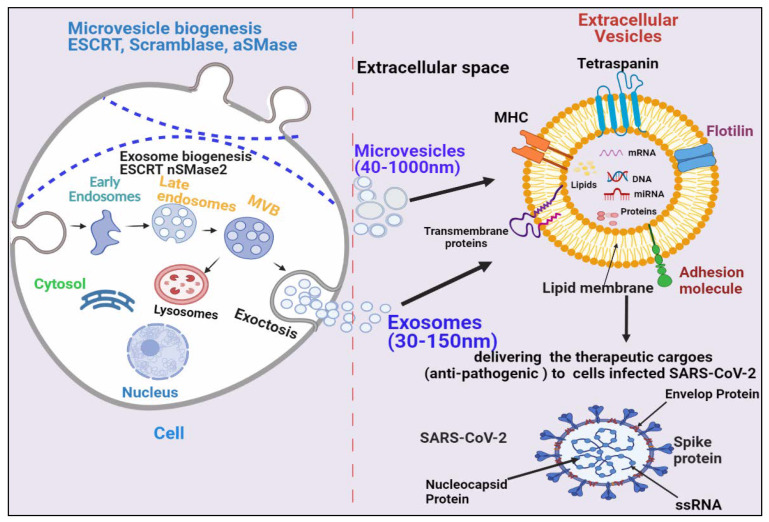
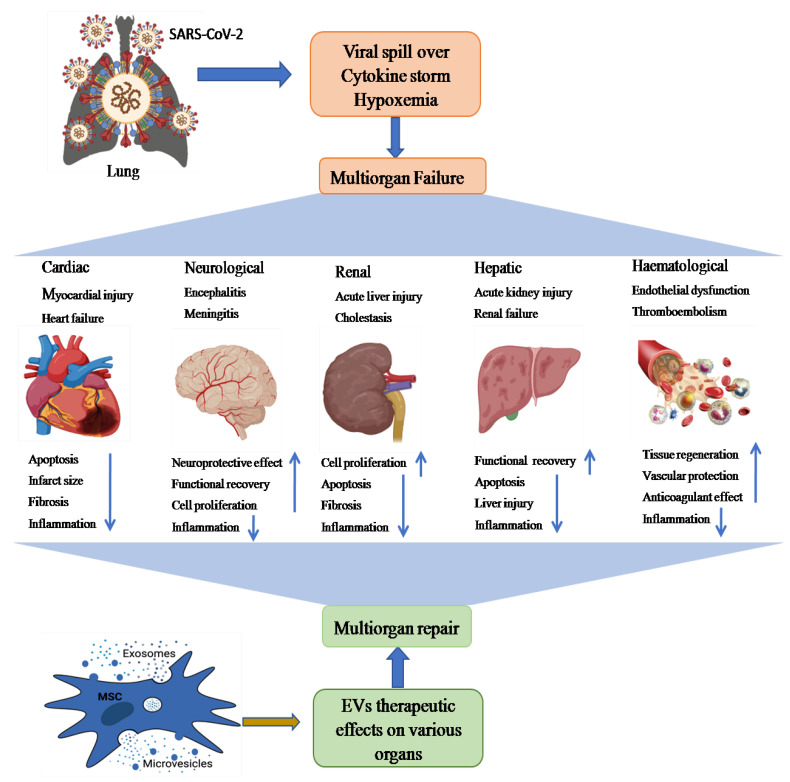
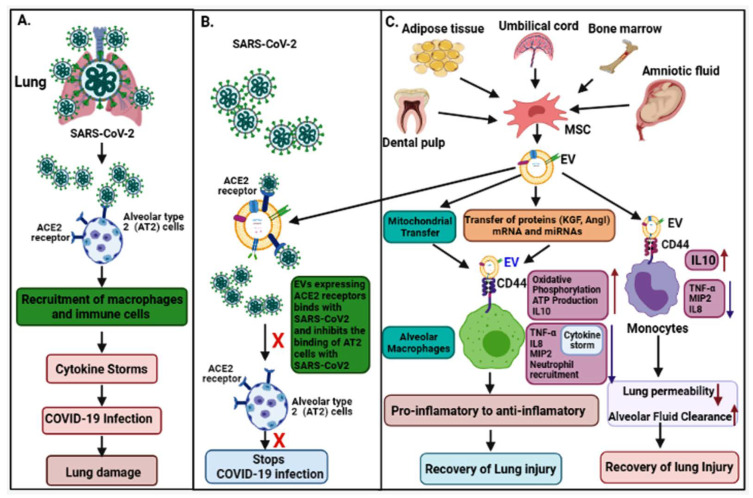
The COVID-19 pandemic has become a serious concern and has negatively impacted public health and the economy. It primarily targets the lungs, causing acute respiratory distress syndrome (ARDS); however, it may also lead to multiple organ failure (MOF) and enhanced mortality rates. Hence, there is an urgent need to develop potential effective therapeutic strategies for COVID-19 patients. Extracellular vesicles (EVs) are released from various types of cells that participate in intercellular communication to maintain physiological and pathological processes. EVs derived from various cellular origins have revealed suppressive effects on the cytokine storm during systemic hyper-inflammatory states of severe COVID-19, leading to enhanced alveolar fluid clearance, promoted epithelial and endothelial recovery, and cell proliferation. Being the smallest subclass of EVs, exosomes offer striking characteristics such as cell targeting, being nano-carriers for drug delivery, high biocompatibility, safety, and low-immunogenicity, thus rendering them a potential cell-free therapeutic candidate against the pathogeneses of various diseases. Due to these properties, numerous studies and clinical trials have been performed to assess their safety and therapeutic efficacy against COVID-19. Hence, in this review, we have comprehensively described current updates on progress and challenges for EVs as a potential therapeutic agent for the management of COVID-19.
新型冠状病毒肺炎疫情已成为严重问题,并对公众健康和经济产生了负面影响。它主要侵袭肺部,导致急性呼吸窘迫综合征(ARDS);然而,它也可能导致多器官功能衰竭(MOF)并提高死亡率。因此,迫切需要为新型冠状病毒肺炎患者制定潜在有效的治疗策略。细胞外囊泡(EVs)由参与细胞间通讯以维持生理和病理过程的各种类型细胞释放。源自各种细胞来源的细胞外囊泡已显示出在重症新型冠状病毒肺炎全身高炎症状态期间对细胞因子风暴具有抑制作用,从而增强肺泡液体清除、促进上皮和内皮恢复以及细胞增殖。作为细胞外囊泡最小的亚类,外泌体具有显著特性,如细胞靶向性、作为药物递送的纳米载体、高生物相容性、安全性和低免疫原性,因此使其成为针对各种疾病发病机制的潜在无细胞治疗候选物。由于这些特性,已经进行了大量研究和临床试验来评估它们针对新型冠状病毒肺炎的安全性和治疗效果。因此,在本综述中,我们全面描述了关于细胞外囊泡作为新型冠状病毒肺炎管理潜在治疗剂的进展和挑战的当前最新情况。