Instituto de Biomedicina y Biotecnología de Cantabria (IBBTEC), Consejo Superior de Investigaciones Científicas (CSIC)-Universidad de Cantabria, 39011 Santander, Spain.
Centro de Investigación Biomédica en Red de Cáncer (CIBERONC), Instituto de Salud Carlos III, 28009 Madrid, Spain.
Genes (Basel). 2021 Sep 30;12(10):1556. doi: 10.3390/genes12101556.
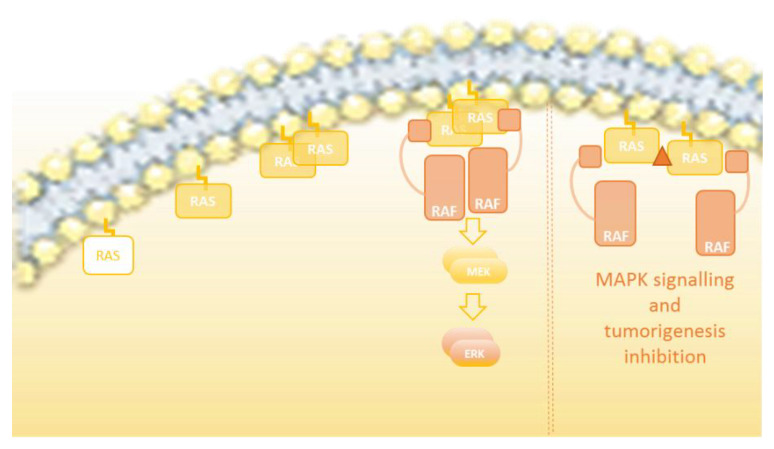
Signals conveyed through the RAS-ERK pathway constitute a pivotal regulatory element in cancer-related cellular processes. Recently, RAS dimerization has been proposed as a key step in the relay of RAS signals, critically contributing to RAF activation. RAS clustering at plasma membrane microdomains and endomembranes facilitates RAS dimerization in response to stimulation, promoting RAF dimerization and subsequent activation. Remarkably, inhibiting RAS dimerization forestalls tumorigenesis in cellular and animal models. Thus, the pharmacological disruption of RAS dimers has emerged as an additional target for cancer researchers in the quest for a means to curtail aberrant RAS activity.
通过 RAS-ERK 途径传递的信号构成了与癌症相关的细胞过程中关键的调节元件。最近,RAS 二聚化被提出作为 RAS 信号传递的关键步骤,对 RAF 激活有重要贡献。RAS 在质膜微区和内膜系统的聚集促进了刺激时的 RAS 二聚化,促进 RAF 二聚化和随后的激活。值得注意的是,抑制 RAS 二聚化可阻止细胞和动物模型中的肿瘤发生。因此,药理学破坏 RAS 二聚体已成为癌症研究人员的另一个目标,以寻求遏制异常 RAS 活性的方法。