
米诺环素衍生的银纳米颗粒对四氧嘧啶诱导的糖尿病小鼠抗糖尿病潜力的评估
Minocycline-Derived Silver Nanoparticles for Assessment of Their Antidiabetic Potential against Alloxan-Induced Diabetic Mice.
作者信息
Kazmi Syed Akif Raza, Qureshi Muhammad Zahid, Alhewairini Saleh S, Ali Shaukat, Khurshid Shazia, Saeed Muhammad, Mumtaz Shumaila, Mughal Tafail Akbar
机构信息
Department of Chemistry, Government College University Lahore, Lahore 54000, Pakistan.
Science Unit, Department of Biochemistry, Deanship of Educational Services, Qassim University, Buraidah 51452, Saudi Arabia.
出版信息
Pharmaceutics. 2021 Oct 14;13(10):1678. doi: 10.3390/pharmaceutics13101678.
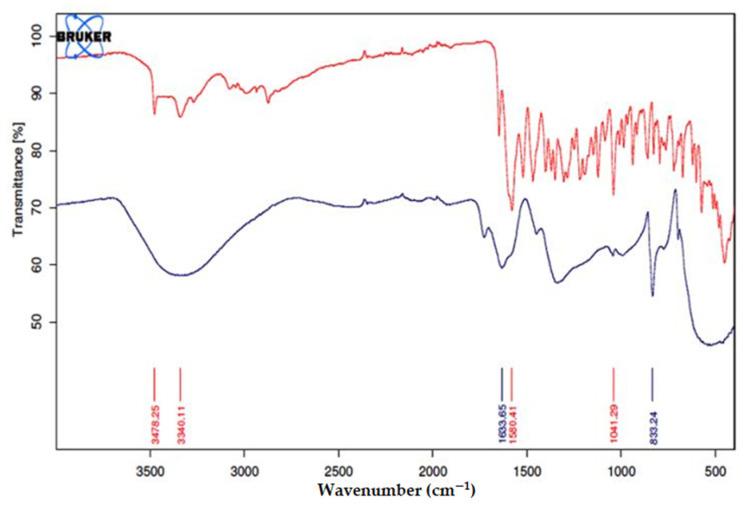
Diabetes is a life-threatening disease, and chronic diabetes affects parts of the body including the liver, kidney, and pancreas. The root cause of diabetes is mainly associated with oxidative stress produced by reactive oxygen species. Minocycline is a drug with a multi-substituted phenol ring and has shown excellent antioxidant activities. The objective of the present study was to investigate the antidiabetic potential of minocycline-modified silver nanoparticles (mino/AgNPs) against alloxan-induced diabetic mice. The mino/AgNPs were synthesized using minocycline as reducing and stabilizing agents. UV-visible, FT-IR, X-ray diffraction (XRD), and transmission electron microscopy (TEM) were applied for the characterization of mino/AgNPs. A 2,2-diphenyl-1-picrylhydrazyl free radical scavenging assay was conducted to determine the antioxidant potential of newly synthesized mino/AgNPs. The results revealed that the mino/AgNPs showed higher radical scavenging activity (IC = 19.7 µg/mL) compared to the minocycline (IC = 26.0 µg/mL) and ascorbic acid (IC = 25.2 µg/mL). Further, mino/AgNPs were successfully employed to examine their antidiabetic potential against alloxan-induced diabetic mice. Hematological results showed that the mice treated with mino/AgNPs demonstrated a significant decrease in fasting blood glucose level and lipid profile compared to the untreated diabetic group. A histopathological examination confirmed that the diabetic mice treated with mino/AgNPs showed significant recovery and revival of the histo-morphology of the kidney, central vein of the liver, and islet cells of the pancreas compared to the untreated diabetic mice. Hence, mino/AgNPs have good antidiabetic potential and could be an appropriate nanomedicine to prevent the development of diabetes.
糖尿病是一种危及生命的疾病,慢性糖尿病会影响身体的多个部位,包括肝脏、肾脏和胰腺。糖尿病的根本原因主要与活性氧产生的氧化应激有关。米诺环素是一种具有多取代酚环的药物,已显示出优异的抗氧化活性。本研究的目的是研究米诺环素修饰的银纳米颗粒(mino/AgNPs)对四氧嘧啶诱导的糖尿病小鼠的抗糖尿病潜力。以米诺环素为还原剂和稳定剂合成了mino/AgNPs。采用紫外可见光谱、傅里叶变换红外光谱、X射线衍射(XRD)和透射电子显微镜(TEM)对mino/AgNPs进行表征。进行了2,2-二苯基-1-苦基肼自由基清除试验,以确定新合成的mino/AgNPs的抗氧化潜力。结果表明,与米诺环素(IC = 26.0 µg/mL)和抗坏血酸(IC = 25.2 µg/mL)相比,mino/AgNPs表现出更高的自由基清除活性(IC = 19.7 µg/mL)。此外,成功地利用mino/AgNPs检测了其对四氧嘧啶诱导的糖尿病小鼠的抗糖尿病潜力。血液学结果表明,与未治疗的糖尿病组相比,用mino/AgNPs治疗的小鼠空腹血糖水平和血脂谱显著降低。组织病理学检查证实,与未治疗的糖尿病小鼠相比,用mino/AgNPs治疗的糖尿病小鼠肾脏、肝脏中央静脉和胰腺胰岛细胞的组织形态有明显恢复。因此,mino/AgNPs具有良好的抗糖尿病潜力,可能是预防糖尿病发展的合适纳米药物。




 Zotero 插件