College of Mathematics and Statistics, Shenzhen University, Shenzhen, 518060, China.
Guang'an Men Hospital, China Academy of Chinese Medical Sciences, Beijing, 100053, China.
Transl Psychiatry. 2021 Oct 23;11(1):546. doi: 10.1038/s41398-021-01637-8.
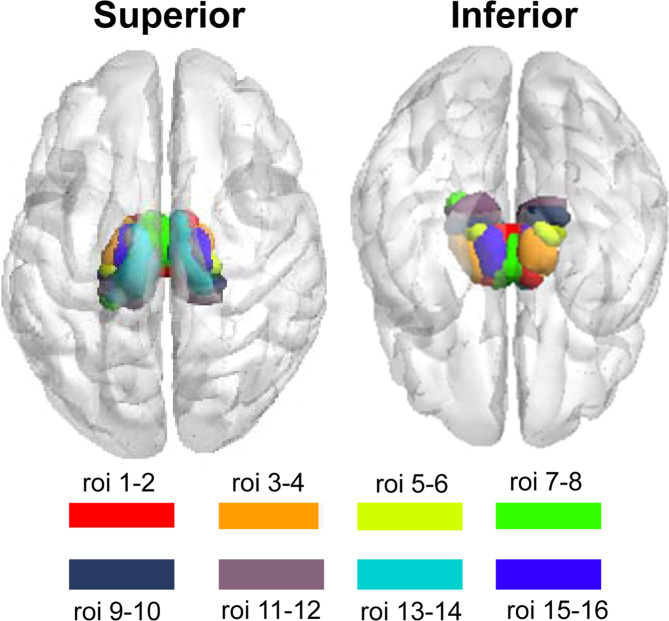
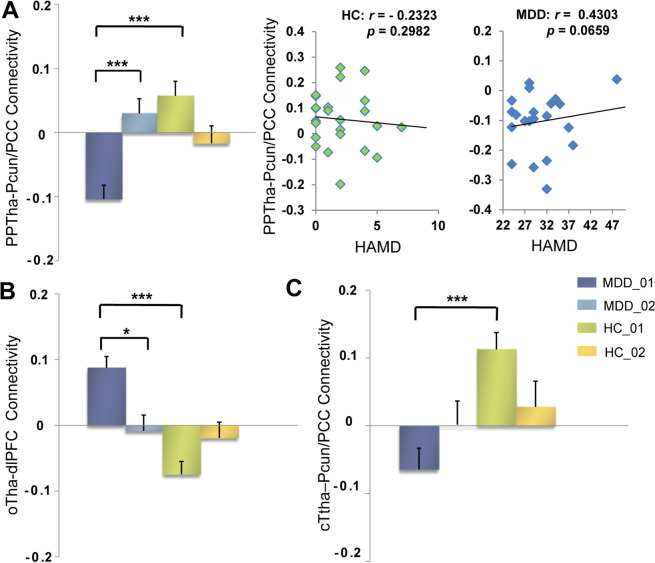
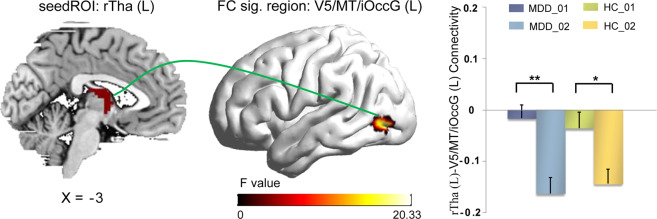
Mindfulness-based interventions such as meditation have increasingly been utilized for the treatment of psychological disorders and have been shown to be effective in the treatment of depression and relapse prevention. However, it remains largely unclear the neural mechanism of the therapeutic effects of meditation among depressed individuals. In this study, we investigated how body-mind relaxation meditation (BMRM) can modulate the thalamocortical functional connectivity (FC) in major depressive disorder patients and healthy controls. In the present study, we recruited 21 medication-naive adolescents with major depressive disorder (MDDs) and 24 matched healthy controls (HCs). We designed an audio recording to induce body-mind relaxation meditation. Resting-state fMRI (rs-fMRI) scans were collected before and after the BMRM intervention in both groups. The thalamus subregions were defined according to the Human Brainnetome Atlas, and functional connectivity (FC) was measured and compared to find brain regions that were affected by the BMRM intervention. Before the BMRM intervention, MDDs showed reduced FC of the bilateral precuneus/post cingulate cortex with the left posterior parietal thalamus and left caudal temporal thalamus, as well as an increased FC of the left occipital thalamus with the left medial frontal cortex. Moreover, aberrant FCs in MDDs at baseline were normalized following the BMRM intervention. After the BMRM intervention, both MDDs and HCs showed decreased FC between the left rostral temporal thalamus and the left inferior occipital. Given the small sample used in this study, future studies are warranted to evaluate the generalizability of these findings. Our findings suggest that BMRM is associated with changes in thalamocortical functional connectivity in MDDs. BMRM may act by strengthening connections between the thalamus and the default mode network, which are involved in a variety of high-level functioning, such as attention and self-related processes.
正念干预,如冥想,已越来越多地被用于治疗心理障碍,并已被证明在治疗抑郁症和预防复发方面是有效的。然而,在抑郁症患者中,冥想的治疗效果的神经机制在很大程度上仍不清楚。在这项研究中,我们研究了身心放松冥想(BMRM)如何调节抑郁症患者和健康对照组的丘脑皮质功能连接(FC)。在本研究中,我们招募了 21 名未经药物治疗的青少年抑郁症患者(MDDs)和 24 名匹配的健康对照组(HCs)。我们设计了一段音频录音来诱导身心放松冥想。在两组被试进行 BMRM 干预前后都采集了静息态 fMRI(rs-fMRI)扫描。根据人类脑连接图谱,定义了丘脑亚区,测量了功能连接(FC)并进行了比较,以找到受 BMRM 干预影响的脑区。在 BMRM 干预前,MDDs 表现出双侧后扣带回/楔前叶与左侧后顶叶丘脑和左侧尾状颞叶丘脑的 FC 降低,以及左侧枕叶丘脑与左侧内侧额皮质的 FC 增加。此外,MDDs 在基线时的异常 FC 在 BMRM 干预后得到了正常化。在 BMRM 干预后,MDDs 和 HCs 都表现出左侧额下回与左侧枕叶的 FC 降低。由于本研究样本较小,需要进一步的研究来评估这些发现的普遍性。我们的研究结果表明,BMRM 与 MDDs 的丘脑皮质功能连接的变化有关。BMRM 可能通过加强丘脑与默认模式网络之间的连接来发挥作用,而默认模式网络参与了各种高级功能,如注意力和自我相关过程。