Department of Nutrition, Simmons University, Boston, MA, USA.
Department of Nutrition, Harvard TH Chan School of Public Health, Boston, MA, USA.
J Nutr. 2021 Oct 23;151(12 Suppl 2):168S-175S. doi: 10.1093/jn/nxab195.
We have developed a diet quality metric intended for global use. To assess its utility in high-income settings, an evaluation of its ability to predict chronic disease is needed.
We aimed to prospectively examine the ability of the Global Diet Quality Score (GDQS) to predict the risk of type 2 diabetes in the United States, examine potential differences of association by age, and compare the GDQS with other diet quality scores.
Health, lifestyle, and diet information was collected from women (n = 88,520) in the Nurses' Health Study II aged 27-44 y at baseline through repeated questionnaires between 1991 and 2017. The overall GDQS consists of 25 food groups. Points are awarded for higher intake of healthy groups and lower intake of unhealthy groups (maximum of 49 points). Multivariable HRs were computed for confirmed type 2 diabetes using proportional hazards models. We also compared the GDQS with the Minimum Diet Diversity score for Women (MDD-W) and the Alternate Healthy Eating Index-2010 (AHEI-2010).
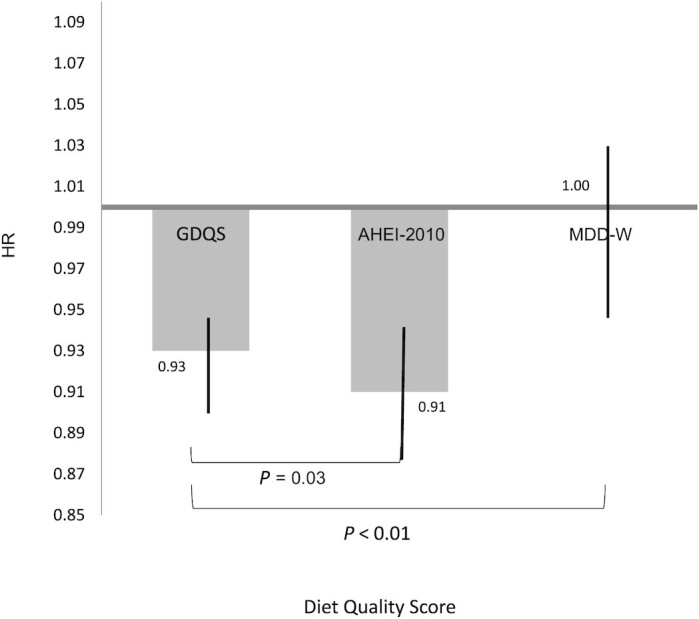
We ascertained 6305 incident cases of type 2 diabetes during follow-up. We observed a lower risk of diabetes with higher GDQS; the multivariable HR comparing extreme quintiles of the GDQS was 0.83 (95% CI: 0.76, 0.91; P-trend < 0.001). The magnitude of association was similar between women aged <50 y and those aged ≥50 y. An inverse association was observed with lower intake of unhealthy components (HR comparing extreme quintiles of the unhealthy submetric: 0.76; 95% CI: 0.69, 0.84; P-trend < 0.001) but was not with the healthy submetric. The inverse association for each 1-SD increase in the GDQS (HR: 0.93; 95% CI: 0.91, 0.96) was stronger (P < 0.001) than for the MDD-W (HR: 1.00; 95% CI: 0.94, 1.04) but was slightly weaker (P = 0.03) than for the AHEI-2010 (HR: 0.91; 95% CI: 0.88, 0.94).
A higher GDQS was inversely associated with type 2 diabetes risk in US women of reproductive age or older, mainly from lower intake of unhealthy foods. The GDQS performed nearly as well as the AHEI-2010.
我们开发了一种旨在全球使用的饮食质量指标。为了评估其在高收入环境中的效用,需要对其预测慢性病的能力进行评估。
我们旨在前瞻性地研究全球饮食质量评分(GDQS)预测美国 2 型糖尿病风险的能力,检验年龄对关联的潜在差异,并将 GDQS 与其他饮食质量评分进行比较。
通过健康、生活方式和饮食信息从参加护士健康研究 II 的女性(n=88520)中收集,这些女性在基线时年龄为 27-44 岁,通过 1991 年至 2017 年期间重复的问卷调查进行随访。总体 GDQS 由 25 种食物组构成。摄入健康组的得分较高,摄入不健康组的得分较低(最高 49 分)。使用比例风险模型计算确诊 2 型糖尿病的多变量 HR。我们还将 GDQS 与女性最低饮食多样性评分(MDD-W)和替代健康饮食指数-2010(AHEI-2010)进行了比较。
我们在随访期间确定了 6305 例 2 型糖尿病新发病例。我们观察到随着 GDQS 的升高,糖尿病的风险降低;GDQS 极端五分位数的多变量 HR 为 0.83(95%CI:0.76,0.91;P-trend<0.001)。<50 岁和≥50 岁女性之间的关联程度相似。不健康成分摄入减少与关联呈负相关(极端五分位数的不健康亚指标 HR:0.76;95%CI:0.69,0.84;P-trend<0.001),但与健康亚指标无关。每增加 1-SD 的 GDQS(HR:0.93;95%CI:0.91,0.96)的负相关更强(P<0.001),优于 MDD-W(HR:1.00;95%CI:0.94,1.04),但略弱于 AHEI-2010(HR:0.91;95%CI:0.88,0.94)。
在处于生育年龄或以上的美国女性中,较高的 GDQS 与 2 型糖尿病风险呈负相关,主要归因于不健康食物的摄入减少。GDQS 的表现与 AHEI-2010 几乎一样好。