Department of Nutrition and Dietetics, School of Health Sciences and Education, Harokopio University, 17676 Athens, Greece.
First Cardiology Clinic, Medical School, National and Kapodistrian University of Athens, Hippokration Hospital, 15772 Athens, Greece.
Nutrients. 2023 Oct 18;15(20):4428. doi: 10.3390/nu15204428.
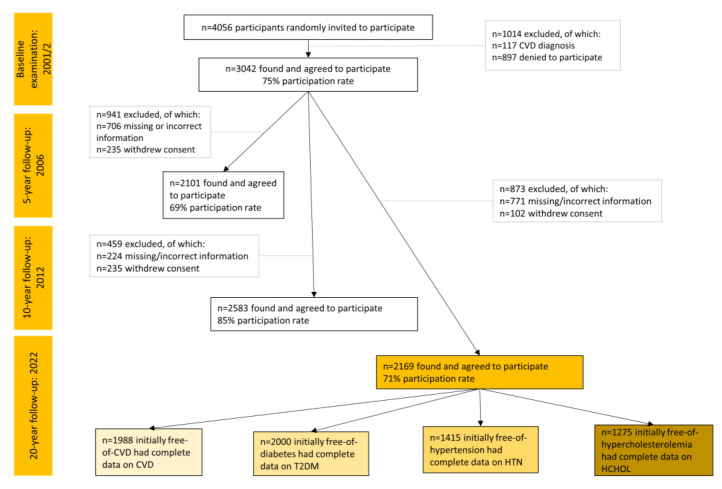
The Global Diet Quality Score (GDQS) is a novel food-based score that assesses both nutrient adequacy and chronic disease risk, by evaluating healthy (GDQS+) and unhealthy foods (GDQS-). The aim of this study was to evaluate the association among GDQS, GDQS+, and GDQS- against the 20-year risk of cardiometabolic outcomes in a Mediterranean population. The sample was = 2169 initially free of cardiovascular disease (CVD) participants of the ATTICA study (2002-2022) that participated in the 20-year follow-up. The incidence of CVD, hypertension, hypercholesterolemia, and type 2 diabetes mellitus (T2DM) was defined according to WHO-ICD-10 criteria. The GDQS was computed based on previously published instructions. In multivariate analyses, a higher diet quality, per 1/49 of the GDQS, was associated with an 8% [95% Confidence Interval-CI: 6-9%] and 2% [95% CI: 1-3%] lower CVD and T2DM risk, respectively. A higher consumption of healthy foods, per 1/32 of GDQS+, was associated with a 9% [95% CI: 7-11%] and 2% [95% CI: 1-3%] lower CVD and T2DM risk, respectively. Contrarily, a lower consumption of unhealthy foods (GDQS-) was not associated with cardiometabolic events in the adjusted models (all value< 0.05). In clinical practice or future public health actions to ameliorate dietary habits and prevent CVD and T2DM, more attention should be focused on healthy foods that should be included in our diets.
全球饮食质量评分(GDQS)是一种新的基于食物的评分,通过评估健康食品(GDQS+)和不健康食品(GDQS-),同时评估营养素的充足性和慢性病风险。本研究的目的是评估在一个地中海人群中,GDQS、GDQS+和 GDQS-与 20 年心血管代谢结局风险之间的关联。该样本最初包括 ATTICA 研究(2002-2022 年)中 2169 名无心血管疾病(CVD)的参与者,他们参加了 20 年的随访。根据世界卫生组织-国际疾病分类第 10 版(WHO-ICD-10)标准,定义了 CVD、高血压、高胆固醇血症和 2 型糖尿病(T2DM)的发生率。根据之前发表的说明计算 GDQS。在多变量分析中,GDQS 每增加 1/49,CVD 和 T2DM 的风险分别降低 8%[95%置信区间-CI:6-9%]和 2%[95% CI:1-3%]。每增加 1/32 的 GDQS+健康食品的消耗,CVD 和 T2DM 的风险分别降低 9%[95% CI:7-11%]和 2%[95% CI:1-3%]。相反,在调整后的模型中,不健康食品(GDQS-)的消耗与心血管代谢事件无关(所有 值<0.05)。在改善饮食习惯和预防 CVD 和 T2DM 的临床实践或未来公共卫生行动中,应更加关注应包含在我们饮食中的健康食品。