Clinical Trials Research Unit, Leeds Institute of Clinical Trials Research, University of Leeds, Leeds, LS2 9JT, UK.
Trials. 2021 Oct 24;22(1):736. doi: 10.1186/s13063-021-05723-6.
Eligibility criteria are a fundamental element of clinical trial design, defining who can and who should not participate in a trial. Problems with the design or application of criteria are known to occur and pose risks to participants' safety and trial integrity, sometimes also negatively impacting on trial recruitment and generalisability. We conducted a short, exploratory survey to gather evidence on UK recruiters' experiences interpreting and applying eligibility criteria and their views on how criteria are communicated and developed.
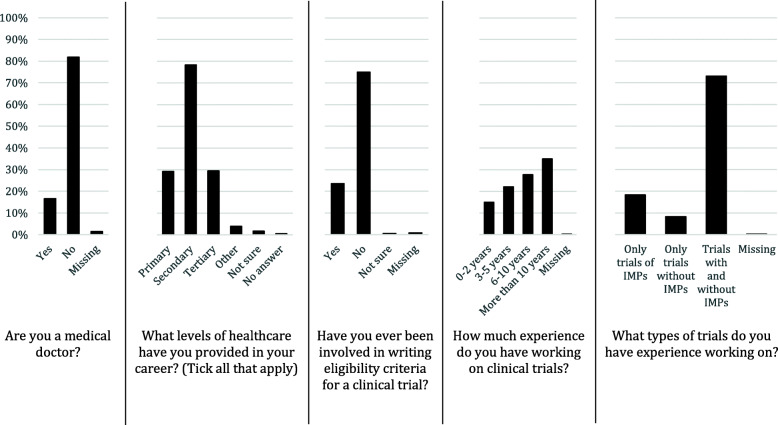
Our survey included topics informed by a wider programme of work at the Clinical Trials Research Unit, University of Leeds, on assuring eligibility criteria quality. Respondents were asked to answer based on all their trial experience, not only on experiences with our trials. The survey was disseminated to recruiters collaborating on trials run at our trials unit, and via other mailing lists and social media. The quantitative responses were descriptively analysed, with inductive analysis of free-text responses to identify themes.
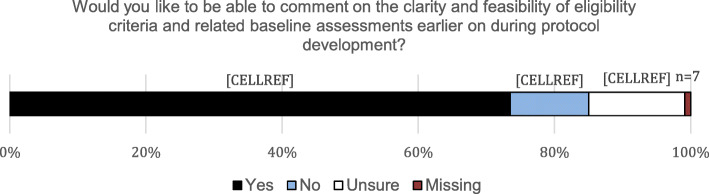
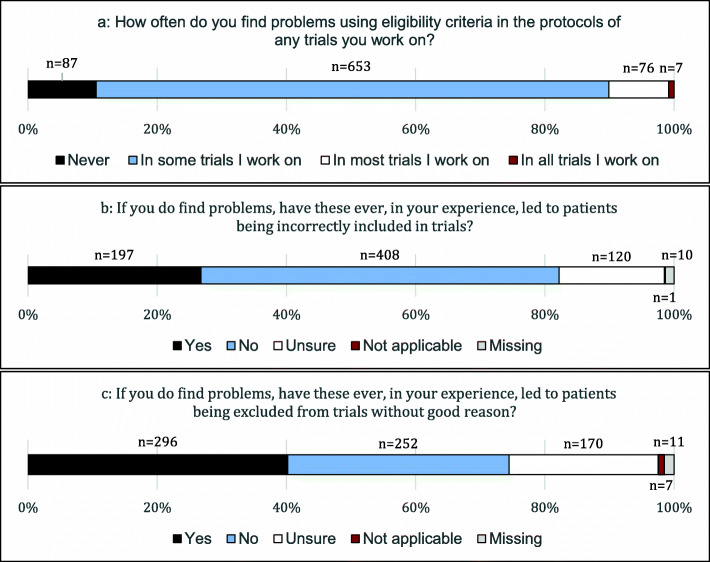
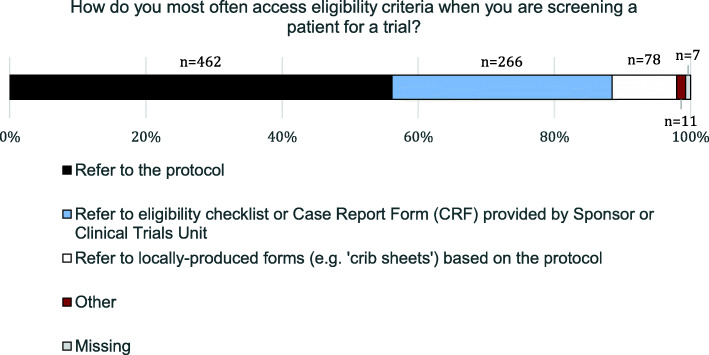
A total of 823 eligible respondents participated. In total, 79% of respondents reported finding problems with eligibility criteria in some trials, and 9% in most trials. The main themes in the types of problems experienced were criteria clarity (67% of comments), feasibility (34%), and suitability (14%). In total, 27% of those reporting some level of problem said these problems had led to patients being incorrectly included in trials; 40% said they had led to incorrect exclusions. Most respondents (56%) reported accessing eligibility criteria mainly in the trial protocol. Most respondents (74%) supported the idea of recruiter review of eligibility criteria earlier in the protocol development process.
Our survey corroborates other evidence about the existence of suboptimal trial eligibility criteria. Problems with clarity were the most often reported, but the number of comments on feasibility and suitability suggest some recruiters feel eligibility criteria and associated assessments can hinder recruitment to trials. Our proposal for more recruiter involvement in protocol development has strong support and some potential benefits, but questions remain about how best to implement this. We invite other trialists to consider our other suggestions for how to assure quality in trial eligibility criteria.
入选标准是临床试验设计的基本要素,决定了谁可以参加和谁不应该参加试验。已知入选标准的设计或应用存在问题,并对参与者的安全和试验完整性构成风险,有时还会对试验招募和推广产生负面影响。我们进行了一项简短的探索性调查,以收集英国招募人员在解释和应用入选标准方面的经验证据,并了解他们对入选标准的沟通和制定方式的看法。
我们的调查主题是基于利兹大学临床试验研究单位更广泛的工作方案,旨在确保入选标准的质量。要求受访者根据他们所有的试验经验来回答问题,而不仅仅是根据我们的试验经验。调查通过我们的试验单位合作进行的试验以及其他邮件列表和社交媒体向招募人员分发。对定量回复进行描述性分析,并对自由文本回复进行归纳分析以确定主题。
共有 823 名符合条件的受访者参与了调查。共有 79%的受访者报告在某些试验中发现入选标准存在问题,9%的受访者在大多数试验中发现问题。在经历的问题类型中,主要主题是标准清晰度(67%的评论)、可行性(34%)和适宜性(14%)。共有 27%的报告存在某种程度问题的受访者表示,这些问题导致患者被错误地纳入试验;40%的受访者表示,这些问题导致错误排除。大多数受访者(56%)主要在试验方案中获取入选标准。大多数受访者(74%)支持在方案开发过程中更早地由招募人员审查入选标准的想法。
我们的调查证实了其他关于存在不适当试验入选标准的证据。标准清晰度是最常被报道的问题,但关于可行性和适宜性的评论数量表明,一些招募人员认为入选标准和相关评估可能会阻碍试验招募。我们提出的让更多招募人员参与方案开发的建议得到了强烈支持,并具有一些潜在的好处,但关于如何最好地实施这一建议仍存在疑问。我们邀请其他试验人员考虑我们在确保试验入选标准质量方面的其他建议。