Epidemiology and Public Health Research Group, Centre for Public Health, Queen's University Belfast, Northern Ireland, UK.
School of Agricultural Economics and Rural Development, Renmin University of China, Beijing, China.
Epigenetics. 2022 Oct;17(10):1159-1172. doi: 10.1080/15592294.2021.1992910. Epub 2021 Oct 30.
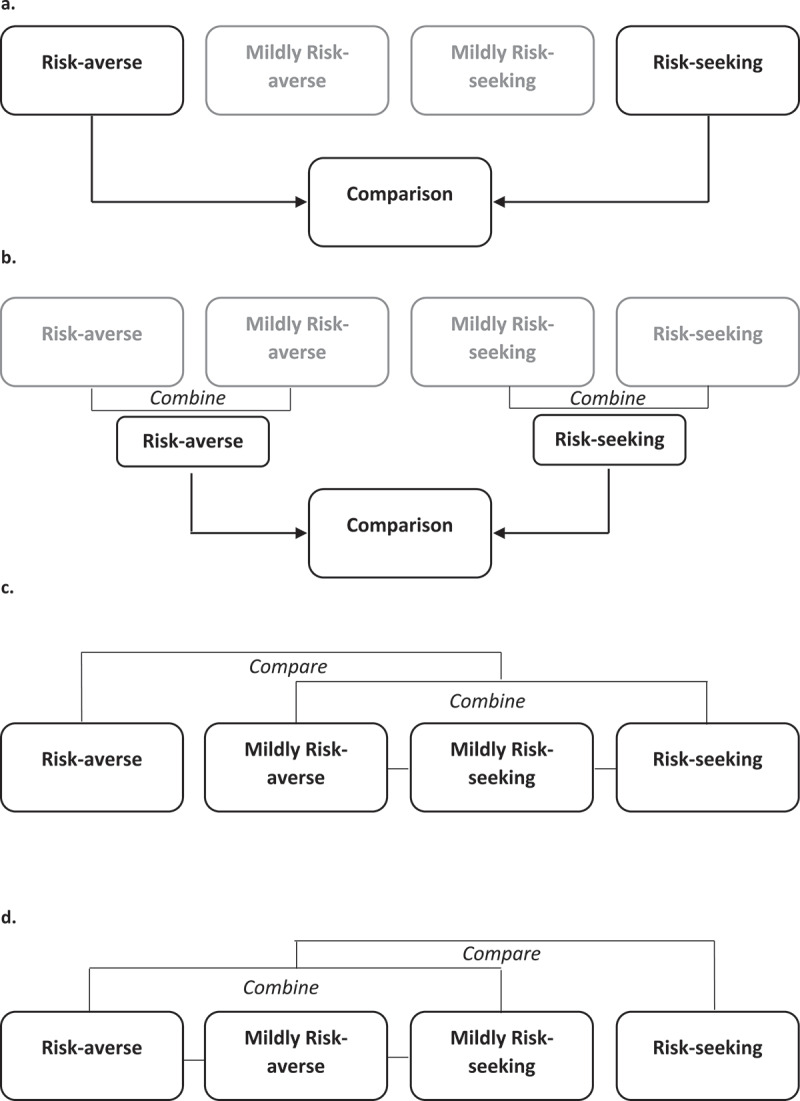
Risk preference is a complex trait governed by psycho-social, environmental and genetic determinants. We aimed to examine how an individual's risk preference associates with their epigenetic profile.Risk preferences were ascertained by asking participants of the Northern Ireland COhort for the Longitudinal study of Ageing to make a series of choices between hypothetical income scenarios. From these, four risk preference categories were derived, ranging from risk-averse to risk-seeking. Illumina's Infinium High-Density Methylation Assay was used to evaluate the status of 862,927 CpGs.Risk preference and DNA methylation data were obtained for 1,656 individuals. The distribution of single-site DNA methylation levels between risk-averse and risk-seeking individuals was assessed whilst adjusting for age, sex and peripheral white cell counts. In this discovery cohort, 55 CpGs were identified with significantly different levels of methylation (p≤x10) between risk-averse and risk-seeking individuals when adjusting for the maximum number of covariates. No CpGs were significantly differentially methylated in any of the risk preference groups at an epigenome-wide association level (p<9x10) following covariate adjustment.Protein-coding genes and were among the genes in which the top-ranked dmCpGs were located for all analyses conducted. Mutations in these genes have previously been linked to neurological conditions.Epigenetic modifications have not previously been linked to risk-aversion using a population cohort, but may represent important biomarkers of accumulated, complex determinants of this trait. Several striking results from this study support further analysis of DNA methylation as an important link between measurable biomarkers and health behaviours.
风险偏好是由心理社会、环境和遗传决定因素共同作用的复杂特征。我们旨在研究个体的风险偏好如何与其表观遗传特征相关联。通过要求北爱尔兰老龄化纵向研究队列的参与者在假设的收入情景之间进行一系列选择,来确定风险偏好。从这些选择中,得出了四个风险偏好类别,从风险规避到风险寻求。Illumina 的 Infinium 高密度甲基化测定法用于评估 862927 个 CpG 的状态。获得了 1656 个人的风险偏好和 DNA 甲基化数据。在调整年龄、性别和外周白细胞计数后,评估了风险规避和风险寻求个体之间单一位点 DNA 甲基化水平的分布。在这个发现队列中,当调整最大数量的协变量时,在风险规避和风险寻求个体之间有 55 个 CpG 具有显著不同的甲基化水平(p≤x10)。在调整协变量后,在任何风险偏好组中,没有 CpG 在全基因组关联水平上(p<9x10)存在显著差异甲基化。在所有进行的分析中,排名最高的 dmCpGs 位于 和 等蛋白编码基因中。这些基因的突变先前已与神经疾病有关。先前没有使用人群队列将表观遗传修饰与风险规避联系起来,但它们可能代表该特征的累积、复杂决定因素的重要生物标志物。这项研究的几个显著结果支持进一步分析 DNA 甲基化为可衡量生物标志物与健康行为之间的重要联系。