Department of Immunobiology and Environment Microbiology, Faculty of Health Sciences with Institute of Maritime and Tropical Medicine Medical University of Gdańsk, ul. Dębinki 7, 80-211, Gdańsk, Poland.
Institute of Marine and Environmental Sciences, University of Szczecin, ul. Mickiewicza 16, 70-383, Szczecin, Poland.
Sci Rep. 2021 Oct 25;11(1):20959. doi: 10.1038/s41598-021-00390-8.
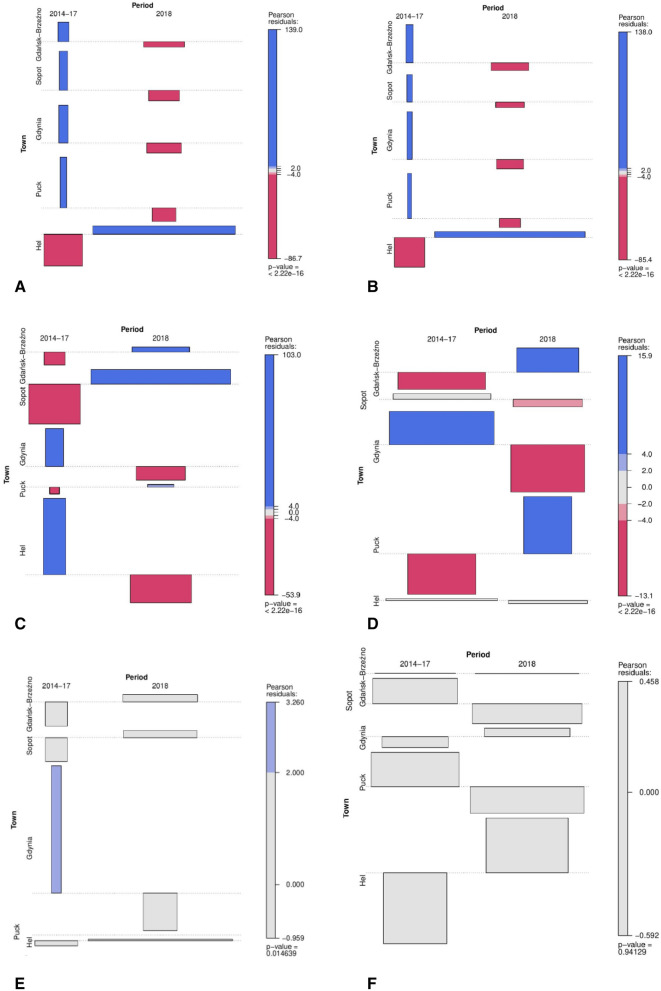
The purpose of this research was to study the presence of potential pathogenic bacteria in the seawater and air in five coastal towns (Hel, Puck, Gdynia, Sopot, Gdańsk-Brzeźno) as well as the enrichment of bacteria from the seawater into the coastal air after an emergency discharge of sewage into the Bay of Gdańsk. A total of 594 samples of air and seawater were collected in the coastal zone between spring and summer (between 2014 and 2018). Air samples were collected using the impact method with a SAS Super ISO 100. The multivariate analysis, conducted using contingency tables, showed a statistically significant variation between the concentration of coliforms, psychrophilic and mesophilic bacteria in the seawater microlayer and air in 2018, after an emergency discharge of sewage into the Bay of Gdańsk, compared to 2014-2017. Moreover, we detected a marine aerosol enrichment in psychrophilic, mesophilic bacteria, coliforms and Escherichia coli. We also showed a statistically significant relationship between the total concentration of bacteria and humidity, air temperature, speed and wind direction. This increased concentration of bacteria in the seawater and coastal air, and the high factor of air enrichment with bacteria maybe associated with the emergency discharge of wastewater into the Bay of Gdańsk. Therefore, it is suggested that in the event of a malfunction of a sewage treatment plant, as well as after floods or sudden rainfall, the public should be informed about the sanitary and epidemiological status of the coastal waters and be recommended to limit their use of coastal leisure areas.
本研究旨在研究五个沿海城镇(赫尔、普克、格但斯克、索波特和格但斯克-布热佐诺)的海水和空气中是否存在潜在的致病细菌,以及在紧急向加迪尼亚湾排放污水后,从海水中向沿海空气中富集细菌的情况。在 2014 年至 2018 年春季至夏季期间,在沿海地区共采集了 594 份海水和空气样本。使用 SAS Super ISO 100 冲击法采集空气样本。使用列联表进行的多变量分析表明,与 2014-2017 年相比,在向加迪尼亚湾紧急排放污水后,2018 年海水中的大肠菌群、嗜冷菌和嗜温菌以及空气中的大肠菌群浓度存在统计学上的显著差异。此外,我们还检测到海洋气溶胶中嗜冷菌、嗜温菌、大肠菌群和大肠杆菌的富集。我们还表明,细菌的总浓度与湿度、空气温度、风速和风向之间存在统计学上的显著关系。这种海水和沿海空气中细菌浓度的增加,以及空气中细菌的高富集因素,可能与向加迪尼亚湾紧急排放废水有关。因此,建议在污水处理厂发生故障、发生洪水或突然降雨后,应告知公众沿海水域的卫生和流行病学状况,并建议限制他们使用沿海休闲区。