Przybyłek Adam, Albecka Marta, Springer Olga, Kowalski Wojciech
Faculty of Electronics, Telecommunications and Informatics, Gdansk University of Technology, Narutowicza 11/12, 80-233 Gdańsk, Poland.
Dynatrace Sp. z o.o, Aleja Grunwaldzka 411, 80-309 Gdańsk, Poland.
Empir Softw Eng. 2022;27(1):1. doi: 10.1007/s10664-021-10043-z. Epub 2021 Oct 19.
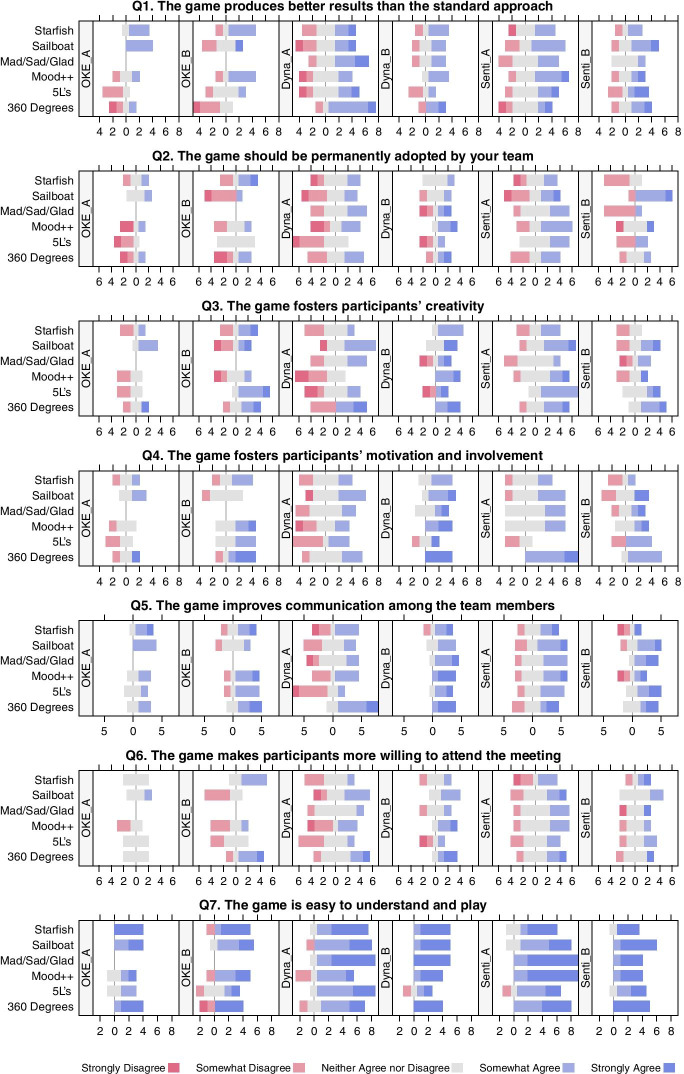
In today's fast-paced world of rapid technological change, software development teams need to constantly revise their work practices. Not surprisingly, regular reflection on how to become more effective is perceived as one of the most important principles of Agile Software Development. Nevertheless, running an effective and enjoyable retrospective meeting is still a challenge in real environments. As reported by several studies, the Sprint Retrospective is an agile practice most likely to be implemented improperly or sacrificed when teams perform under pressure to deliver. To facilitate the implementation of the practice, some agile coaches have proposed to set up retrospective meetings in the form of retrospective games. However, there has been little research-based evidence to support the positive effects of retrospective games. Our aim is to investigate whether the adoption of retrospective games can improve retrospective meetings in general and lead to positive societal outcomes. In this paper, we report on an Action Research project in which we implemented six retrospective games in six Scrum teams that had experienced common retrospective problems. The received feedback indicates that the approach helped the teams to mitigate many of the "accidental difficulties" pertaining to the Sprint Retrospective, such as lack of structure, dullness, too many complaints, or unequal participation and made the meetings more productive to some degree. Moreover, depending on their individual preferences, different participants perceived different games as having a positive impact on their communication, motivation-and-involvement, and/or creativity, even though there were others, less numerous, who had an opposite view. The advantages and disadvantages of each game as well as eight lessons learned are presented in the paper.
在当今技术变革迅速的快节奏世界中,软件开发团队需要不断修订其工作方法。不足为奇的是,定期反思如何提高效率被视为敏捷软件开发最重要的原则之一。然而,在实际环境中,组织一场有效且令人愉快的回顾会议仍然是一项挑战。多项研究报告显示,当团队在交付压力下工作时, Sprint回顾会议是最有可能被不当实施或牺牲的敏捷实践。为了促进该实践的实施,一些敏捷教练提议以回顾游戏的形式组织回顾会议。然而,几乎没有基于研究的证据支持回顾游戏的积极效果。我们的目标是调查采用回顾游戏是否总体上能改进回顾会议并带来积极的社会成果。在本文中,我们报告了一个行动研究项目,在六个经历过常见回顾问题的Scrum团队中实施了六个回顾游戏。收到的反馈表明,该方法帮助团队缓解了许多与Sprint回顾会议相关的“意外困难”,例如缺乏结构、枯燥乏味、抱怨过多或参与不平等,并在一定程度上使会议更有成效。此外,根据个人偏好,不同的参与者认为不同的游戏对他们的沟通、积极性和参与度以及/或创造力有积极影响,尽管也有少数人持相反观点。本文介绍了每个游戏的优缺点以及八点经验教训。