Moinet Marie, Wilkinson David A, Aberdein Danielle, Russell James C, Vallée Emilie, Collins-Emerson Julie M, Heuer Cord, Benschop Jackie
School of Veterinary Science, Massey University, Palmerston North 4442, New Zealand.
New Zealand Food Safety Science and Research Centre, Hopkirk Research Institute, Palmerston North 4442, New Zealand.
Trop Med Infect Dis. 2021 Oct 20;6(4):189. doi: 10.3390/tropicalmed6040189.
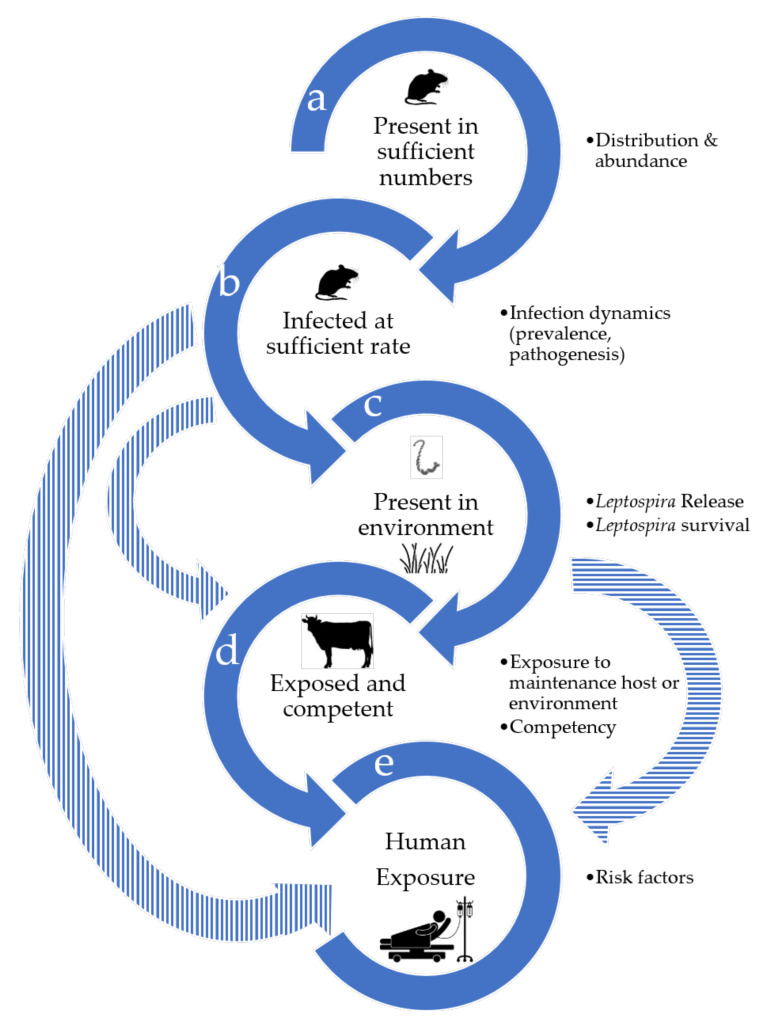
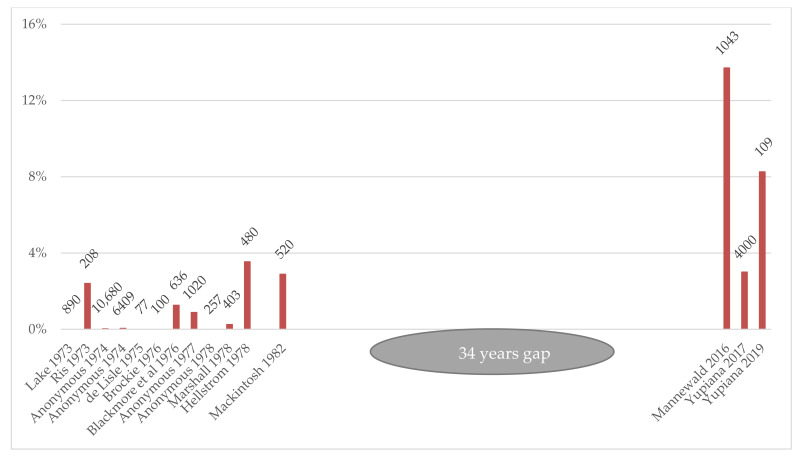
In New Zealand (NZ), leptospirosis is a mostly occupational zoonosis, with >66% of the recently notified cases being farm or abattoir workers. Livestock species independently maintain serovar Hardjo and serovar Pomona, and both are included in livestock vaccines. The increasing importance in human cases of Ballum, a serovar associated with wildlife, suggests that wildlife may be an overlooked source of infection. Livestock could also act as bridge hosts for humans. Drawing from disease ecology frameworks, we chose five barriers to include in this review based on the hypothesis that cattle act as bridge hosts for Ballum. Using a narrative methodology, we collated published studies pertaining to (a) the distribution and abundance of potential wild maintenance hosts of Ballum, (b) the infection dynamics (prevalence and pathogenesis) in those same hosts, (c) Ballum shedding and survival in the environment, (d) the exposure and competency of cattle as a potential bridge host, and (e) exposure for humans as a target host of Ballum. Mice (), rats (, ) and hedgehogs () were suspected as maintenance hosts of Ballum in NZ in studies conducted in the 1970s-1980s. These introduced species are distributed throughout NZ, and are present on pastures. The role of other wildlife in Ballum (and more broadly ) transmission remains poorly defined, and has not been thoroughly investigated in NZ. The experimental and natural Ballum infection of cattle suggest a low pathogenicity and the possibility of shedding. The seroprevalence in cattle appears higher in recent serosurveys (3 to 14%) compared with studies from the 1970s (0 to 3%). This review identifies gaps in the knowledge of Ballum, and highlights cattle as a potential spillover host. Further studies are required to ascertain the role that wild and domestic species may play in the eco-epidemiology of Ballum in order to understand its survival in the environment, and to inform control strategies.
在新西兰,钩端螺旋体病主要是一种职业性人畜共患病,最近报告的病例中超过66%是农场或屠宰场工人。家畜种群独立维持哈焦血清型和波摩那血清型,这两种血清型都包含在家畜疫苗中。与野生动物相关的巴伦血清型在人类病例中的重要性日益增加,这表明野生动物可能是一个被忽视的感染源。家畜也可能成为人类的桥梁宿主。基于牛作为巴伦血清型桥梁宿主的假设,我们从疾病生态学框架中选取了五个障碍因素纳入本综述。我们采用叙述性方法,整理了已发表的研究,这些研究涉及:(a) 巴伦血清型潜在野生维持宿主的分布和数量;(b) 这些宿主中的感染动态(患病率和发病机制);(c) 巴伦血清型在环境中的排泄和存活情况;(d) 牛作为潜在桥梁宿主的接触情况和易感性;(e) 作为巴伦血清型目标宿主的人类的接触情况。在20世纪70年代至80年代进行的研究中,小鼠()、大鼠(,)和刺猬()被怀疑是新西兰巴伦血清型的维持宿主。这些外来物种分布于新西兰各地,且存在于牧场。其他野生动物在巴伦血清型(以及更广泛的 )传播中的作用仍不明确,在新西兰也尚未得到充分研究。对牛进行的实验性和自然巴伦血清型感染表明其致病性较低且有排泄的可能性。与20世纪70年代的研究(0%至3%)相比,近期血清学调查中牛的血清阳性率似乎更高(3%至14%)。本综述确定了巴伦血清型知识方面的空白,并强调牛是潜在的溢出宿主。需要进一步研究以确定野生和家养物种在巴伦血清型生态流行病学中可能发挥的作用,以便了解其在环境中的生存情况,并为控制策略提供依据。