Department of Physical Activity and Sport, Faculty of Sport Sciences, Campus of Excellence Mare Nostrum, University of Murcia, Murcia 30720, Spain.
Centre for Sport Studies, King Juan Carlos University, Madrid 28933, Spain.
J Sport Health Sci. 2022 Nov;11(6):681-695. doi: 10.1016/j.jshs.2021.10.002. Epub 2021 Oct 23.
To conduct a systematic review and meta-analysis of epidemiological data of injuries in male and female youth football players.
Searches were performed in MEDLINE/PubMed, Web of Science, Cochrane Library, and SPORTDiscus databases. Studies were considered if they reported injury incidence rate in male and female youth (≤19 years old) football players. Two reviewers (FJRP and ALV) extracted data and assessed trial quality using the Strengthening the Reporting of Observational Studies in Epidemiology (STROBE) statement and the Newcastle Ottawa Scale. The Grading of Recommendations Assessment, Development, and Evaluation approach determined the quality of evidence. Studies were combined using a Poisson random effects regression model.
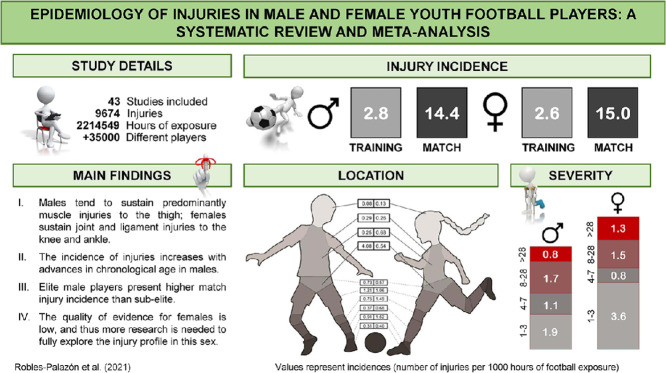
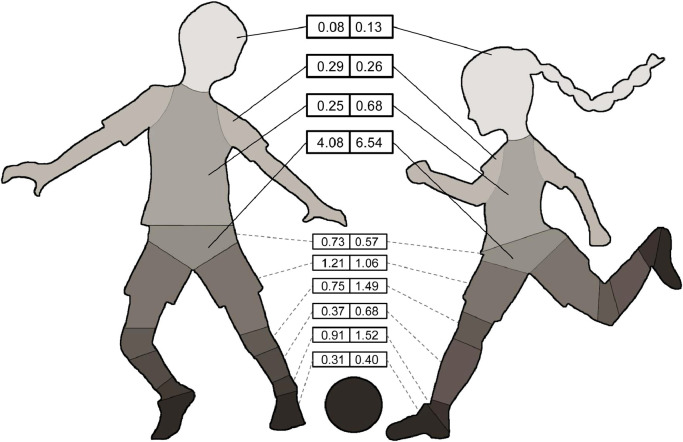
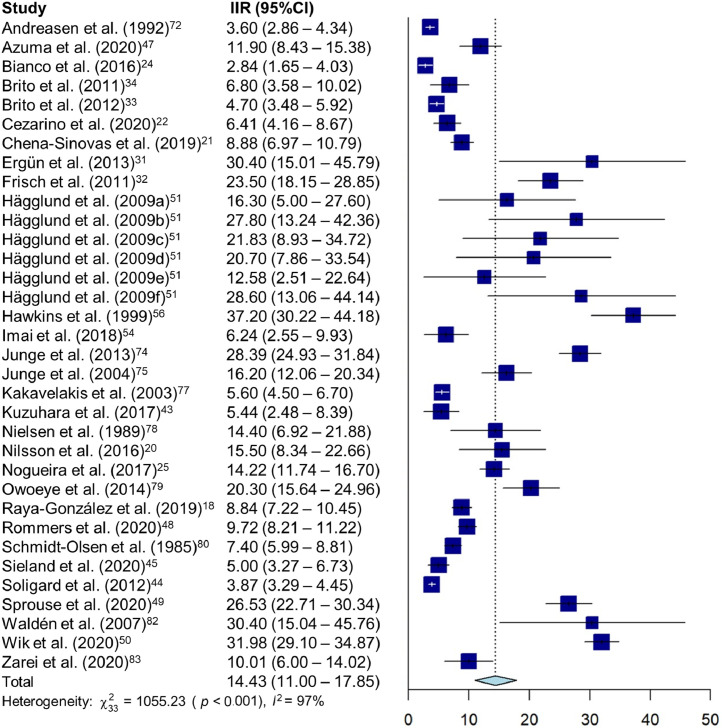
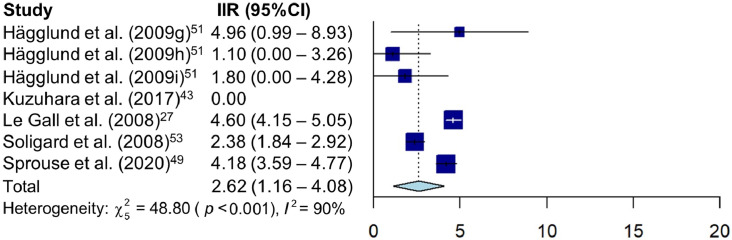
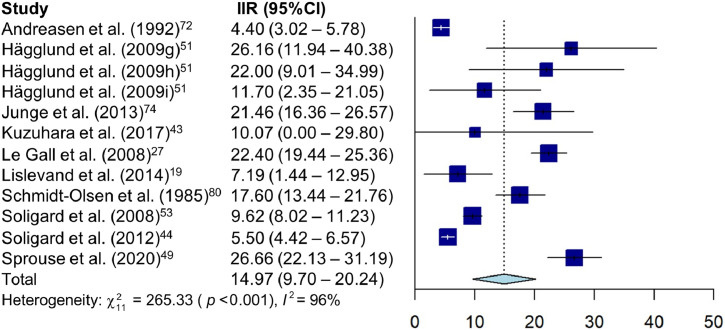
Forty-three studies were included. The overall incidence rate was 5.70 injuries/1000 h in males and 6.77 injuries/1000 h in females. Match injury incidence (14.43 injuries/1000 h in males and 14.97 injuries/1000 h in females) was significantly higher than training injury incidence (2.77 injuries/1000 h in males and 2.62 injuries/1000 h in females). The lower extremity had the highest incidence rate in both sexes. The most common type of injury was muscle/tendon for males and joint/ligament for females. Minimal injuries were the most common in both sexes. The incidence rate of injuries increased with advances in chronological age in males. Elite male players presented higher match injury incidence than sub-elite players. In females, there was a paucity of data for comparison across age groups and levels of play.
The high injury incidence rates and sex differences identified for the most common location and type of injury reinforce the need for implementing different targeted injury-risk mitigation strategies in male and female youth football players.
对男性和女性青年足球运动员损伤的流行病学数据进行系统回顾和荟萃分析。
在 MEDLINE/PubMed、Web of Science、Cochrane 图书馆和 SPORTDiscus 数据库中进行了检索。如果研究报告了男性和女性青年(≤19 岁)足球运动员的损伤发生率,则认为该研究符合纳入标准。两位审查员(FJRP 和 ALV)使用观察性研究的 STRengthening 报告(STROBE)声明和纽卡斯尔-渥太华量表提取数据并评估试验质量。推荐评估、制定和评估方法(Grading of Recommendations Assessment, Development, and Evaluation,GRADE)确定证据质量。使用泊松随机效应回归模型对研究进行合并。
共纳入 43 项研究。男性总体损伤发生率为 5.70 次/1000 小时,女性为 6.77 次/1000 小时。比赛损伤发生率(男性 14.43 次/1000 小时,女性 14.97 次/1000 小时)显著高于训练损伤发生率(男性 2.77 次/1000 小时,女性 2.62 次/1000 小时)。下肢在两性中发生率最高。最常见的损伤类型为男性的肌肉/肌腱损伤和女性的关节/韧带损伤。两性中最小的损伤最常见。男性损伤发生率随年龄增长而增加。精英男性运动员的比赛损伤发生率高于次精英运动员。在女性中,由于缺乏不同年龄组和不同运动水平的比较数据,因此无法进行比较。
男性和女性最常见的损伤部位和类型的高损伤发生率和性别差异表明,需要针对男性和女性青年足球运动员实施不同的有针对性的损伤风险缓解策略。