International Statistics and Epidemiology Group, London School of Hygiene & Tropical Medicine, London, UK.
Department of Infectious Disease Epidemiology, London School of Hygiene & Tropical Medicine, London, UK.
Nat Commun. 2021 Oct 26;12(1):6196. doi: 10.1038/s41467-021-26452-z.
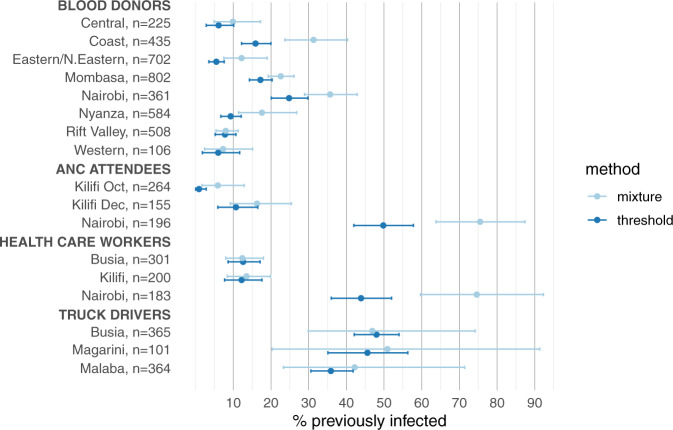
As countries decide on vaccination strategies and how to ease movement restrictions, estimating the proportion of the population previously infected with SARS-CoV-2 is important for predicting the future burden of COVID-19. This proportion is usually estimated from serosurvey data in two steps: first the proportion above a threshold antibody level is calculated, then the crude estimate is adjusted using external estimates of sensitivity and specificity. A drawback of this approach is that the PCR-confirmed cases used to estimate the sensitivity of the threshold may not be representative of cases in the wider population-e.g., they may be more recently infected and more severely symptomatic. Mixture modelling offers an alternative approach that does not require external data from PCR-confirmed cases. Here we illustrate the bias in the standard threshold-based approach by comparing both approaches using data from several Kenyan serosurveys. We show that the mixture model analysis produces estimates of previous infection that are often substantially higher than the standard threshold analysis.
随着各国决定疫苗接种策略和如何放宽流动限制,估算先前感染 SARS-CoV-2 的人群比例对于预测 COVID-19 的未来负担非常重要。通常通过两步从血清学调查数据中估算这一比例:首先计算超过阈值抗体水平的比例,然后使用外部敏感性和特异性估计值对粗略估计进行调整。这种方法的一个缺点是,用于估计阈值敏感性的 PCR 确诊病例可能不能代表更广泛人群中的病例 - 例如,它们可能最近感染且症状更严重。混合模型提供了一种不需要来自 PCR 确诊病例的外部数据的替代方法。在这里,我们使用来自肯尼亚几项血清学调查的数据比较了这两种方法,说明了标准阈值方法的偏差。我们表明,混合模型分析产生的先前感染估计值通常远高于标准阈值分析。