KEMRI-Wellcome Trust Research Programme, Kilifi, Kenya.
Department of Infectious Diseases Epidemiology, London School of Hygiene and Tropical Medicine, London, United Kingdom.
PLoS One. 2022 Oct 14;17(10):e0265478. doi: 10.1371/journal.pone.0265478. eCollection 2022.
The high proportion of SARS-CoV-2 infections that have remained undetected presents a challenge to tracking the progress of the pandemic and estimating the extent of population immunity.
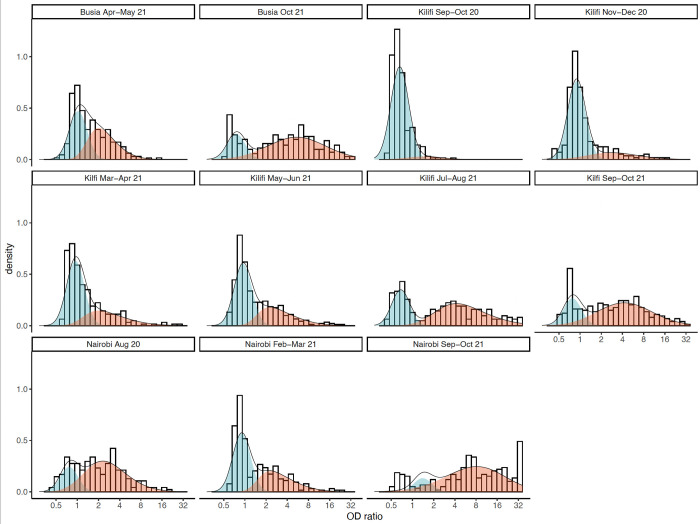
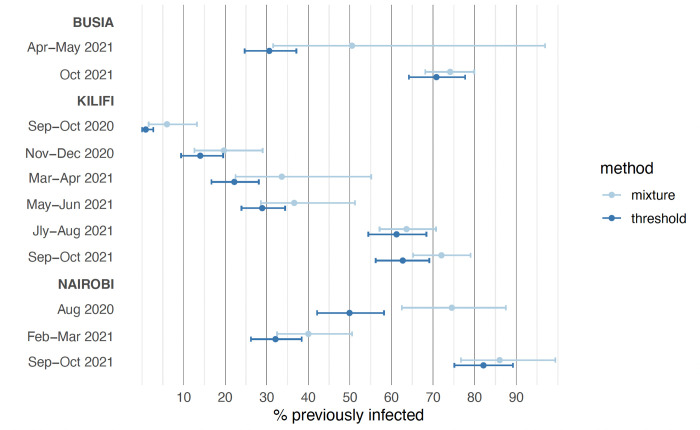
We used residual blood samples from women attending antenatal care services at three hospitals in Kenya between August 2020 and October 2021and a validated IgG ELISA for SARS-Cov-2 spike protein and adjusted the results for assay sensitivity and specificity. We fitted a two-component mixture model as an alternative to the threshold analysis to estimate of the proportion of individuals with past SARS-CoV-2 infection.
We estimated seroprevalence in 2,981 women; 706 in Nairobi, 567 in Busia and 1,708 in Kilifi. By October 2021, 13% of participants were vaccinated (at least one dose) in Nairobi, 2% in Busia. Adjusted seroprevalence rose in all sites; from 50% (95%CI 42-58) in August 2020, to 85% (95%CI 78-92) in October 2021 in Nairobi; from 31% (95%CI 25-37) in May 2021 to 71% (95%CI 64-77) in October 2021 in Busia; and from 1% (95% CI 0-3) in September 2020 to 63% (95% CI 56-69) in October 2021 in Kilifi. Mixture modelling, suggests adjusted cross-sectional prevalence estimates are underestimates; seroprevalence in October 2021 could be 74% in Busia and 72% in Kilifi.
There has been substantial, unobserved transmission of SARS-CoV-2 in Nairobi, Busia and Kilifi Counties. Due to the length of time since the beginning of the pandemic, repeated cross-sectional surveys are now difficult to interpret without the use of models to account for antibody waning.
未被发现的 SARS-CoV-2 感染比例很高,这给追踪大流行进展和估计人群免疫程度带来了挑战。
我们使用了 2020 年 8 月至 2021 年 10 月期间在肯尼亚三家医院接受产前保健服务的女性的剩余血液样本,并使用经过验证的 SARS-CoV-2 刺突蛋白 IgG ELISA 进行检测,并对结果进行了检测敏感性和特异性的调整。我们拟合了一个两分量混合模型作为阈值分析的替代方法,以估计过去 SARS-CoV-2 感染个体的比例。
我们估计了 2981 名女性的血清流行率;内罗毕 706 人,布西亚 567 人,基利菲 1708 人。到 2021 年 10 月,内罗毕有 13%的参与者(至少一剂)接种了疫苗,布西亚有 2%。所有地点的调整血清流行率均上升;2020 年 8 月为 50%(95%CI 42-58),2021 年 10 月为 85%(95%CI 78-92),2021 年 5 月为 31%(95%CI 25-37)至 71%(95%CI 64-77),2020 年 9 月为 1%(95%CI 0-3)至 2021 年 10 月为 63%(95%CI 56-69)。混合模型表明,调整后的横断面流行率估计值被低估;2021 年 10 月布西亚的血清流行率可能为 74%,基利菲为 72%。
在内罗毕、布西亚和基利菲县,SARS-CoV-2 发生了大量未被发现的传播。由于大流行开始以来的时间较长,现在如果不使用模型来解释抗体衰减,重复的横断面调查就很难解释。