Department of Pathology, Sealy Center for Vector-Borne and Zoonotic Diseases, Center for Biodefense and Emerging Infectious Diseases, Center for Tropical Diseases, Institute for Human Infections and Immunity, University of Texas Medical Branch, Galveston, TX, USA.
Fundação de Medicina Tropical Doutor Heitor Vieira Dourado (FMT-HVD), Manaus, Amazonas, Brazil.
Sci Rep. 2021 Oct 26;11(1):21129. doi: 10.1038/s41598-021-00514-0.
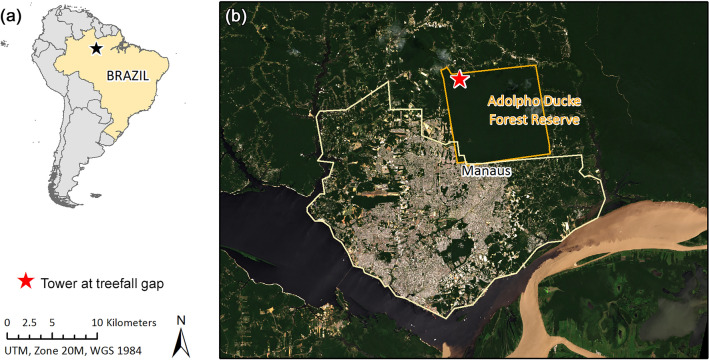
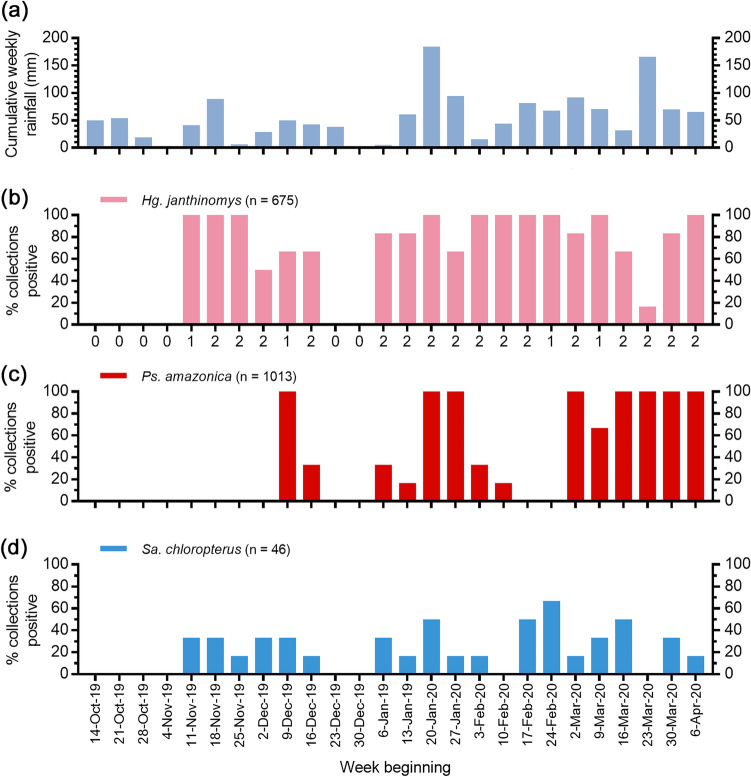
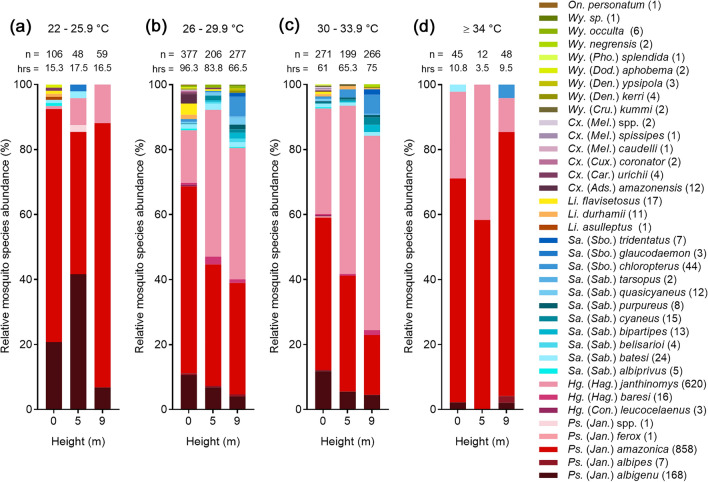
In the Americas, some mosquito-borne viruses such as Zika, chikungunya, and dengue circulate among humans in urban transmission cycles, while others, including yellow fever and Mayaro, circulate among monkeys in sylvatic cycles. The intersection of humans and wildlife at forest edges creates risk for zoonotic virus exchange. We built a scaffold tower at the edge of a treefall gap in rainforest bordering Manaus, Brazil, to identify vectors that may bridge transmission between humans and monkeys. We vertically sampled diurnally active, anthropophilic mosquitoes using handheld nets at 0, 5, and 9 m and container-breeding mosquitoes in ovitraps at 0, 5, 10, and 15 m. Haemagogus janthinomys and Psorophora amazonica were present in high relative abundance in nets at each height sampled, while anthropophilic species were uncommon in ovitraps. Hg. janthinomys was more abundant at elevated heights than at ground level, while Ps. amazonica abundance was not significantly stratified across heights. The presence of each species increased with increasing 7-day rainfall lagged at 1 week, and at 1 and 4 weeks prior to collection, respectively. In addition, Hg. janthinomys was most frequently collected at 29.9 °C, irrespective of height. These data provide insight into the potential role of each species as bridge vectors.
在美洲,一些蚊媒病毒,如寨卡病毒、基孔肯雅热和登革热,在城市传播周期中在人类中传播,而其他病毒,如黄热病和马亚罗热,在森林边缘的野生动物中循环。人类和野生动物在森林边缘的交叉点为动物源性病毒的交换创造了风险。我们在巴西玛瑙斯附近的雨林中的树倒缺口边缘建造了一个支架塔,以确定可能在人类和猴子之间架起传播桥梁的媒介。我们使用手持网在 0、5 和 9 米处以及在 0、5、10 和 15 米处的卵胎生蚊子的卵胎生蚊子中,每天在白天活动的、嗜人血的蚊子中进行垂直采样。在每个采样高度的网中,Haemagogus janthinomys 和 Psorophora amazonica 的相对丰度都很高,而卵胎生蚊子中的嗜人血物种则很少见。Hg. janthinomys 在高处的丰度高于地面水平,而 Ps. amazonica 的丰度在高度上没有明显分层。每种物种的存在随着滞后 1 周的 7 天降雨增加而增加,并且分别在采集前 1 周和 4 周增加。此外,Hg. janthinomys 无论高度如何,最常在 29.9°C 下采集。这些数据提供了对每种物种作为桥梁媒介的潜在作用的深入了解。