GHU Paris Psychiatry & Neurosciences, Clinic of Mental Illnesses & Brain Disorders (CMME), 75014Paris, France.
University of Paris, Institute of Psychiatry and Neuroscience of Paris (IPNP), INSERM U1266, 75014Paris, France.
Eur Psychiatry. 2021 Oct 28;64(1):e67. doi: 10.1192/j.eurpsy.2021.2242.
This study aimed to investigate the effectiveness of mindfulness-based cognitive therapy (MBCT) as a complementary approach in patients with bulimia nervosa (BN) or binge eating disorder (BED), and to assess how the reduction of the cognitive load of words related to eating disorders (ED) could constitute an intermediate factor explaining its global efficacy.
Eighty-eight women and men participated in clinical assessments upon inscription, prior to and following 8-week group MBCT. Mindfulness skills were assessed using the five facet mindfulness questionnaire; eating behaviors were assessed using the Three Factor Eating Questionnaire (TFEQ); comorbid pathologies were assessed using the beck depression index and the state-trait anxiety inventory. The cognitive load of words associated with ED was assessed through a modified version of the Stroop color naming task.
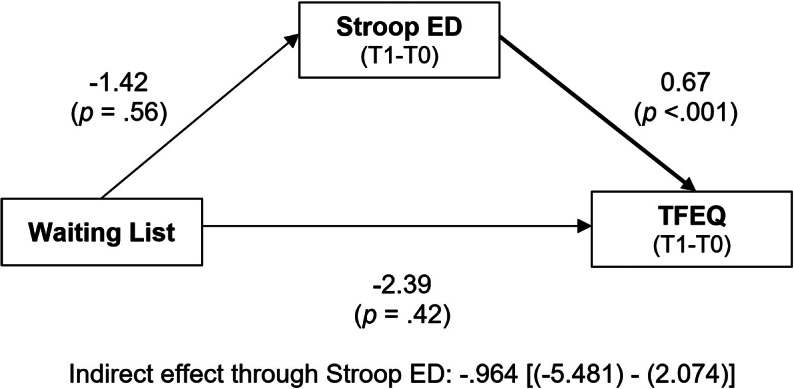
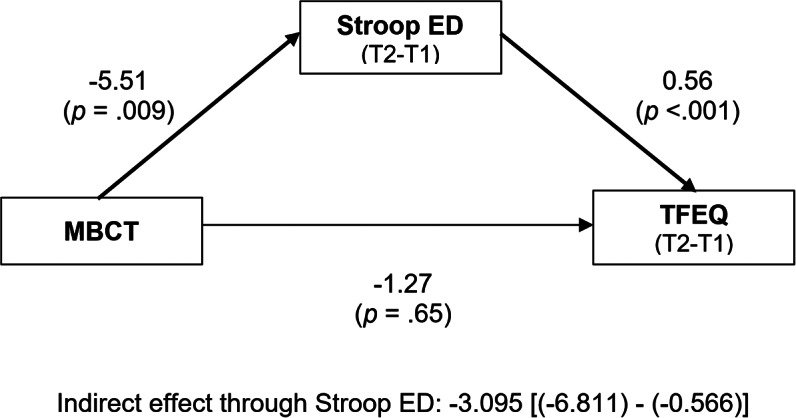
Mindfulness skills improved significantly (p < .05) after group MBCT. The improvement of TFEQ scores was accompanied by reduced levels of depressive mood and trait anxiety. The positive impact of MBCT on TFEQ score was directly related to an improvement of the performance in the Stroop task.
MBCT represents an interesting complementary therapy for patients with either BN or BED, at least when cognitive and behavioral domains are concerned. Such efficacy seems to be mediated by the reduction of the cognitive load associated with ED stimuli, which offers a possible explanation of how MBCT could reduce binge-eating behaviors. Other studies are needed, in independent centers, to focus more directly on core symptoms and long-term outcome.
本研究旨在探究正念认知疗法(MBCT)作为神经性贪食症(BN)或暴食障碍(BED)患者辅助治疗手段的有效性,并评估与进食障碍(ED)相关词汇的认知负荷降低如何成为解释其整体疗效的中间因素。
88 名女性和男性在入组时、入组前和 8 周团体 MBCT 后进行临床评估。使用五因素正念问卷评估正念技能;使用三因素饮食问卷(TFEQ)评估饮食行为;使用贝克抑郁指数和状态-特质焦虑量表评估共病病理。通过修改版 Stroop 颜色命名任务评估与 ED 相关的词汇的认知负荷。
团体 MBCT 后,正念技能显著提高(p<.05)。TFEQ 评分的改善伴随着抑郁情绪和特质焦虑水平的降低。MBCT 对 TFEQ 评分的积极影响与 Stroop 任务表现的改善直接相关。
MBCT 代表了一种有趣的 BN 或 BED 患者辅助治疗方法,至少在认知和行为领域是如此。这种疗效似乎是通过降低与 ED 刺激相关的认知负荷来介导的,这为 MBCT 如何减少暴食行为提供了一种可能的解释。需要在独立中心进行其他研究,更直接地关注核心症状和长期结果。