Iacoangeli Alfredo, Fogh Isabella, Selvackadunco Sashika, Topp Simon D, Shatunov Aleksey, van Rheenen Wouter, Al-Khleifat Ahmad, Opie-Martin Sarah, Ratti Antonia, Calvo Andrea, Van Damme Philip, Robberecht Wim, Chio Adriano, Dobson Richard J, Hardiman Orla, Shaw Christopher E, van den Berg Leonard H, Andersen Peter M, Smith Bradley N, Silani Vincenzo, Veldink Jan H, Breen Gerome, Troakes Claire, Al-Chalabi Ammar, Jones Ashley R
Maurice Wohl Clinical Neuroscience Institute, Institute of Psychiatry, Psychology and Neuroscience King's College London, 5 Cutcombe Road, London SE5 9RT, UK.
Department of Biostatistics and Health Informatics, Institute of Psychiatry, Psychology and Neuroscience, King's College London, London, UK.
Brain Commun. 2021 Oct 7;3(4):fcab236. doi: 10.1093/braincomms/fcab236. eCollection 2021.
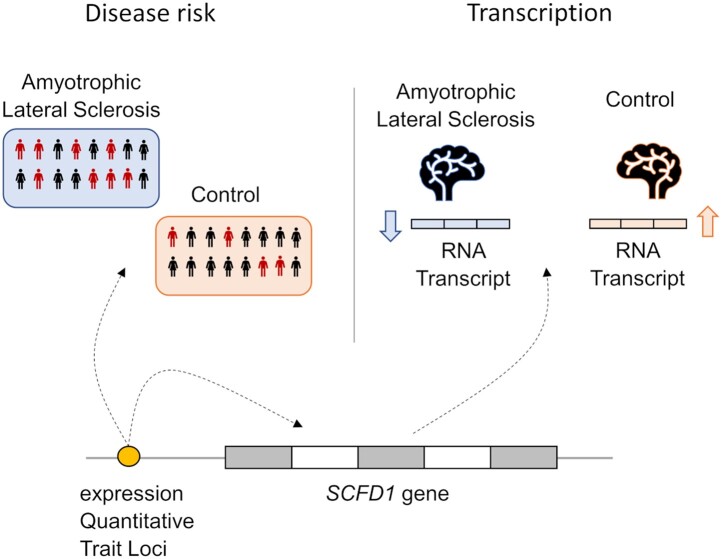
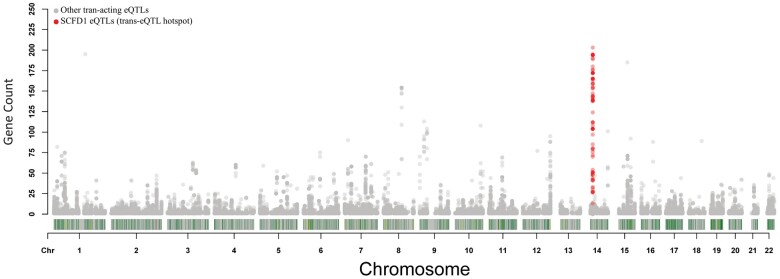
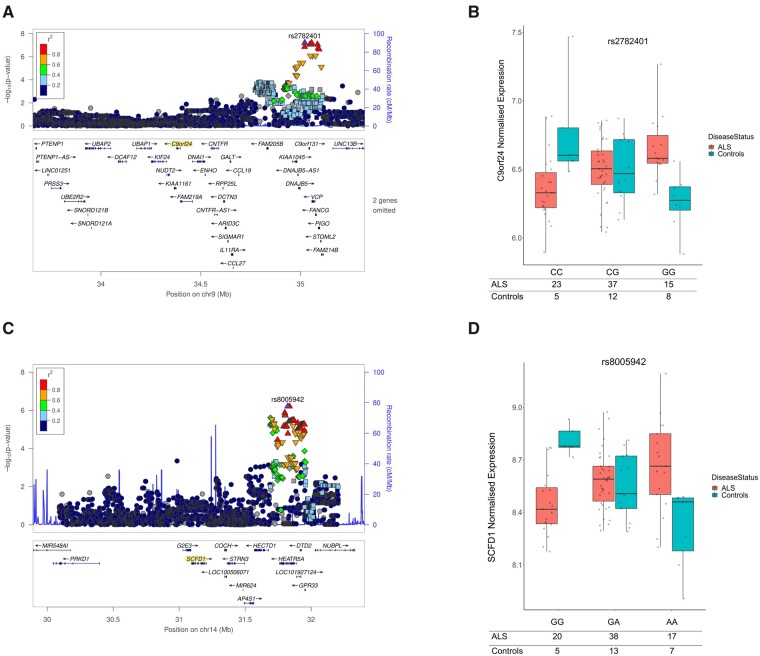
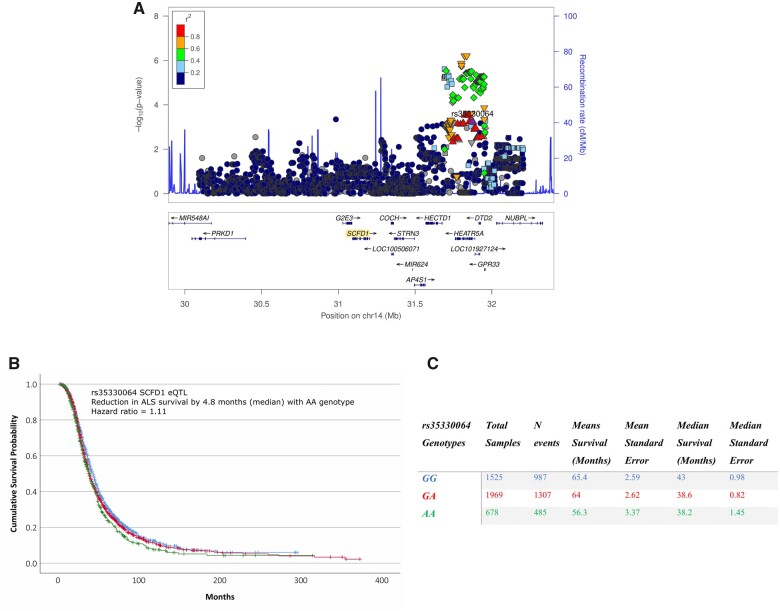
Evidence indicates that common variants found in genome-wide association studies increase risk of disease through gene regulation via expression Quantitative Trait Loci. Using multiple genome-wide methods, we examined if Single Nucleotide Polymorphisms increase risk of Amyotrophic Lateral Sclerosis through expression Quantitative Trait Loci, and whether expression Quantitative Trait Loci expression is consistent across people who had Amyotrophic Lateral Sclerosis and those who did not. In combining public expression Quantitative Trait Loci data with Amyotrophic Lateral Sclerosis genome-wide association studies, we used Summary-data-based Mendelian Randomization to confirm that was the only gene that was genome-wide significant in mediating Amyotrophic Lateral Sclerosis risk via expression Quantitative Trait Loci (Summary-data-based Mendelian Randomization beta = 0.20, standard error = 0.04, -value = 4.29 × 10). Using motor cortex, we tested whether expression Quantitative Trait Loci showed significant differences in expression between Amyotrophic Lateral Sclerosis ( = 76) and controls ( = 25), genome-wide. Of 20 757 genes analysed, the two most significant expression Quantitative Trait Loci to show differential in expression between Amyotrophic Lateral Sclerosis and controls involve two known Amyotrophic Lateral Sclerosis genes ( and ). -acting expression Quantitative Trait Loci downstream of the gene showed significant differences in expression between Amyotrophic Lateral Sclerosis and controls (top expression Quantitative Trait Loci beta = 0.34, standard error = 0.063, -value = 4.54 × 10). These expression Quantitative Trait Loci also significantly modified Amyotrophic Lateral Sclerosis survival (number of samples = 4265, hazard ratio = 1.11, 95% confidence interval = 1.05-1.17, -value = 2.06 × 10) and act as an Amyotrophic Lateral Sclerosis trans-expression Quantitative Trait Loci hotspot for a wider network of genes enriched for function and Amyotrophic Lateral Sclerosis pathways. Using gene-set analyses, we found the genes that correlate with this trans-expression Quantitative Trait Loci hotspot significantly increase risk of Amyotrophic Lateral Sclerosis (beta = 0.247, standard deviation = 0.017, = 0.001) and schizophrenia (beta = 0.263, standard deviation = 0.008, -value = 1.18 × 10), a disease that genetically correlates with Amyotrophic Lateral Sclerosis. In summary, expression Quantitative Trait Loci are a major factor in Amyotrophic Lateral Sclerosis, not only influencing disease risk but are differentially expressed in Amyotrophic Lateral Sclerosis. expression Quantitative Trait Loci show distinct expression profiles in Amyotrophic Lateral Sclerosis that correlate with a wider network of genes that also confer risk of the disease and modify the disease's duration.
有证据表明,全基因组关联研究中发现的常见变异通过表达数量性状位点进行基因调控,从而增加疾病风险。我们使用多种全基因组方法,研究单核苷酸多态性是否通过表达数量性状位点增加肌萎缩侧索硬化症的风险,以及表达数量性状位点的表达在患有肌萎缩侧索硬化症的人和未患该病的人之间是否一致。在将公开的表达数量性状位点数据与肌萎缩侧索硬化症全基因组关联研究相结合时,我们使用基于汇总数据的孟德尔随机化方法来确认,是唯一在通过表达数量性状位点介导肌萎缩侧索硬化症风险方面具有全基因组显著性的基因(基于汇总数据的孟德尔随机化β值 = 0.20,标准误 = 0.04,P值 = 4.29×10)。利用运动皮层,我们在全基因组范围内测试了表达数量性状位点在肌萎缩侧索硬化症患者(n = 76)和对照组(n = 25)之间的表达是否存在显著差异。在分析的20757个基因中,在肌萎缩侧索硬化症患者和对照组之间表达差异最显著的两个表达数量性状位点涉及两个已知的肌萎缩侧索硬化症基因(和)。该基因下游的顺式作用表达数量性状位点在肌萎缩侧索硬化症患者和对照组之间的表达存在显著差异(顶级表达数量性状位点β值 = 0.34,标准误 = 0.063,P值 = 4.54×10)。这些表达数量性状位点还显著改变了肌萎缩侧索硬化症的生存期(样本数量 = 4265,风险比 = 1.11,95%置信区间 = 1.05 - 1.17,P值 = 2.06×10),并作为一个肌萎缩侧索硬化症反式表达数量性状位点热点,存在于一个功能和肌萎缩侧索硬化症通路丰富的更广泛基因网络中。通过基因集分析,我们发现与这个反式表达数量性状位点热点相关的基因显著增加了肌萎缩侧索硬化症的风险(β值 = 0.247,标准差 =