Dagro Amy M, Wilkerson Justin W, Thomas Thaddeus P, Kalinosky Benjamin T, Payne Jason A
U.S. Army Research Laboratory, Aberdeen Proving Ground, MD 21005, USA.
J. Mike '66 Department of Mechanical Engineering, Texas A&M University, College Station, TX 77843, USA.
Sci Adv. 2021 Oct 29;7(44):eabd8405. doi: 10.1126/sciadv.abd8405.
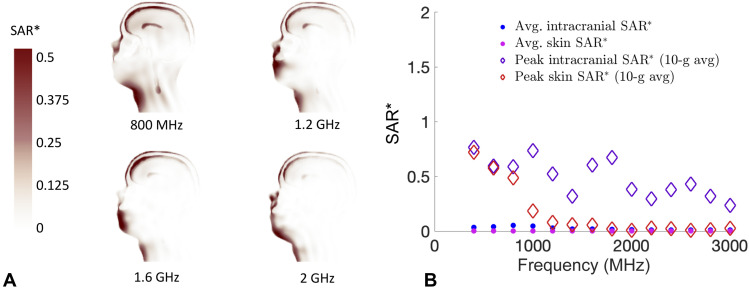
When considering safety standards for human exposure to radiofrequency (RF) and microwave energy, the dominant concerns pertain to a thermal effect. However, in the case of high-power pulsed RF/microwave energy, a rapid thermal expansion can lead to stress waves within the body. In this study, a computational model is used to estimate the temperature profile in the human brain resulting from exposure to various RF/microwave incident field parameters. The temperatures are subsequently used to simulate the resulting mechanical response of the brain. Our simulations show that, for certain extremely high-power microwave exposures (permissible by current safety standards), very high stresses may occur within the brain that may have implications for neuropathological effects. Although the required power densities are orders of magnitude larger than most real-world exposure conditions, they can be achieved with devices meant to emit high-power electromagnetic pulses in military and research applications.
在考虑人类暴露于射频(RF)和微波能量的安全标准时,主要关注点与热效应有关。然而,对于高功率脉冲RF/微波能量而言,快速的热膨胀会导致体内产生应力波。在本研究中,使用一个计算模型来估计暴露于各种RF/微波入射场参数下人类大脑中的温度分布。随后利用这些温度来模拟大脑产生的机械响应。我们的模拟结果表明,对于某些极高功率的微波暴露(当前安全标准允许),大脑内可能会出现非常高的应力,这可能对神经病理效应产生影响。尽管所需的功率密度比大多数实际暴露条件大几个数量级,但在军事和研究应用中,用于发射高功率电磁脉冲的设备可以实现这样的功率密度。