Sidney Kimmel Medical College at Thomas Jefferson University, Philadelphia, PA, United States of America.
Department of Medicine at Thomas Jefferson University, Philadelphia, PA, United States of America.
PLoS One. 2021 Oct 29;16(10):e0259364. doi: 10.1371/journal.pone.0259364. eCollection 2021.
Virtual reality (VR) has proven effective in the treatment of specific phobias and trauma particularly when in-vivo exposure therapy might be costly (e.g. fear of flying, combat scenes). Similarly, VR has been associated with improvement of chronic pain and of acute pain during medical procedures. Despite its effectiveness as a healthcare tool, VR technology is not well-integrated into common practice. This qualitative study aims to explore the provider perception of the value of VR and identify barriers to VR implementation among healthcare providers.
A 66-item self-report survey was created to examine application of VR to clinical practice, perceived value of this treatment, ease of learning the technology, billing considerations, and other obstacles. 128 providers (MDs and PhDs) who were located in the United States and had used VR as a therapeutic tool in the past year were identified through research papers, as well as user lists and news articles from VR application websites. Of the 128 providers contacted, 17% (22) completed our online self-report measure. Of these, 13% of respondents (N = 17) completed greater than 75% of the questionnaire and were considered completers. Provider responses were collected over a one-month period and qualitatively analyzed.
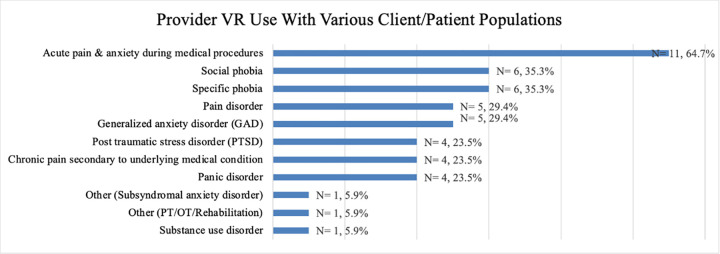
The majority of providers were from an academic institution (n = 12, 70.6%), and all providers practiced in the outpatient setting. Providers most commonly reported using VR for the treatment of acute pain and/or anxiety related to medical procedures (n = 11, 64.7%), followed by specific phobia (n = 6, 35.3%) and social phobia (n = 6, 35.3%). All providers agreed VR is a valuable tool they would recommend to colleagues. The majority (n = 15, 93.8%) believed VR helped their patients progress in treatment, compared with other methods. Providers cited the ability to individualize treatment (n = 14, 87.5%) and increase patient engagement (n = 15, 93.8%) as main benefits of VR. A minority reported negative feedback from patients about content (n = 4, 25%) or about the technology in general (n = 6, 37.5%), whereas all reported some form of positive feedback. The slight majority (n = 10, 58.8%) of providers did not find transitioning to VR difficult. Of those who did, cost was the most commonly cited barrier (n = 6). Regarding reimbursement, only 17.6% (n = 3) of providers reported the ability to bill for VR sessions. Most providers (n = 15, 88.2%) received training on their VR platform which they found beneficial. Comparing the trained and untrained groups found no significant difference in VR comfort level (p = 0.5058), the value of VR in practice (p = 0.551) or whether providers would recommend VR to others (p = 0.551), though sample sizes were small.
In corroboration with previous research, this study demonstrates that VR is well-received by patients and providers, allowing increased patient engagement and treatment individualization. However, associated costs, including an inability to bill for this service, can present a barrier to further implementation. These findings will guide further development of virtual reality as a standardized tool in psychiatry and pain management.
虚拟现实(VR)已被证明在治疗特定恐惧症和创伤方面非常有效,特别是在可能需要昂贵的现场暴露疗法时(例如,飞行恐惧、战斗场景)。同样,VR 也与改善慢性疼痛和医疗程序中的急性疼痛有关。尽管作为一种医疗保健工具,VR 技术并未很好地融入常规实践。这项定性研究旨在探讨提供者对 VR 价值的看法,并确定医疗保健提供者在实施 VR 方面的障碍。
创建了一个包含 66 个项目的自我报告调查,以检查 VR 在临床实践中的应用、这种治疗方法的感知价值、学习技术的易用性、计费考虑因素以及其他障碍。通过研究论文、VR 应用网站的用户列表和新闻文章,确定了过去一年中在美国使用 VR 作为治疗工具的 128 名医疗保健提供者(MD 和博士)。在联系的 128 名提供者中,有 17%(22 名)完成了我们的在线自我报告量表。在这些完成者中,有 13%(17 名)完成了超过 75%的问卷,被认为是完成者。提供者的反应是在一个月的时间内收集的,并进行了定性分析。
大多数提供者来自学术机构(n = 12,70.6%),所有提供者都在门诊环境中执业。提供者最常报告使用 VR 治疗与医疗程序相关的急性疼痛和/或焦虑(n = 11,64.7%),其次是特定恐惧症(n = 6,35.3%)和社交恐惧症(n = 6,35.3%)。所有提供者都同意 VR 是他们会向同事推荐的有价值的工具。大多数(n = 15,93.8%)提供者认为 VR 有助于患者在治疗中取得进展,与其他方法相比。提供者列举了能够个性化治疗(n = 14,87.5%)和增加患者参与度(n = 15,93.8%)是 VR 的主要好处。少数提供者报告了患者对内容(n = 4,25%)或对技术总体(n = 6,37.5%)的负面反馈,而所有提供者都报告了某种形式的积极反馈。略多于一半(n = 10,58.8%)的提供者认为过渡到 VR 并不困难。那些认为困难的人,成本是最常提到的障碍(n = 6)。关于报销,只有 17.6%(n = 3)的提供者报告能够为 VR 疗程计费。大多数提供者(n = 15,88.2%)在他们的 VR 平台上接受了培训,他们发现这很有帮助。比较受过培训和未受过培训的小组发现,VR 舒适度水平(p = 0.5058)、实践中 VR 的价值(p = 0.551)或提供者是否会向他人推荐 VR(p = 0.551)方面没有显著差异,尽管样本量很小。
与先前的研究一致,这项研究表明,VR 受到患者和提供者的欢迎,允许增加患者参与度和治疗个性化。然而,相关成本,包括无法为此服务计费,可能成为进一步实施的障碍。这些发现将指导 VR 作为精神病学和疼痛管理领域的标准化工具的进一步发展。
