School of Psychology and Center for Studies of Psychological Application, South China Normal University, Tianhe District, Guangzhou City, Guangzhou province, 510631, China.
Key Laboratory of Brain, Cognition and Education Sciences (SCNU), Ministry of Education, Guangzhou, China.
BMC Public Health. 2021 Oct 30;21(1):1963. doi: 10.1186/s12889-021-12017-8.
Sleep duration is a vital public health topic, yet most existing studies have been limited to cross-sectional surveys or inconsistent classifications of sleep duration categories, and few characterized its continuous development process. The current study aimed to depict its change trajectory in the general population and identify associated factors from a dynamic perspective.
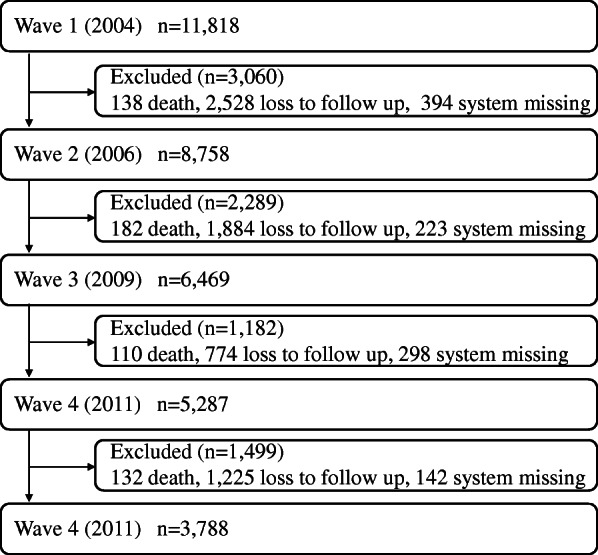
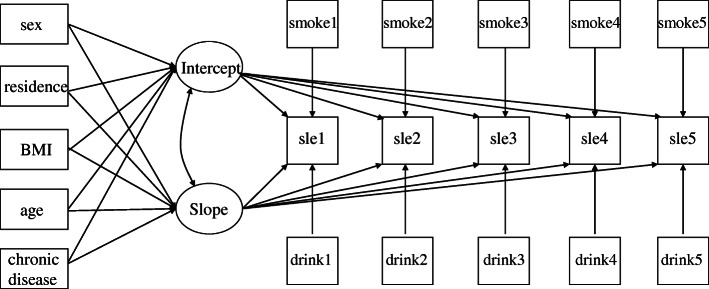
A total of 3788 subjects (45.4% male, mean age 46.72 ± 14.89 years) from the China Health and Nutrition Survey were recruited, and their daily sleep duration for five consecutive measurements from 2004 to 2015 was recorded. We adopted latent growth modelling to establish systematic relations between sleep duration and time. Participants' sociodemographic characteristics, lifestyle, and health factors were taken as covariates.
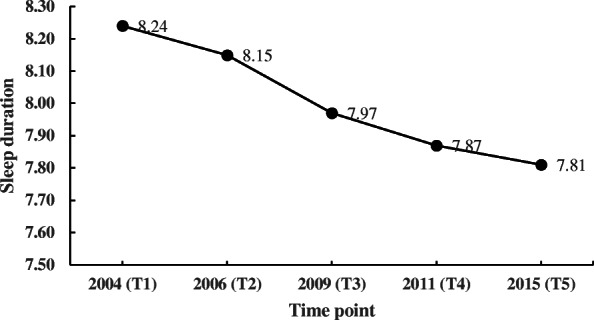
The change in sleep duration could be depicted by a linear decreasing trajectory with the mean yearly decrease at 2.5 min/day. The trajectory did not differ by residence, BMI category, chronic disease situation, smoking status, or drinking status. Moreover, there were sex and age differences in the trajectory, and females and those under 30 were prone to larger decrease rates.
The quantified yearly change in sleep duration provided insights for the prediction and early warning of insufficient sleep. Public health interventions focusing on slowing down the decrease rates among females and young individuals are warranted.
睡眠时长是一个重要的公共健康话题,但大多数现有研究仅限于横断面调查或睡眠时长类别的不一致分类,很少从动态角度描述其连续发展过程。本研究旨在从动态角度描述一般人群中睡眠时长的变化轨迹,并确定相关因素。
共纳入 3788 名(45.4%为男性,平均年龄 46.72±14.89 岁)来自中国健康与营养调查的研究对象,记录了他们在 2004 年至 2015 年连续五次的日常睡眠时间。我们采用潜在增长模型建立睡眠时长与时间之间的系统关系。将参与者的社会人口统计学特征、生活方式和健康因素作为协变量。
睡眠时长的变化可以通过线性递减轨迹来描述,平均每年减少 2.5 分钟/天。该轨迹不受居住地点、BMI 类别、慢性病状况、吸烟状况或饮酒状况的影响。此外,轨迹存在性别和年龄差异,女性和 30 岁以下的人睡眠减少率较高。
量化的每年睡眠时长变化为预测和预警睡眠不足提供了依据。有必要针对女性和年轻人群体,开展减缓睡眠减少率的公共卫生干预措施。