School of Integrated Traditional Chinese and Western Medicine, Binzhou Medical University, Yantai, Shandong, China.
Department of Urology, Taizhou Hospital of Zhejiang Province Affiliated with Wenzhou Medical University, Linhai, Zhejiang, China.
PeerJ. 2023 Sep 18;11:e16009. doi: 10.7717/peerj.16009. eCollection 2023.
The prevalence of sleep deprivation among college students is increasing and has a few associated factors.
The present study analyzed 2,142 college students from 28 provinces in China. The Chinese version of the Pittsburgh Sleep Quality Index (PSQI) was used to assess sleep duration. Binary logistic regression was conducted to explore the sleep deprivation related factors. Age and gender were controlled as covariates.
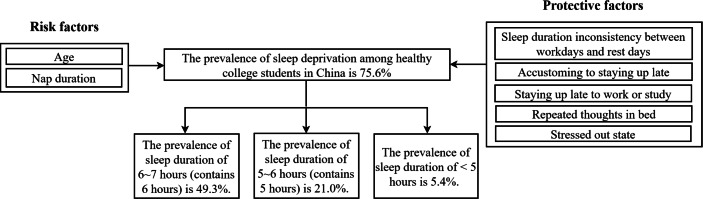
Among the 2,142 college students (27.7% male, 72.3% female), 1,620 (75.6%) reported the average sleep duration was below 7 h per day for one month, 49.3% (1,055/2,142) slept 6∼7 h (contains 6 h), 21.0% (449/2,142) slept 5∼6 h (contains 5 h), and 5.4% (116/2,142) slept <5 h. Age increased the risk of sleep deprivation, the adjusted odds ratio = 1.05 (95% CI [1.01∼1.10]). The adjusted odds ratio (A-OR) for sleep deprivation was higher for students of more than 60 min nap duration per day (A-OR = 2.35, 95% CI [1.45∼3.80]), and age growth (A-OR = 1.05, 95% CI [1.01∼1.10]). In contrast, A-ORs were lower among sleeping inconsistency between work and rest days (A-OR = 0.61, 95% CI [0.49∼0.75]), accustomed to staying up late (A-OR = 0.45, 95% CI [0.36∼0.57]), staying up late to work or study (A-OR = 0.62, 95% CI [0.49∼0.78]), stress (A-OR = 0.75, 95% CI [0.58∼0.98]), and repeated thoughts in bed had (A-OR = 0.79, 95% CI [0.62∼0.99]).
Sleep deprivation is extremely common among healthy college students in China. It is necessary to perform methods maintaining enough sleep due to the current high incidence of sleep deprivation. Controlling the nap duration and getting enough sleep on rest days to replace missing hours of sleep on workdays might improve college students' sleep.
大学生睡眠不足的现象日益普遍,且存在一些相关因素。
本研究分析了来自中国 28 个省的 2142 名大学生。采用匹兹堡睡眠质量指数(PSQI)中文版评估睡眠时间。采用二项逻辑回归分析探讨睡眠不足的相关因素。以年龄和性别为协变量进行控制。
在 2142 名大学生中(27.7%为男性,72.3%为女性),1620 名(75.6%)报告平均每天的睡眠时间不足 7 小时,49.3%(1055/2142)睡眠时间为 6∼7 小时(包含 6 小时),21.0%(449/2142)睡眠时间为 5∼6 小时(包含 5 小时),5.4%(116/2142)睡眠时间<5 小时。年龄增加了睡眠不足的风险,调整后的优势比(AOR)=1.05(95%CI[1.01∼1.10])。每天午睡时间超过 60 分钟(AOR=2.35,95%CI[1.45∼3.80])和年龄增长(AOR=1.05,95%CI[1.01∼1.10])的学生睡眠不足的 AOR 更高。相比之下,工作日和休息日睡眠不规律(AOR=0.61,95%CI[0.49∼0.75])、习惯熬夜(AOR=0.45,95%CI[0.36∼0.57])、熬夜工作或学习(AOR=0.62,95%CI[0.49∼0.78])、压力(AOR=0.75,95%CI[0.58∼0.98])和躺在床上反复思考(AOR=0.79,95%CI[0.62∼0.99])的 AOR 较低。
睡眠不足在中国健康大学生中极为常见。由于目前睡眠不足的发生率较高,有必要采取保持充足睡眠的方法。控制午睡时间并在休息日获得足够的睡眠以弥补工作日的睡眠时间不足,可能会改善大学生的睡眠。