International Livestock Research Institute, Nairobi, Kenya.
Department of Biological Sciences, University of Embu, Embu, Kenya.
BMC Vet Res. 2021 Oct 30;17(1):342. doi: 10.1186/s12917-021-03036-z.
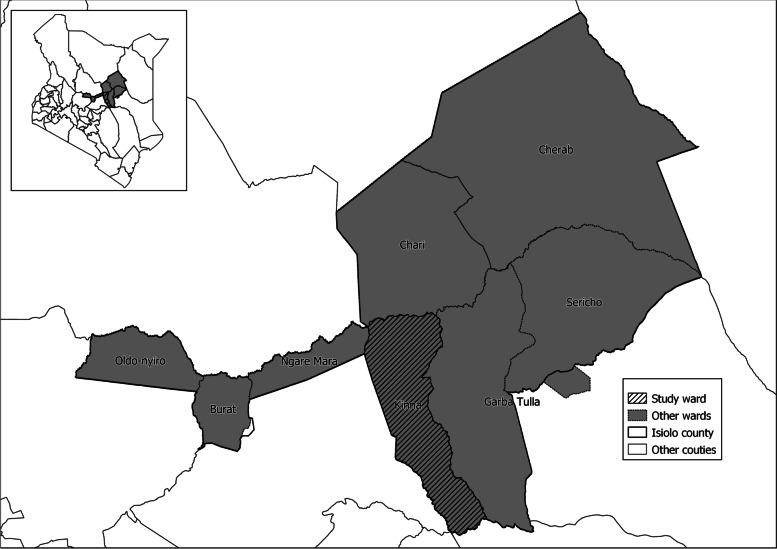
We implemented a longitudinal study to determine the incidence of Brucella infection in cattle, camels, sheep and goats that were being raised in a pastoral area in Isiolo County, Kenya. An initial cross-sectional survey was implemented to identify unexposed animals for follow up; that survey used 141 camels, 216 cattle, 208 sheep and 161 goats. Sera from these animals were screened for Brucella spp. using the Rose Bengal Plate test (RBPT), a modified RBPT, and an indirect multispecies Enzyme Linked Immunosorbent Assay (iELISA). Results of RBPT and iELISA were interpreted in parallel to determine seroprevalence. A total of 30 camels, 31 cattle, 22 sheep and 32 goats that were seronegative by all the above tests were recruited in a subsequent longitudinal study for follow up. These animals were followed for 12 months and tested for anti-Brucella antibodies using iELISA. Seroconversion among these animals was defined by a positive iELISA test following a negative iELISA result in the previous sampling period. All seropositive samples were further tested using real-time PCR-based assays to identify Brucella species. These analyses targeted the alkB and BMEI1162 genes for B. abortus, and B. melitensis, respectively. Data from the longitudinal study were analysed using Cox proportional hazards model that accounted for within-herds clustering of Brucella infections.
The overall incidence rate of Brucella infection was 0.024 (95% confidence interval [CI]: 0.014-0.037) cases per animal-months at risk. Brucella infection incidence in camels, cattle, goats and sheep were 0.053 (0.022-0.104), 0.028 (0.010-0.061), 0.013 (0.003-0.036) and 0.006 (0.0002-0.034) cases per animal-month at risk, respectively. The incidence rate of Brucella infection among females and males were 0.020 (0.009-0.036) and 0.016 (0.004-0.091), respectively. Real-time PCR analyses showed that B. abortus was more prevalent than B. melitensis in the area. Results of multivariable Cox regression analysis identified species (camels and cattle) as an important predictor of Brucella spp. exposure in animals.
This study estimated an overall brucellosis incidence of 0.024 cases per animal-months at risk with camels and cattle having higher incidence than sheep and goats. These results will inform surveillance studies in the area.
我们在肯尼亚伊西奥洛县的一个牧区实施了一项纵向研究,以确定正在饲养的牛、骆驼、绵羊和山羊中布鲁氏菌感染的发生率。我们进行了一项初步的横断面调查,以确定后续研究中未暴露的动物;该调查使用了 141 头骆驼、216 头牛、208 只绵羊和 161 只山羊。使用虎红平板试验(RBPT)、改良 RBPT 和间接多物种酶联免疫吸附试验(iELISA)对这些动物的血清进行布鲁氏菌属 spp. 的筛查。平行解读 RBPT 和 iELISA 的结果以确定血清阳性率。共有 30 头骆驼、31 头牛、22 只绵羊和 32 只山羊在上述所有检测中均呈血清阴性,随后被招募参加后续的纵向研究。这些动物被随访 12 个月,并使用 iELISA 检测抗布鲁氏菌抗体。如果在前一个采样期的 iELISA 检测结果为阴性,随后的 iELISA 检测结果为阳性,则定义为血清转换。所有血清阳性样本均进一步使用基于实时 PCR 的检测方法进行分析,以鉴定布鲁氏菌种。这些分析分别针对 alkB 和 BMEI1162 基因,用于检测 B. abortus 和 B. melitensis。使用 Cox 比例风险模型分析纵向研究数据,该模型考虑了布鲁氏菌感染在畜群内的聚集情况。
在风险动物月中,布鲁氏菌感染的总发病率为 0.024(95%置信区间 [CI]:0.014-0.037)例。骆驼、牛、山羊和绵羊的布鲁氏菌感染发病率分别为 0.053(0.022-0.104)、0.028(0.010-0.061)、0.013(0.003-0.036)和 0.006(0.0002-0.034)例/动物-月。雌性和雄性动物的感染率分别为 0.020(0.009-0.036)和 0.016(0.004-0.091)。实时 PCR 分析显示,在该地区,B. abortus 的流行率高于 B. melitensis。多变量 Cox 回归分析的结果确定了物种(骆驼和牛)是动物布鲁氏菌属 spp. 暴露的重要预测因素。
本研究估计总布鲁氏菌病发病率为 0.024 例/动物-月,骆驼和牛的发病率高于绵羊和山羊。这些结果将为该地区的监测研究提供信息。