Boekhout Teun, Aime M Catherine, Begerow Dominik, Gabaldón Toni, Heitman Joseph, Kemler Martin, Khayhan Kantarawee, Lachance Marc-André, Louis Edward J, Sun Sheng, Vu Duong, Yurkov Andrey
Westerdijk Fungal Biodiversity Institute, Utrecht, The Netherlands.
Institute of Biodiversity and Ecosystem Dynamics (IBED), University of Amsterdam, Amsterdam, The Netherlands.
Fungal Divers. 2021;109(1):27-55. doi: 10.1007/s13225-021-00475-9. Epub 2021 Jun 26.
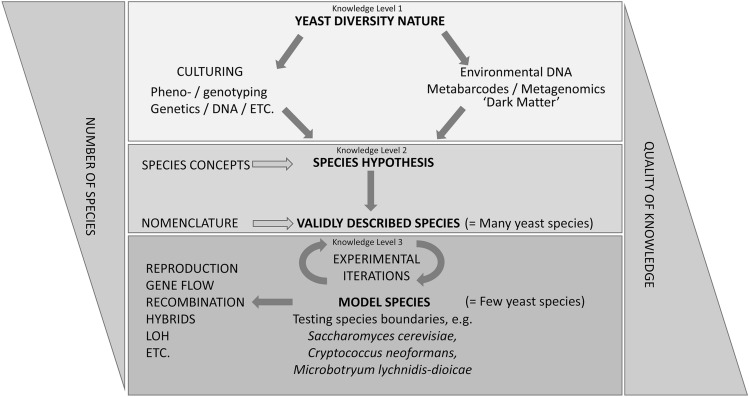
Here we review how evolving species concepts have been applied to understand yeast diversity. Initially, a phenotypic species concept was utilized taking into consideration morphological aspects of colonies and cells, and growth profiles. Later the biological species concept was added, which applied data from mating experiments. Biophysical measurements of DNA similarity between isolates were an early measure that became more broadly applied with the advent of sequencing technology, leading to a sequence-based species concept using comparisons of parts of the ribosomal DNA. At present phylogenetic species concepts that employ sequence data of rDNA and other genes are universally applied in fungal taxonomy, including yeasts, because various studies revealed a relatively good correlation between the biological species concept and sequence divergence. The application of genome information is becoming increasingly common, and we strongly recommend the use of complete, rather than draft genomes to improve our understanding of species and their genome and genetic dynamics. Complete genomes allow in-depth comparisons on the evolvability of genomes and, consequently, of the species to which they belong. Hybridization seems a relatively common phenomenon and has been observed in all major fungal lineages that contain yeasts. Note that hybrids may greatly differ in their post-hybridization development. Future in-depth studies, initially using some model species or complexes may shift the traditional species concept as isolated clusters of genetically compatible isolates to a cohesive speciation network in which such clusters are interconnected by genetic processes, such as hybridization.
在此,我们回顾不断演变的物种概念是如何被应用于理解酵母多样性的。最初,人们采用表型物种概念,考虑菌落和细胞的形态特征以及生长曲线。后来增加了生物学物种概念,该概念应用了交配实验的数据。分离株之间DNA相似性的生物物理测量是一种早期方法,随着测序技术的出现得到更广泛应用,从而产生了基于核糖体DNA部分序列比较的基于序列的物种概念。目前,采用核糖体DNA(rDNA)和其他基因序列数据的系统发育物种概念在包括酵母在内的真菌分类学中得到普遍应用,因为各种研究表明生物学物种概念与序列差异之间存在相对良好的相关性。基因组信息的应用越来越普遍,我们强烈建议使用完整基因组而非草图基因组,以增进我们对物种及其基因组和遗传动态的理解。完整基因组能够对基因组以及它们所属物种的进化能力进行深入比较。杂交似乎是一种相对常见的现象,在所有包含酵母的主要真菌谱系中都有观察到。请注意,杂交后代在杂交后的发育情况可能有很大差异。未来的深入研究,最初可使用一些模式物种或复合体,可能会将传统的物种概念从作为遗传相容分离株的孤立集群转变为一个连贯的物种形成网络,其中这些集群通过诸如杂交等遗传过程相互连接。