Yu Jincong, Yang Ziyun, Wu Yuqin, Ge Ming, Tang Xuemei, Jiang Hongbo
Education and Counseling Center for Psychological Health, Zhongnan University of Economics and Law, Wuhan, China.
School of Foreign Languages, Zhongnan University of Economics and Law, Wuhan, China.
Front Psychiatry. 2021 Oct 15;12:742950. doi: 10.3389/fpsyt.2021.742950. eCollection 2021.
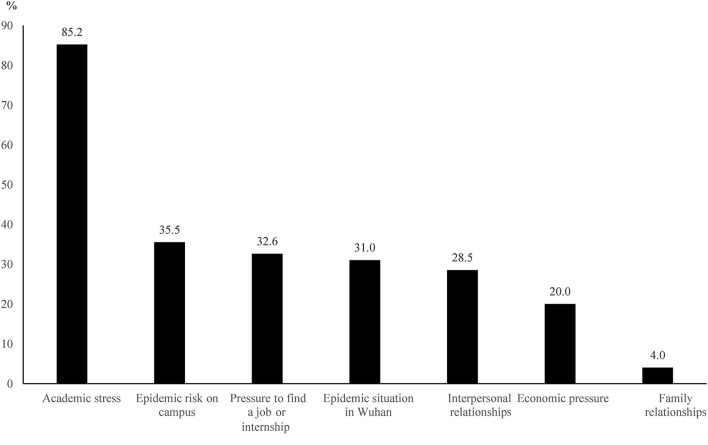
The 2019 coronavirus disease (COVID-19) epidemic has led to persistent negative psychological effects on the general public, especially on college students, who are highly susceptible to psychological difficulties, such as fear, anxiety, and depression. Little information is known about depressive symptoms among college students during the normalization stage of COVID-19 prevention and control in China. This study aimed to understand the prevalence of and factors associated with depressive symptoms after a long quarantine time and online learning at home among college students in Wuhan, China. A web-based survey was conducted from July to August 2020 during the Chinese summer holiday to collect data on sociodemographic variables, depressive symptoms, and their potential associated factors using an electronic questionnaire among college students in Wuhan, China. The Patient Health Questionnaire-9 (PHQ-9) was used to measure depressive symptoms. Binary logistic regression was used to explore the factors associated with depressive symptoms. A total of 9,383 college students were included in the analysis. The prevalence of depressive symptoms was 15.8% (1,486/9,383) among college students. The binary logistic regression showed that the experience of being quarantined for observation or treatment, family members or friends dying of COVID-19, rarely or never seeking help from others, fewer supportive relatives or friends, less support from family in the past month, a worse relationship with parents at home, a longer time spent daily on electronic devices except for online learning, and feeling anxious in the face of returning to school were independently associated with a higher risk of depressive symptoms. Academic stress and concern about the epidemic were the main reasons for their anxiety. Targeted psychological intervention measures are recommended for college students to improve their mental health during the normalization stage of COVID-19 prevention and control.
2019冠状病毒病(COVID-19)疫情给公众带来了持续的负面心理影响,尤其是对大学生,他们极易出现恐惧、焦虑和抑郁等心理问题。在中国COVID-19防控常态化阶段,关于大学生抑郁症状的信息知之甚少。本研究旨在了解中国武汉大学生在长时间居家隔离和线上学习后抑郁症状的患病率及其相关因素。2020年7月至8月中国暑假期间,通过网络调查,使用电子问卷收集了中国武汉大学生的社会人口学变量、抑郁症状及其潜在相关因素的数据。采用患者健康问卷-9(PHQ-9)来测量抑郁症状。采用二元逻辑回归分析探讨与抑郁症状相关的因素。共有9383名大学生纳入分析。大学生抑郁症状的患病率为15.8%(1486/9383)。二元逻辑回归分析显示,被隔离观察或治疗的经历、家庭成员或朋友死于COVID-19、很少或从不向他人求助、支持自己的亲属或朋友较少、过去一个月家庭支持较少、在家与父母关系较差、除线上学习外每天花在电子设备上的时间较长以及面对返校感到焦虑等因素与抑郁症状风险较高独立相关。学业压力和对疫情的担忧是他们焦虑的主要原因。建议针对大学生采取有针对性的心理干预措施,以在COVID-19防控常态化阶段改善他们的心理健康。