Fan Xiaoyuan, Zhang Xiaoqian, Lai Zhichao, Lin Tianye, You Hui, Liu Changwei, Feng Feng
Department of Radiology, Peking Union Medical College Hospital, Chinese Academy of Medical Sciences and Peking Union Medical College, Beijing, China.
Department of Vascular Surgery, Peking Union Medical College Hospital, Chinese Academy of Medical Sciences and Peking Union Medical College, Beijing, China.
Front Neurol. 2021 Oct 14;12:731237. doi: 10.3389/fneur.2021.731237. eCollection 2021.
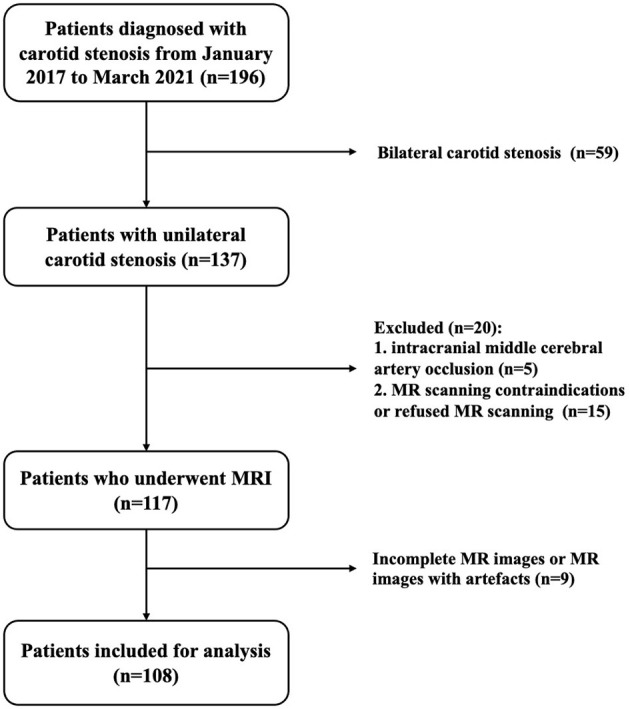
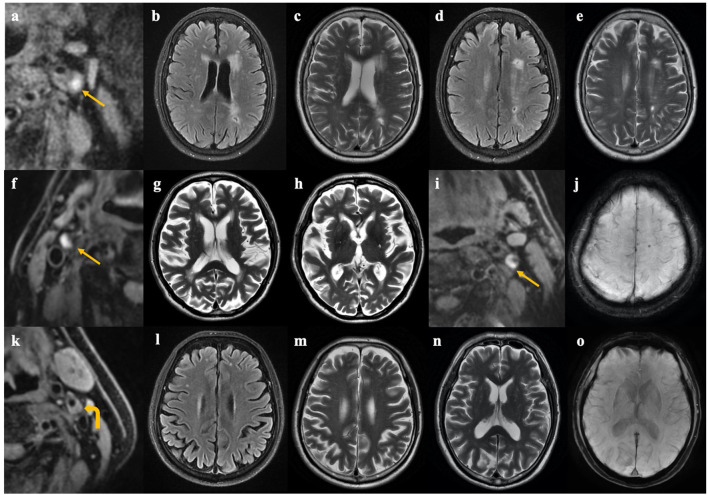
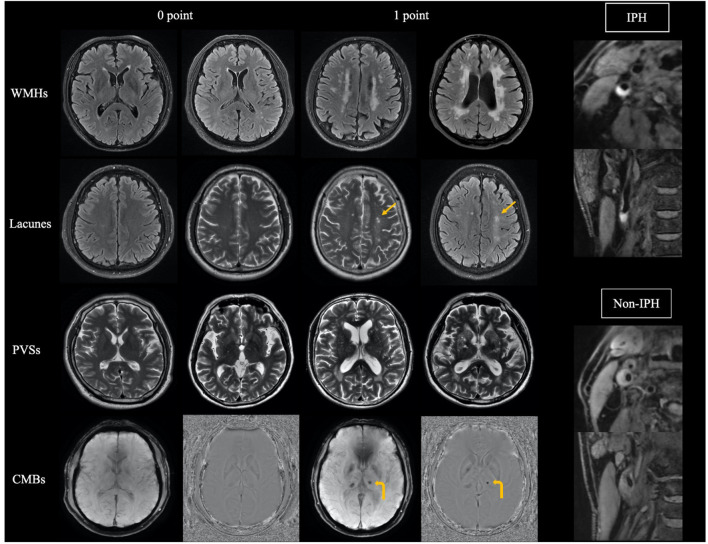
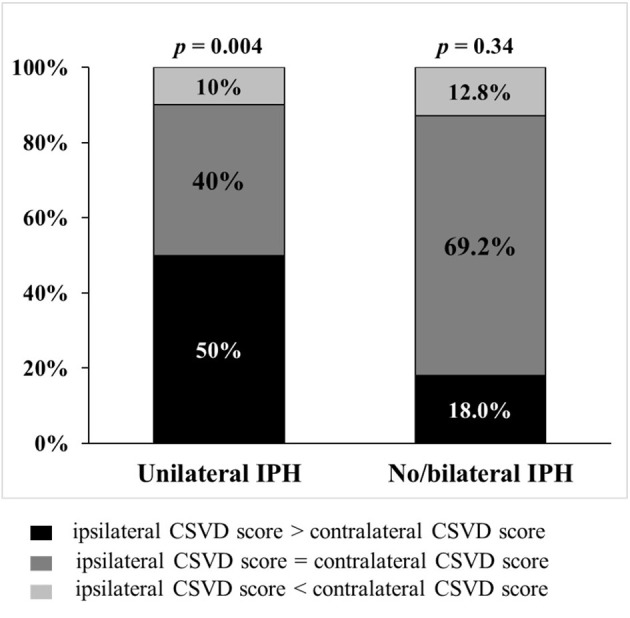
In patients with carotid stenosis, to investigate the relationship between carotid intraplaque hemorrhage (IPH) and total burden of cerebral small vessel disease (CSVD) and preliminarily explore whether the total CSVD burden as an imaging marker can distinguish the severity of clinical symptoms. A total of 108 patients (the mean age was 66 ± 7 years, and 85.2% were male) with unilateral carotid stenosis ≥50% underwent brain MRI and high-resolution MRI for carotid plaque characterization. The total burden of CSVD was calculated by accumulating one point according to the presence or severity of each of the four MRI markers: white matter hyperintensities, lacunes, perivascular spaces, and cerebral microbleeds. Recent clinical symptoms including transient ischemic attack, amaurosis fugax, and ischemic stroke were recorded. The association between intraplaque hemorrhage (IPH) and total CSVD burden was examined adjusted for other risk factors. The symmetry of CSVD burdens between the ipsilateral and contralateral hemispheres of IPH was tested. Imaging features (CSVD score, IPH, degree of stenosis, and completeness of the circle of Willis) were correlated with clinical symptoms by Kruskal-Wallis H test, Chi-square test, and Fisher's exact test. Multivariable logistic regression analysis showed that IPH (OR = 2.98, 95% CI [1.39, 6.40], = 0.005) was independently associated with a higher CSVD score. The presence of unilateral IPH was associated with the inter-hemispheric CSVD score difference ( = 0.004). Patients with stroke had a higher ipsilateral CSVD score than asymptomatic patients ( = 0.004) and those with transient ischemic attack/amaurosis fugax ( = 0.008). The statistical difference was marginally significant between symptoms and IPH ( = 0.057). No statistical difference was found between the symptoms and degree of stenosis and the completeness of the circle of Willis ( > 0.05). Carotid IPH is associated with an elevated total burden of CSVD in patients with carotid stenosis. Compared with the degree of stenosis, primary collaterals, and IPH, the total CSVD score might be a more effective imaging marker linked with clinical symptoms.
在颈动脉狭窄患者中,研究颈动脉斑块内出血(IPH)与脑小血管病(CSVD)总负担之间的关系,并初步探讨CSVD总负担作为一种影像学标志物是否能够区分临床症状的严重程度。共有108例单侧颈动脉狭窄≥50%的患者(平均年龄为66±7岁,男性占85.2%)接受了脑部MRI检查以及用于颈动脉斑块特征分析的高分辨率MRI检查。根据四种MRI标志物(白质高信号、腔隙、血管周围间隙和脑微出血)中每种标志物的存在情况或严重程度累积一分来计算CSVD的总负担。记录近期的临床症状,包括短暂性脑缺血发作、一过性黑矇和缺血性卒中。在校正其他危险因素后,检验斑块内出血(IPH)与CSVD总负担之间的关联。测试IPH同侧和对侧半球CSVD负担的对称性。通过Kruskal-Wallis H检验、卡方检验和Fisher精确检验,分析影像学特征(CSVD评分、IPH、狭窄程度和Willis环完整性)与临床症状之间的相关性。多变量逻辑回归分析显示,IPH(比值比=2.98,95%置信区间[1.39, 6.40],P=0.005)与较高的CSVD评分独立相关。单侧IPH的存在与半球间CSVD评分差异有关(P=0.004)。卒中患者同侧CSVD评分高于无症状患者(P=0.004)以及短暂性脑缺血发作/一过性黑矇患者(P=0.008)。症状与IPH之间的统计学差异接近显著(P=0.057)。症状与狭窄程度以及Willis环完整性之间未发现统计学差异(P>0.05)。颈动脉IPH与颈动脉狭窄患者CSVD总负担升高有关。与狭窄程度、主要侧支循环和IPH相比,CSVD总分可能是与临床症状相关的更有效的影像学标志物。