Department of Biochemistry & Molecular Biology, University of Chittagong, Chittagong4331, Bangladesh.
Institute of Food Science and Technology, Bangladesh Council of Scientific and Industrial Research, Dhaka 1205, Bangladesh.
Biomed Res Int. 2021 Oct 23;2021:6978450. doi: 10.1155/2021/6978450. eCollection 2021.
Hatikana is a traditional medicinal plant used to treat inflammation, urolithiasis, goiter, cancer, wounds and sores, gastrointestinal, tumor, tetanus, arthritis, hepatic damage, neurodegeneration, and other ailments. The goal of this study is to investigate the antidiabetic properties of Hatikana extract (HKEx) and to construct the effects of its natural constituents on the genes and biochemical indices that are connected with them.
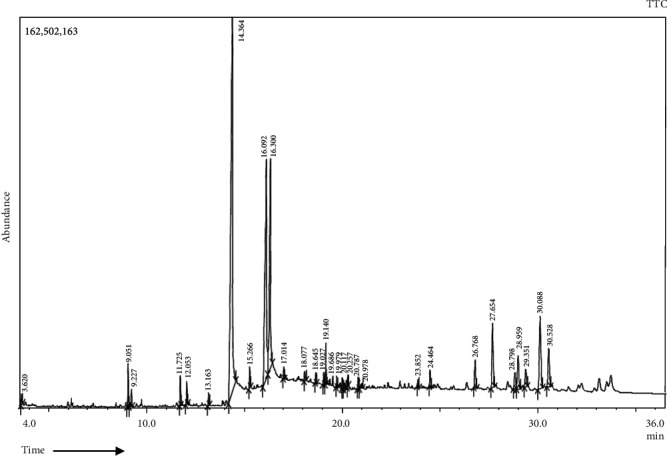
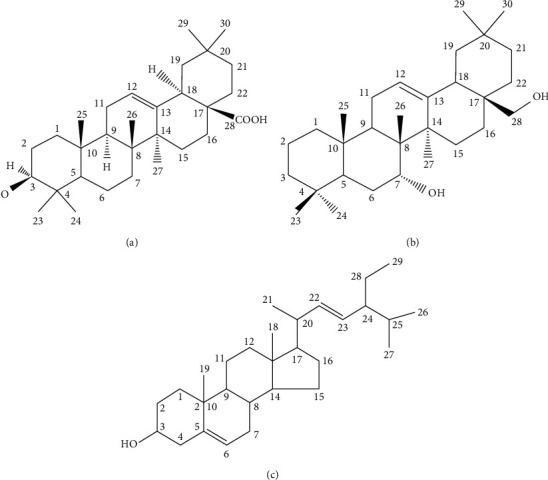
HKEx was evaluated using GC-MS and undertaken for a three-week intervention in fructose-fed STZ-induced Wistar albino rats at the doses of HKEx50, HKEx100, and HKEx200 mg/kg bw. Following intervention, blood serum was examined for biochemical markers, and liver tissue was investigated for the mRNA expression of catalase (CAT), glutathione peroxidase (GPx), and superoxide dismutase (SOD1) by RTPCR analysis. Most abundant compounds (oleanolic acid, 7, 28-olean diol, and stigmasterol) from GC-MS were chosen for the network pharmacological assay to verify function-specific gene-compound interactions using STITCH, STRING, GSEA, and Cytoscape plugin cytoHubba.
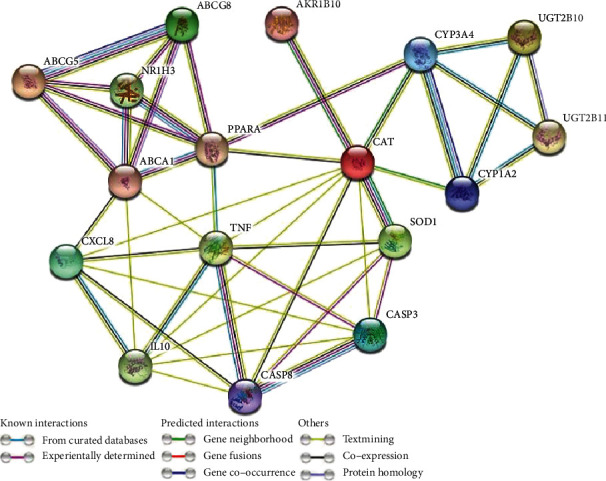
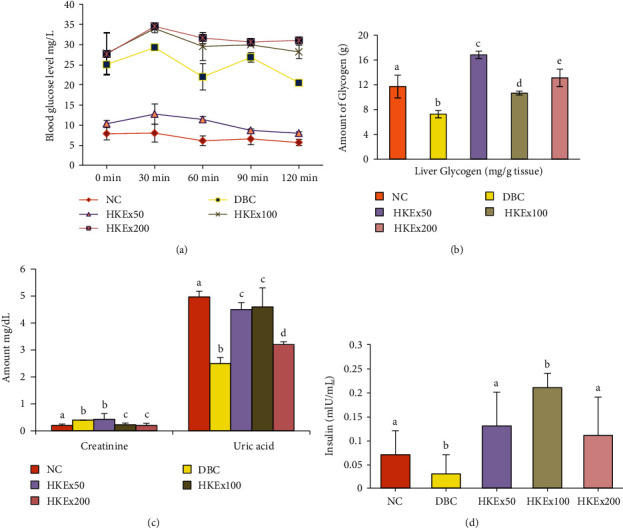
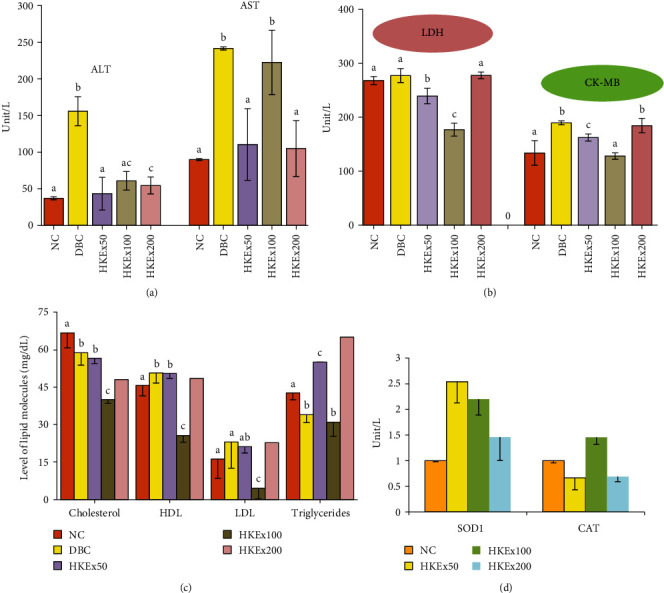
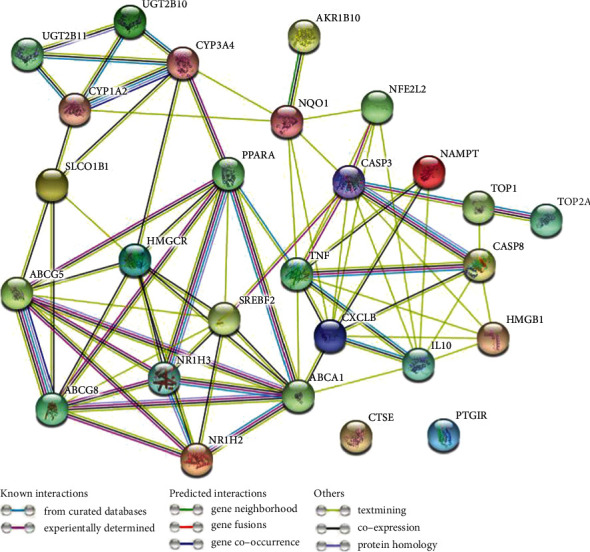
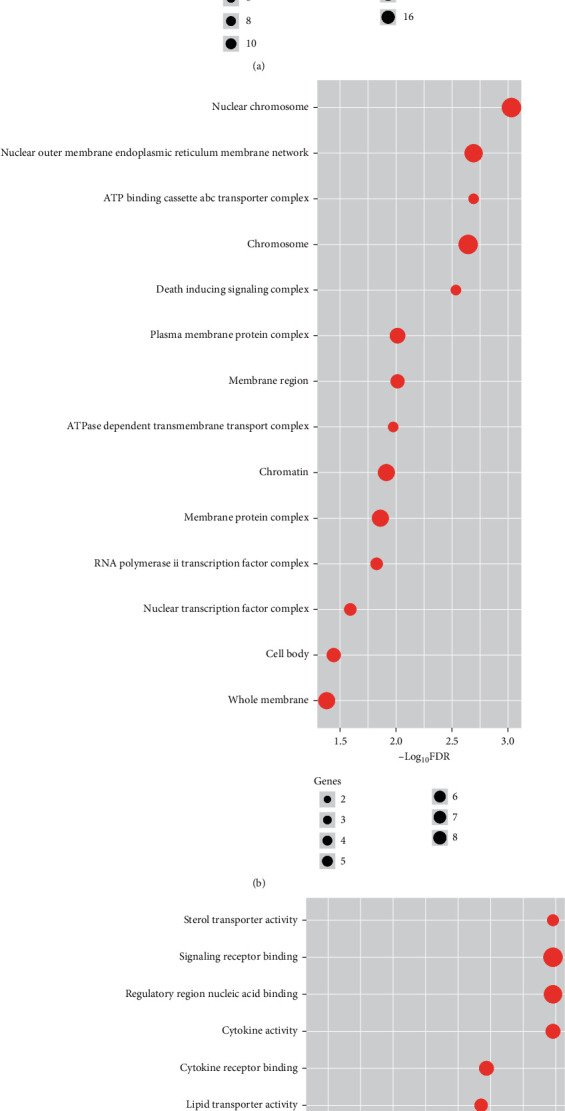
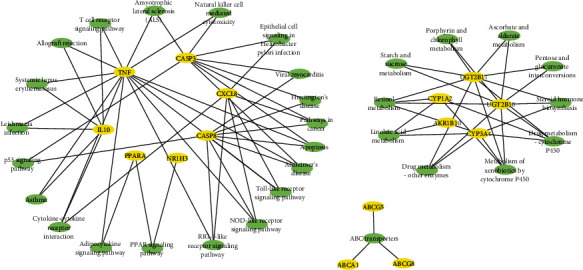
In vivo results showed a significant ( < 0.05) decrease of blood sugar, aspartate aminotransferase (AST), alanine aminotransferase (ALT), creatinine kinase (CK-MB), and lactate dehydrogenase (LDH) and increase of liver glycogen, glucose load, and serum insulin. Out of three antioxidative genes, catalase () and superoxide dismutase () were found to be few fold increased. Oleanolic acid and stigmasterol were noticed to strongly interact with 27 target proteins. Oleanolic acid interacted with the proteins AKR1B10, CASP3, CASP8, CYP1A2, CYP1A2, HMGB1, NAMPT, NFE2L2, NQO1, PPARA, PTGIR, TOP1, TOP2A, UGT2B10, and UGT2B11 and stigmasterol with ABCA1, ABCG5, ABCG8, CTSE, HMGCR, IL10, CXCL8, NR1H2, NR1H3, SLCO1B1, SREBF2, and TNF. Protein-protein interaction (PPI) analysis revealed the involvement of 25 target proteins out of twenty seven. Cytoscape plugin cytoHubba identified TNF, CXCL8, CASP3, PPARA, SREBF2, and IL10 as top hub genes. Pathway analysis identified 31 KEGG metabolic, signaling, and immunogenic pathways associated with diabetes. Notable degree of PPI enrichment showed that SOD1 and CAT are responsible for controlling signaling networks and enriched pathways.
The findings show that antioxidative genes have regulatory potential, allowing the HKEx to be employed as a possible antidiabetic source pending further validation.
Hatikana 是一种传统药用植物,用于治疗炎症、尿路结石、甲状腺肿、癌症、伤口和溃疡、胃肠道、肿瘤、破伤风、关节炎、肝损伤、神经退行性疾病等。本研究的目的是研究 Hatikana 提取物 (HKEx) 的降血糖特性,并构建其天然成分对与其相关的基因和生化指标的影响。
使用 GC-MS 对 HKEx 进行评估,并在果糖喂养的 STZ 诱导的 Wistar 白化大鼠中进行为期 3 周的干预,剂量为 HKEx50、HKEx100 和 HKEx200mg/kg bw。干预后,检测血清生化标志物,并用 RT-PCR 分析检测肝组织中天冬氨酸转氨酶 (AST)、丙氨酸转氨酶 (ALT)、肌酸激酶 (CK-MB) 和乳酸脱氢酶 (LDH) 的 CAT、GPx 和 SOD1 的 mRNA 表达。从 GC-MS 中选择最丰富的化合物(齐墩果酸、7,28-齐墩二醇和豆甾醇)进行网络药理学分析,使用 STITCH、STRING、GSEA 和 Cytoscape 插件 cytoHubba 来验证功能特异性基因-化合物相互作用。
体内结果表明,血糖 ( < 0.05)、天冬氨酸转氨酶 (AST)、丙氨酸转氨酶 (ALT)、肌酸激酶 (CK-MB) 和乳酸脱氢酶 (LDH) 显著降低,肝糖原、葡萄糖负荷和血清胰岛素水平升高。在三种抗氧化基因中,发现过氧化氢酶 () 和超氧化物歧化酶 () 倍数增加。齐墩果酸和豆甾醇被发现与 27 个靶蛋白有很强的相互作用。齐墩果酸与 AKR1B10、CASP3、CASP8、CYP1A2、CYP1A2、HMGB1、NAMPT、NFE2L2、NQO1、PPARA、PTGIR、TOP1、TOP2A、UGT2B10 和 UGT2B11 相互作用,而豆甾醇与 ABCA1、ABCG5、ABCG8、CTSE、HMGCR、IL10、CXCL8、NR1H2、NR1H3、SLCO1B1、SREBF2 和 TNF 相互作用。蛋白质-蛋白质相互作用 (PPI) 分析显示,在 27 个靶蛋白中有 25 个参与。Cytoscape 插件 cytoHubba 将 TNF、CXCL8、CASP3、PPARA、SREBF2 和 IL10 确定为顶级枢纽基因。通路分析确定了与糖尿病相关的 31 个 KEGG 代谢、信号和免疫途径。显著的 PPI 富集程度表明,SOD1 和 CAT 负责控制信号网络和富集途径。
研究结果表明,抗氧化基因具有调节潜力,使 HKEx 成为一种可能的抗糖尿病来源,有待进一步验证。