Department of Plant Science, The Pennsylvania State University, University Park, PA, 16802, USA.
Plant J. 2022 Jan;109(2):415-431. doi: 10.1111/tpj.15560. Epub 2021 Nov 29.
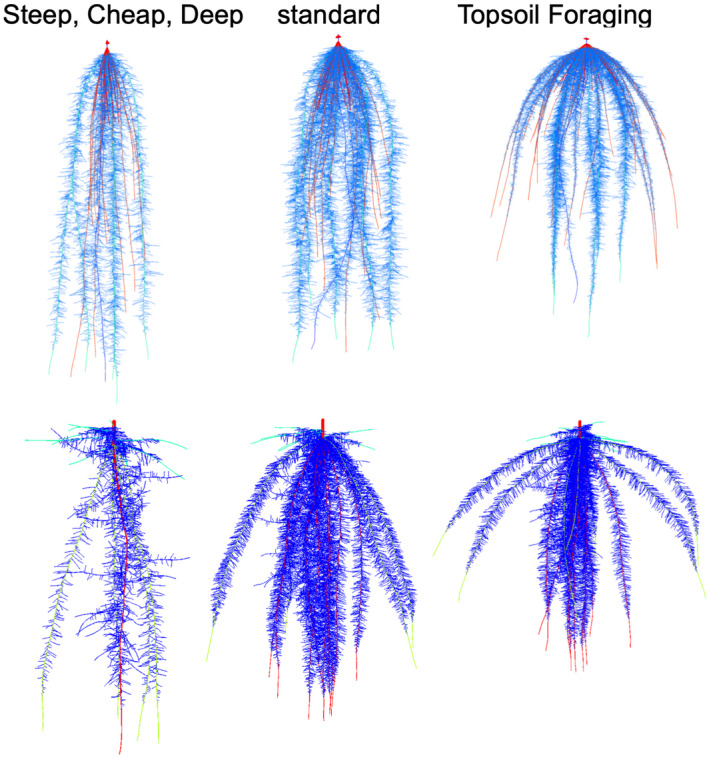
Root architecture can be targeted in breeding programs to develop crops with better capture of water and nutrients. In rich nations, such crops would reduce production costs and environmental pollution and, in developing nations, they would improve food security and economic development. Crops with deeper roots would have better climate resilience while also sequestering atmospheric CO . Deeper rooting, which improves water and N capture, is facilitated by steeper root growth angles, fewer axial roots, reduced lateral branching, and anatomical phenotypes that reduce the metabolic cost of root tissue. Mechanical impedance, hypoxia, and Al toxicity are constraints to subsoil exploration. To improve topsoil foraging for P, K, and other shallow resources, shallower root growth angles, more axial roots, and greater lateral branching are beneficial, as are metabolically cheap roots. In high-input systems, parsimonious root phenotypes that focus on water capture may be advantageous. The growing prevalence of Conservation Agriculture is shifting the mechanical impedance characteristics of cultivated soils in ways that may favor plastic root phenotypes capable of exploiting low resistance pathways to the subsoil. Root ideotypes for many low-input systems would not be optimized for any one function, but would be resilient against an array of biotic and abiotic challenges. Root hairs, reduced metabolic cost, and developmental regulation of plasticity may be useful in all environments. The fitness landscape of integrated root phenotypes is large and complex, and hence will benefit from in silico tools. Understanding and harnessing root architecture for crop improvement is a transdisciplinary opportunity to address global challenges.
根系结构可以作为作物育种的目标,以培育更好地吸收水分和养分的作物。在富裕国家,这种作物可以降低生产成本和环境污染,在发展中国家,它可以提高粮食安全和促进经济发展。具有更深根系的作物将具有更好的气候适应能力,同时还可以固存大气中的 CO2。增加根系的深度可以提高水分和氮素的吸收能力,这可以通过增加根生长角度、减少轴向根、减少侧根分支和减少根组织代谢成本的解剖学表型来实现。机械阻抗、缺氧和 Al 毒性是限制向底土探索的因素。为了改善表土对 P、K 和其他浅层资源的觅食,较浅的根生长角度、更多的轴向根和更大的侧根分支以及代谢成本较低的根是有益的。在高投入系统中,专注于水分吸收的简约根系表型可能是有利的。保护性农业的日益普及正在改变耕作土壤的机械阻抗特性,这可能有利于具有可塑性的根系表型,这些表型能够利用低阻力途径进入底土。许多低投入系统的根理想型不会针对任何单一功能进行优化,而是具有抵御各种生物和非生物挑战的弹性。根毛、降低代谢成本和可塑性的发育调节可能在所有环境中都有用。综合根系表型的适应度景观很大且复杂,因此将受益于计算机模拟工具。理解和利用根系结构来改良作物是应对全球挑战的跨学科机会。