Division of Cardiology, Department of Internal Medicine, Tongji Hospital, Tongji Medical College, Huazhong University of Science and Technology, Wuhan, Hubei 430030, P.R. China.
Department of Geriatrics, Tongji Hospital, Tongji Medical College, Huazhong University of Science and Technology, Wuhan, Hubei 430030, P.R. China.
Int J Oncol. 2021 Dec;59(6). doi: 10.3892/ijo.2021.5279. Epub 2021 Nov 2.
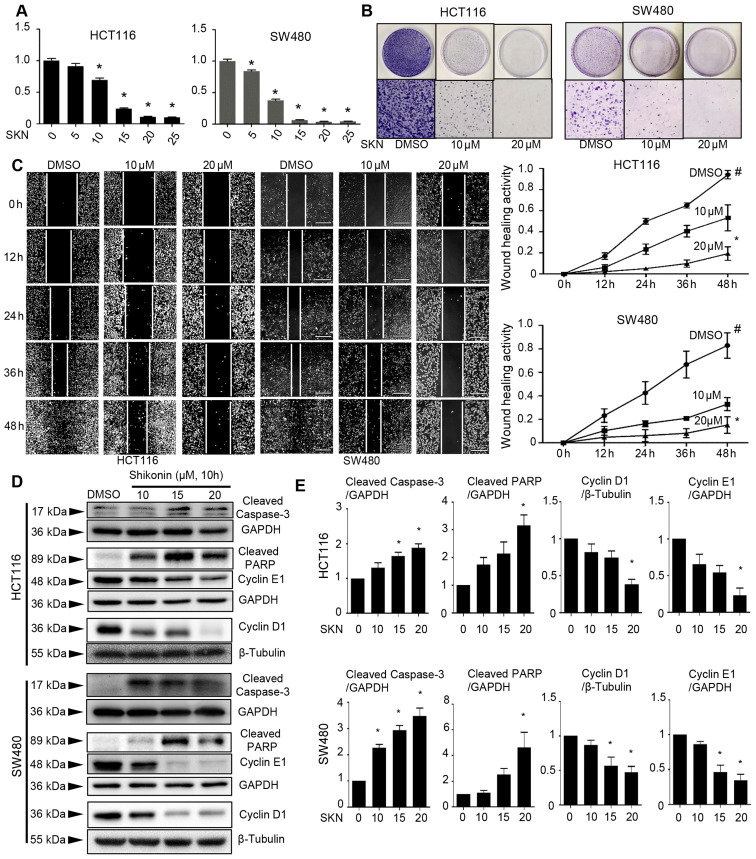
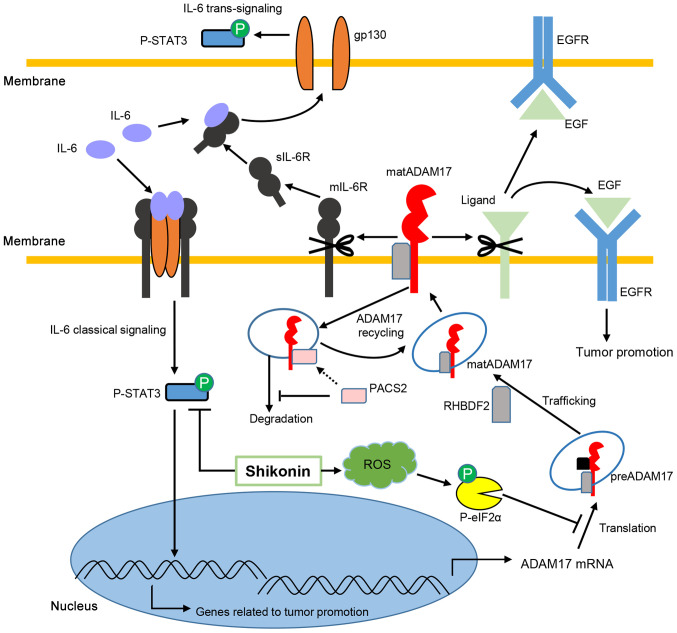
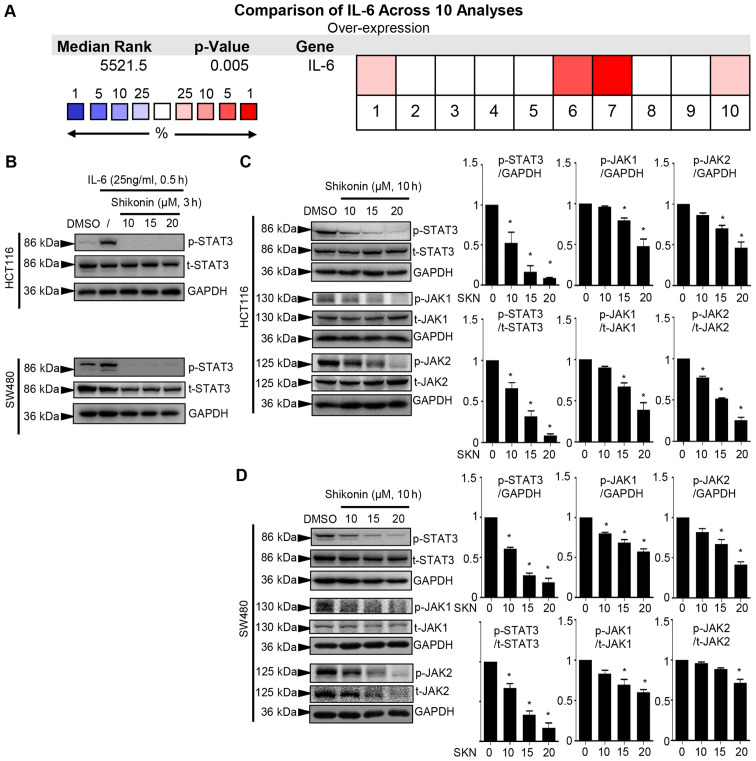
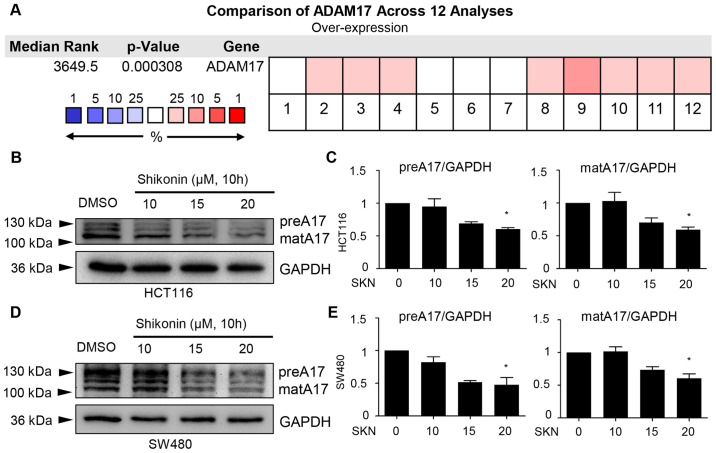
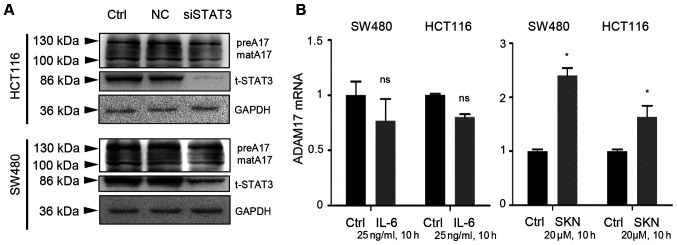
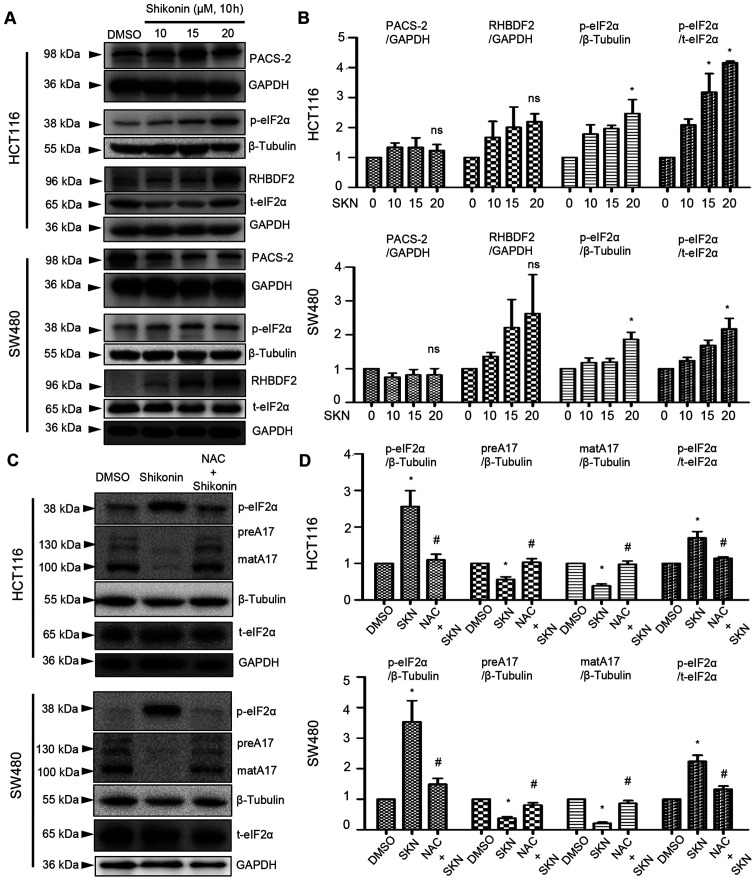
Signal transducer and activator of transcription 3 (STAT3) activation is associated with drug resistance induced by anti‑epidermal growth factor receptor (anti‑EGFR) therapy in the treatment of colon cancer. Thus, the combined inhibition of EGFR and STAT3 may prove beneficial for this type of cancer. STAT3 has been proven to play a critical role in colon cancer initiation and progression, and is considered the primary downstream effector driven by interleukin‑6 (IL‑6). A disintegrin and metalloproteinase 17 (ADAM17), documented as an oncogene, catalyzes the cleavage of both EGF and IL‑6R, inducing EGFR signaling and enabling IL‑6 ‑signaling to activate STAT3 in a wide range of cell types to promote inflammation and cancer development. As a natural product, shikonin (SKN) has been found to function as an antitumor agent; however, its role in the regulation of ADAM17 and IL‑6/STAT3 signaling in colon cancer cells remains unknown. In the present study, it was found that SKN inhibited colon cancer cell growth, suppressed both constitutive and IL‑6‑induced STAT3 phosphorylation, and downregulated the expression of ADAM17. ADAM17 expression was not altered in response to STAT3 knockdown, while IL‑6‑induced STAT3 activation did not induce ADAM17 transcripts. Furthermore, it was demonstrated that SKN did not affect the expression of key proteins involved in the maturation and degradation of ADAM17. SKN decreased ADAM17 expression possibly through reactive oxygen species (ROS)‑mediated translational inhibition, as evidenced by the increased ADAM17 mRNA and phosphorylation levels of eukaryotic initiation factor 2α (eIF2α). The expression of ADAM17 and p‑eIF2α was reversed by ‑acetylcysteine (NAC, a ROS scavenger). Taken together, these results indicate that the concurrent inhibition of ADAM17 and IL‑6/STAT3 signaling by SKN may synergistically contribute to the suppression of colon cancer cell growth.
信号转导子和转录激活子 3(STAT3)的激活与结肠癌治疗中抗表皮生长因子受体(anti-EGFR)治疗诱导的耐药性有关。因此,联合抑制 EGFR 和 STAT3 可能对这种癌症有益。STAT3 已被证明在结肠癌的发生和发展中起关键作用,并且被认为是白细胞介素 6(IL-6)驱动的主要下游效应子。一种去整合素和金属蛋白酶 17(ADAM17),被证明是一种癌基因,它催化 EGF 和 IL-6R 的裂解,诱导 EGFR 信号转导,并使 IL-6-信号转导在广泛的细胞类型中激活 STAT3,从而促进炎症和癌症的发展。紫草素(SKN)作为一种天然产物,已被发现具有抗肿瘤作用;然而,其在调节结肠癌细胞中的 ADAM17 和 IL-6/STAT3 信号通路中的作用尚不清楚。在本研究中,发现 SKN 抑制结肠癌细胞生长,抑制组成性和 IL-6 诱导的 STAT3 磷酸化,并下调 ADAM17 的表达。ADAM17 的表达不受 STAT3 敲低的影响,而 IL-6 诱导的 STAT3 激活不会诱导 ADAM17 转录物。此外,还表明 SKN 不会影响 ADAM17 成熟和降解过程中关键蛋白的表达。SKN 通过活性氧(ROS)介导的翻译抑制来降低 ADAM17 的表达,这一点可以从真核起始因子 2α(eIF2α)的 ADAM17 mRNA 和磷酸化水平增加得到证明。N-乙酰半胱氨酸(NAC,一种 ROS 清除剂)逆转了 ADAM17 的表达和 p-eIF2α。综上所述,这些结果表明,SKN 对 ADAM17 和 IL-6/STAT3 信号通路的同时抑制可能协同促进结肠癌细胞生长的抑制。