Goodday Sarah M, Karlin Emma, Alfarano Alexandria, Brooks Alexa, Chapman Carol, Desille Rachelle, Rangwala Shazia, Karlin Daniel R, Emami Hoora, Woods Nancy Fugate, Boch Adrien, Foschini Luca, Wildman Mackenzie, Cormack Francesca, Taptiklis Nick, Pratap Abhishek, Ghassemi Marzyeh, Goldenberg Anna, Nagaraj Sujay, Walsh Elaine, Friend Stephen
4YouandMe, Seattle, WA, United States.
Department of Psychiatry, University of Oxford, Oxford, United Kingdom.
JMIR Form Res. 2021 Dec 10;5(12):e32165. doi: 10.2196/32165.
Several app-based studies share similar characteristics of a light touch approach that recruit, enroll, and onboard via a smartphone app and attempt to minimize burden through low-friction active study tasks while emphasizing the collection of passive data with minimal human contact. However, engagement is a common challenge across these studies, reporting low retention and adherence.
This study aims to describe an alternative to a light touch digital health study that involved a participant-centric design including high friction app-based assessments, semicontinuous passive data from wearable sensors, and a digital engagement strategy centered on providing knowledge and support to participants.
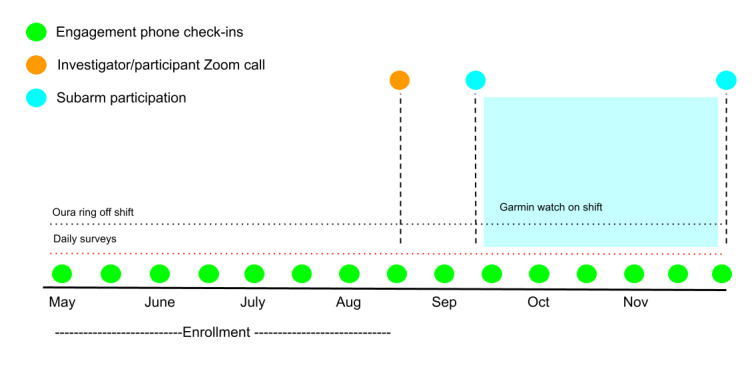
The Stress and Recovery in Frontline COVID-19 Health Care Workers Study included US frontline health care workers followed between May and November 2020. The study comprised 3 main components: (1) active and passive assessments of stress and symptoms from a smartphone app, (2) objective measured assessments of acute stress from wearable sensors, and (3) a participant codriven engagement strategy that centered on providing knowledge and support to participants. The daily participant time commitment was an average of 10 to 15 minutes. Retention and adherence are described both quantitatively and qualitatively.
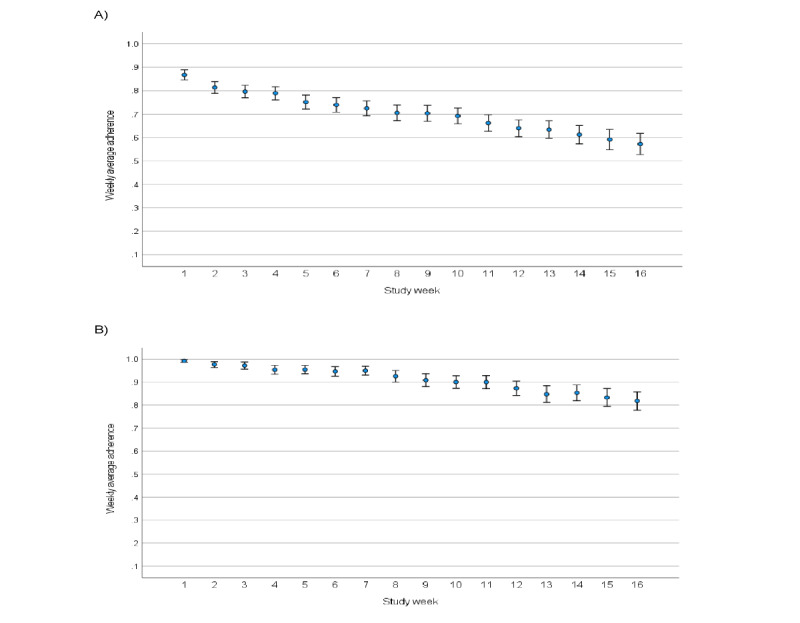
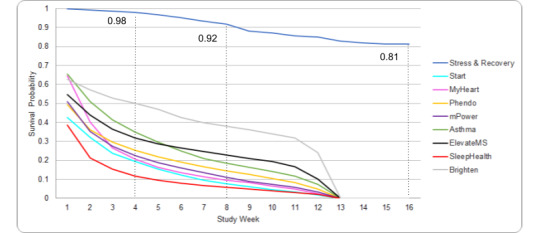
A total of 365 participants enrolled and started the study, and 81.0% (n=297) of them completed the study for a total study duration of 4 months. Average wearable sensor use was 90.6% days of total study duration. App-based daily, weekly, and every other week surveys were completed on average 69.18%, 68.37%, and 72.86% of the time, respectively.
This study found evidence for the feasibility and acceptability of a participant-centric digital health study approach that involved building trust with participants and providing support through regular phone check-ins. In addition to high retention and adherence, the collection of large volumes of objective measured data alongside contextual self-reported subjective data was able to be collected, which is often missing from light touch digital health studies.
ClinicalTrials.gov NCT04713111; https://clinicaltrials.gov/ct2/show/NCT04713111.
多项基于应用程序的研究具有相似的轻触式方法特点,即通过智能手机应用程序招募、登记和接纳参与者,并试图通过低摩擦的主动研究任务将负担降至最低,同时强调以最少的人际接触收集被动数据。然而,参与度是这些研究中普遍存在的挑战,报告显示留存率和依从性较低。
本研究旨在描述一种不同于轻触式数字健康研究的方法,该方法采用以参与者为中心的设计,包括高摩擦的基于应用程序的评估、可穿戴传感器的半连续被动数据,以及以向参与者提供知识和支持为中心的数字参与策略。
一线新冠医护人员的压力与恢复研究纳入了2020年5月至11月期间跟踪的美国一线医护人员。该研究包括3个主要部分:(1)通过智能手机应用程序对压力和症状进行主动和被动评估;(2)通过可穿戴传感器对急性压力进行客观测量评估;(3)以参与者共同驱动的参与策略,该策略以向参与者提供知识和支持为中心。参与者每天的时间投入平均为10至15分钟。对留存率和依从性进行了定量和定性描述。
共有365名参与者登记并开始了该研究,其中81.0%(n = 297)完成了为期4个月的整个研究。可穿戴传感器的平均使用天数占总研究时长的90.6%。基于应用程序的每日、每周和每两周一次的调查平均完成率分别为69.18%、68.37%和72.86%。
本研究发现了一种以参与者为中心的数字健康研究方法的可行性和可接受性的证据,该方法包括与参与者建立信任并通过定期电话回访提供支持。除了高留存率和依从性外,还能够收集大量客观测量数据以及背景下自我报告的主观数据,而这些数据在轻触式数字健康研究中往往缺失。
ClinicalTrials.gov NCT04713111;https://clinicaltrials.gov/ct2/show/NCT04713111 。