Mintairov Alexander M, Lebedev Dmitrii V, Vlasov Alexei S, Orlov Alexei O, Snider Gregory L, Blundell Steven A
Ioffe Institute, Saint Petersburg, 194021, Russia.
Electrical Engineering, University of Notre Dame, Notre Dame, IN, 46556, USA.
Sci Rep. 2021 Nov 2;11(1):21440. doi: 10.1038/s41598-021-00859-6.
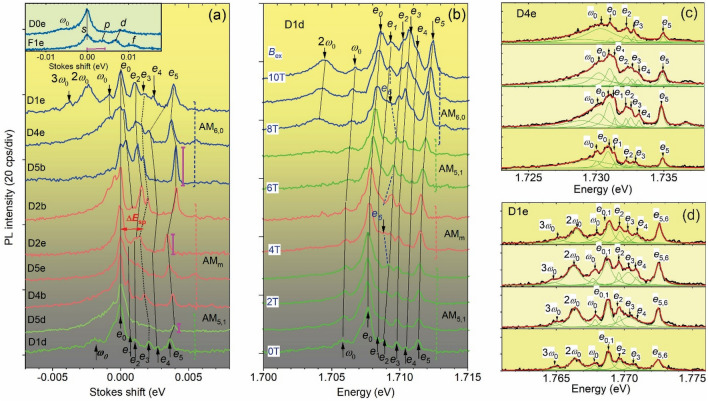
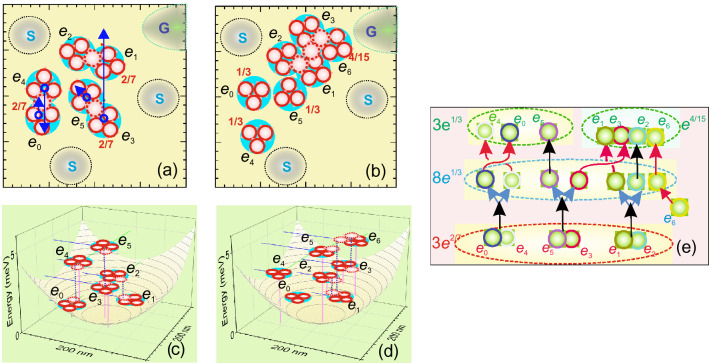
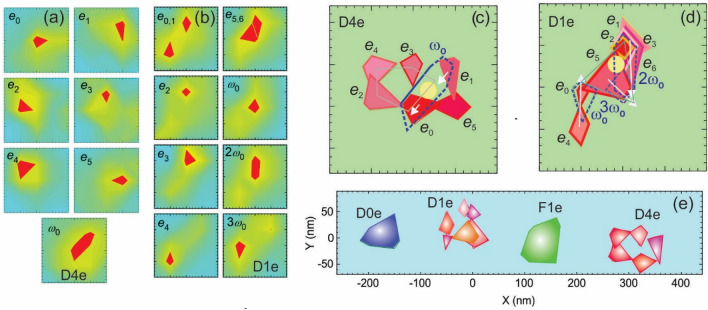
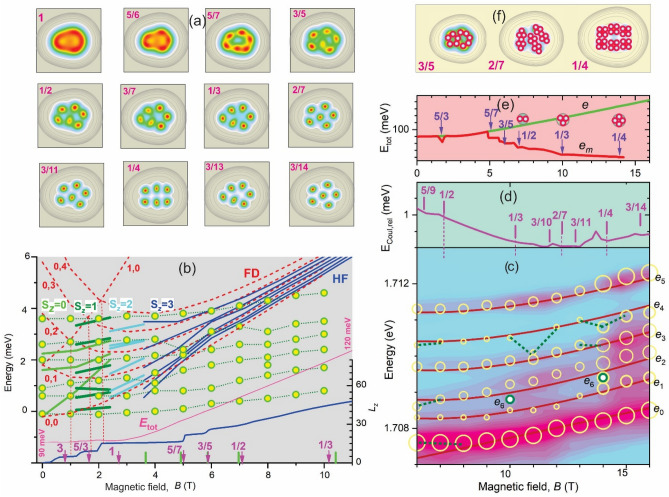
The proposal of fault-tolerant quantum computations, which promise to dramatically improve the operation of quantum computers and to accelerate the development of the compact hardware for them, is based on topological quantum field theories, which rely on the existence in Nature of physical systems described by a Lagrangian containing a non-Abelian (NA) topological term. These are solid-state systems having two-dimensional electrons, which are coupled to magnetic-flux-quanta vortexes, forming complex particles, known as anyons. Topological quantum computing (TQC) operations thus represent a physical realization of the mathematical operations involving NA representations of a braid group B, generated by a set of n localized anyons, which can be braided and fused using a "tweezer" and controlled by a detector. For most of the potential TQC material systems known so far, which are 2D-electron-gas semiconductor structure at high magnetic field and a variety of hybrid superconductor/topological-material heterostructures, the realization of anyon localization versus tweezing and detecting meets serious obstacles, chief among which are the necessity of using current control, i.e., mobile particles, of the TQC operations and high density electron puddles (containing thousands of electrons) to generate a single vortex. Here we demonstrate a novel system, in which these obstacles can be overcome, and in which vortexes are generated by a single electron. This is a ~ 150 nm size many electron InP/GaInP self-organized quantum dot, in which molecules, consisting of a few localized anyons, are naturally formed and exist at zero external magnetic field. We used high-spatial-resolution scanning magneto-photoluminescence spectroscopy measurements of a set of the dots having five and six electrons, together with many-body quantum mechanical calculations to demonstrate spontaneous formation of the anyon magneto-electron particles (e) having fractional charge ν = n/k, where n = 1-4 and k = 3-15 are the number of electrons and vortexes, respectively, arranged in molecular structures having a built-in (internal) magnetic field of 6-12 T. Using direct imaging of the molecular configurations we observed fusion and braiding of e-anyons under photo-excitation and revealed the possibility of using charge sensing for their control. Our investigations show that InP/GaInP anyon-molecule QDs, which have intrinsic transformations of localized e-anyons compatible with TQC operations and capable of being probed by charge sensing, are very promising for the realization of TQC.
容错量子计算的提议有望显著改善量子计算机的运行并加速其紧凑型硬件的开发,该提议基于拓扑量子场论,而拓扑量子场论依赖于自然界中由包含非阿贝尔(NA)拓扑项的拉格朗日量描述的物理系统的存在。这些是具有二维电子的固态系统,二维电子与磁通量量子涡旋耦合,形成称为任意子的复合粒子。因此,拓扑量子计算(TQC)操作代表了涉及辫子群B的NA表示的数学操作的物理实现,该辫子群由一组n个局域任意子生成,可以使用“镊子”进行编织和融合,并由探测器控制。对于迄今为止已知的大多数潜在TQC材料系统,即在高磁场下的二维电子气半导体结构以及各种混合超导体/拓扑材料异质结构,任意子定位与镊子操作和检测的实现遇到了严重障碍,其中主要障碍是在TQC操作中需要使用电流控制,即移动粒子,以及需要高密度电子 puddles(包含数千个电子)来产生单个涡旋。在这里,我们展示了一种新颖的系统,其中可以克服这些障碍,并且其中单个电子可以产生涡旋。这是一个尺寸约为150 nm的多电子InP/GaInP自组织量子点,其中由几个局域任意子组成的分子自然形成并存在于零外部磁场中。我们使用具有高空间分辨率的扫描磁光致发光光谱测量了一组具有五个和六个电子的量子点,并结合多体量子力学计算,证明了分数电荷ν = n/k的任意子磁电子粒子(e)的自发形成,其中n = 1 - 4且k = 3 - 15分别是电子数和涡旋数,它们排列在具有6 - 12 T的内置(内部)磁场的分子结构中。通过对分子构型的直接成像,我们观察到了光激发下e - 任意子的融合和编织,并揭示了使用电荷传感对其进行控制的可能性。我们的研究表明,InP/GaInP任意子分子量子点具有与TQC操作兼容的局域e - 任意子的固有变换,并且能够通过电荷传感进行探测,对于实现TQC非常有前景。