Cho David, Khalil Suzan, Kamath Megan, Wilhalme Holly, Lewis Angelica, Moore Melissa, Nsair Ali
Department of Medicine, Division of Cardiovascular Medicine, Ronald Reagan UCLA Medical Center, UCLA David Geffen School of Medicine, Los Angeles, California.
Department of Medicine, Statistics Core, UCLA David Geffen School of Medicine, Los Angeles, California.
Cardiovasc Digit Health J. 2021 Dec;2(6):312-322. doi: 10.1016/j.cvdhj.2021.10.005. Epub 2021 Oct 29.
The impact of telehealth on cardiovascular care during the COVID-19 pandemic on patient satisfaction and factors associated with satisfaction are not well characterized.
We conducted a nonrandomized, prospective cross-sectional survey study for outpatient telehealth cardiovascular visits over a 169-day period utilizing a validated telehealth usability questionnaire. For each variable, patients were divided into 2 groups-1 with scores above the median, labeled "greater satisfaction," and the other with scores below the median, labeled "less satisfaction."
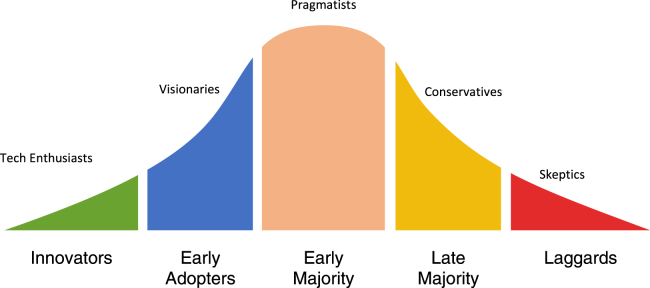
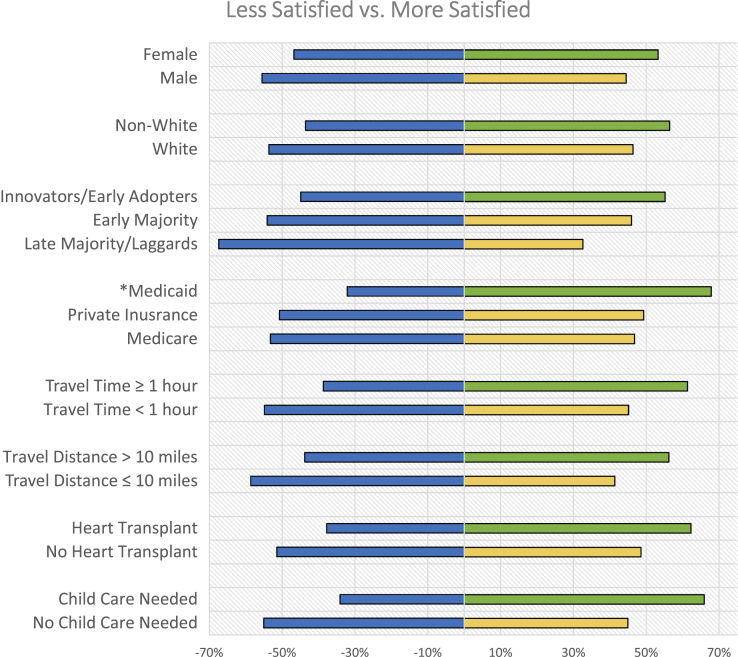
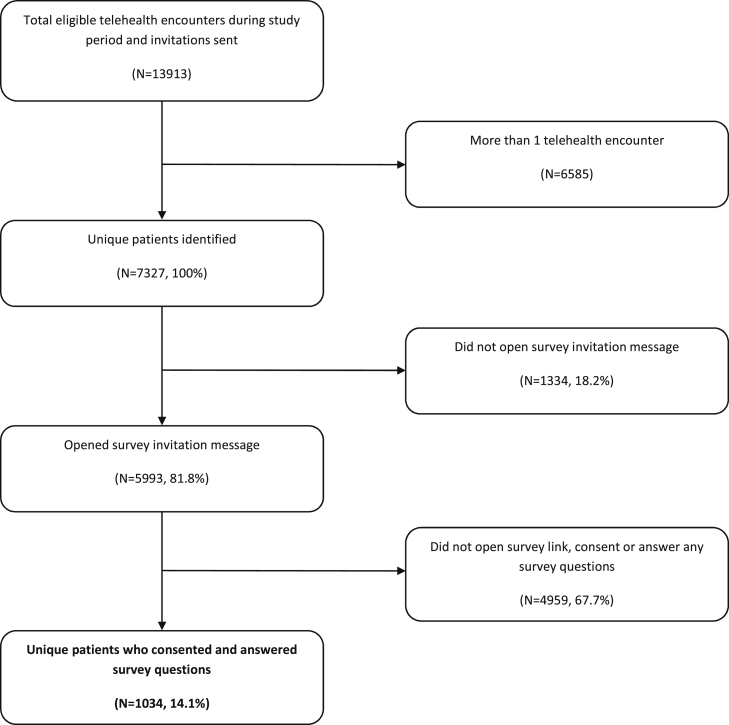
A total of 13,913 outpatient telehealth encounters were successfully completed during the study period. A total of 7327 unique patients were identified and received a survey invitation; 5993 (81.8%) patients opened the invitation, and 1034 (14.1%) patients consented and completed the survey. Overall mean and median scores were 3.15 (standard deviation 0.74) and 3.37 (interquartile range 2.73-3.68) (maximum score 4.00). Greater satisfaction was noted among younger patients (mean age 63.3 ± 14.0 years, = .005), female gender (46.3%, = .007), non-White ethnicity (24.2% = .006), self-identified early adopters and innovators of new technology (49.8%, < .001), 1-way travel time greater than 1 hour (22.3%, < .001), 1-way travel distance greater than 10 miles (49.0%, < .001), patients needing child care arrangement (16.4%, < .001), and history of orthotopic heart transplant (OHT) (5.1%, = .04).
Patients reported overall satisfaction with telehealth during the COVID-19 pandemic. Factors associated with patient convenience, along with female gender, younger age, and non-White ethnicity, correlated with greater satisfaction. Cardiovascular comorbidities did not correlate with greater satisfaction except for OHT. Further research into the impact of telehealth on patient satisfaction, safety, and clinical outcomes is needed.
在新冠疫情期间,远程医疗对心血管护理的影响以及与满意度相关的因素尚未得到充分描述。
我们进行了一项非随机的前瞻性横断面调查研究,在169天的时间里,利用经过验证的远程医疗可用性问卷对门诊远程医疗心血管就诊情况进行调查。对于每个变量,患者被分为两组,一组得分高于中位数,标记为“满意度较高”,另一组得分低于中位数,标记为“满意度较低”。
在研究期间,共成功完成了13913次门诊远程医疗会诊。总共识别出7327名独特患者并向他们发出了调查邀请;5993名(81.8%)患者打开了邀请,1034名(14.1%)患者同意并完成了调查。总体平均分和中位数分别为3.15(标准差0.74)和3.37(四分位间距2.73 - 3.68)(满分4.00)。年轻患者(平均年龄63.3 ± 14.0岁,P = 0.005)、女性(46.3%,P = 0.007)、非白人种族(24.2%,P = 0.006)、自认为是新技术的早期采用者和创新者(49.8%,P < 0.001)、单程出行时间大于1小时(22.3%,P < 0.001)、单程出行距离大于10英里(49.0%,P < 0.001)、需要安排儿童照料的患者(16.4%,P < 0.001)以及原位心脏移植(OHT)病史患者(5.1%,P = 0.04)的满意度较高。
患者报告在新冠疫情期间对远程医疗总体满意。与患者便利性相关的因素,以及女性、年轻和非白人种族,与更高的满意度相关。除了原位心脏移植外,心血管合并症与更高的满意度无关。需要进一步研究远程医疗对患者满意度、安全性和临床结局的影响。