Population Medicine and AMR Laboratory, Department of Medicine, Faculty of Veterinary Science, Bangladesh Agricultural University, Mymensingh, Bangladesh.
Department of Livestock Services, Dhaka, Bangladesh.
Vet Med Sci. 2022 Jan;8(1):187-199. doi: 10.1002/vms3.664. Epub 2021 Nov 2.
Antimicrobial resistance (AMR) has become an emerging threat worldwide, and developing countries such as Bangladesh are considered to be at greater risk of disseminating the resistant bacteria between human-animal interfaces.
The present study was carried out to determine the prevalence and AMR profile of Escherichia coli isolated from broiler chickens, the environment, and farmworkers. This study also aimed to identify the risk factors associated with multidrug-resistant (MDR) E. coli infection in broiler chickens. In addition, the presence of carbapenem resistance gene (NDM-1) was assessed.
A total of 114 E. coli isolates, recovered from 150 samples (cloacal swabs = 50, farm sewage = 50, and hand washed water of farmworkers = 50) collected from 50 broiler farms, were identified by biochemical examination and polymerase chain reaction (PCR) assay. Antimicrobial susceptibility test was performed for 10 antibiotics by disk diffusion test. Carbapenem resistance gene (NDM-1) was detected by PCR. Risk factors were identified through multivariable logistic regression.
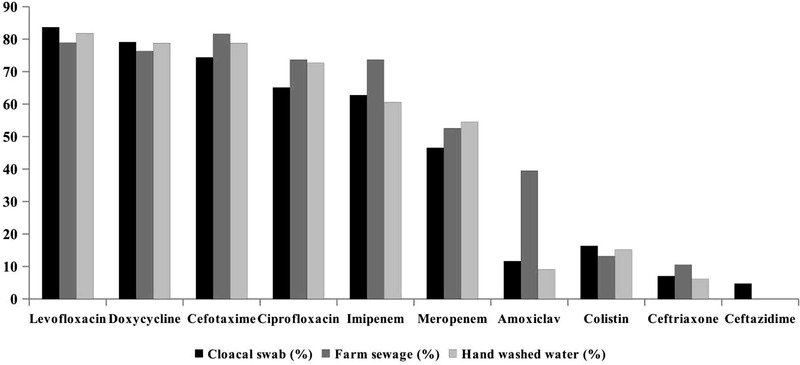
The highest prevalence of E. coli was recorded in broiler chickens (86%) and the lowest in farmworkers (66%). For MDR E. coli infection, 'winter season', 'absence of specific shoes for staff', and 'use of antibiotics without veterinarian's prescription' were the significant risk factors. High resistance of the E. coli isolates was observed against levofloxacin (81.6%), doxycycline (78.1%), cefotaxime (78.1%), and ciprofloxacin (70.2%). About 76% of the isolates demonstrated MDR. None of the isolates were positive for the NDM-1 gene.
The high level and similar pattern of antibiotic resistance in E. coli isolates from broiler chickens, farmworkers, and sewage in poultry farms indicates a good possibility of spreading the antibiotic-resistant E. coli in such settings.
抗菌药物耐药性(AMR)已成为全球范围内的新兴威胁,孟加拉国等发展中国家被认为在人与人畜界面之间传播耐药菌的风险更大。
本研究旨在确定从肉鸡、环境和农场工人中分离出的大肠杆菌的流行率和 AMR 特征,还旨在确定与肉鸡中多重耐药(MDR)大肠杆菌感染相关的危险因素。此外,还评估了碳青霉烯类耐药基因(NDM-1)的存在。
从 50 个肉鸡养殖场采集的 150 个样本(直肠拭子=50 个、农场污水=50 个和农场工人洗手水=50 个)中分离出 114 株大肠杆菌,通过生化试验和聚合酶链反应(PCR)检测进行鉴定。采用纸片扩散法对 10 种抗生素进行药敏试验。通过 PCR 检测碳青霉烯类耐药基因(NDM-1)。通过多变量逻辑回归确定危险因素。
大肠杆菌在肉鸡中的检出率最高(86%),在农场工人中最低(66%)。对于 MDR 大肠杆菌感染,“冬季”、“员工无专用鞋”和“未经兽医处方使用抗生素”是显著的危险因素。大肠杆菌分离株对左氧氟沙星(81.6%)、强力霉素(78.1%)、头孢噻肟(78.1%)和环丙沙星(70.2%)的耐药率较高。约 76%的分离株表现出 MDR。没有分离株对 NDM-1 基因呈阳性。
从肉鸡、农场工人和家禽养殖场污水中分离出的大肠杆菌对多种抗生素的高水平和相似的耐药模式表明,在这些环境中,传播具有抗药性的大肠杆菌的可能性很大。