Bridge Quality Enhancement Research Initiative Program, Center for Healthcare Organization and Implementation Research, VA Bedford Healthcare System, Bedford, Massachusetts.
Section of General Internal Medicine, Boston University School of Medicine, Boston, Massachusetts.
JAMA Netw Open. 2021 Nov 1;4(11):e2132548. doi: 10.1001/jamanetworkopen.2021.32548.
Compared with the general population, veterans are at high risk for COVID-19 and have a complex relationship with the government. This potentially affects their attitudes toward receiving COVID-19 vaccines.
To assess veterans' attitudes toward and intentions to receive COVID-19 vaccines.
DESIGN, SETTING, AND PARTICIPANTS: This cross-sectional web-based survey study used data from the Department of Veterans Affairs (VA) Survey of Healthcare Experiences of Patients' Veterans Insight Panel, fielded between March 12 and 28, 2021. Of 3420 veterans who were sent a link to complete a 58-item web-based survey, 1178 veterans (34%) completed the survey. Data were analyzed from April 1 to August 25, 2021.
Veterans eligible for COVID-19 vaccines.
The outcomes of interest were veterans' experiences with COVID-19, vaccination status and intention groups, reasons for receiving or not receiving a vaccine, self-reported health status, and trusted and preferred sources of information about COVID-19 vaccines. Reasons for not getting vaccinated were classified into categories of vaccine deliberation, dissent, distrust, indifference, skepticism, and policy and processes.
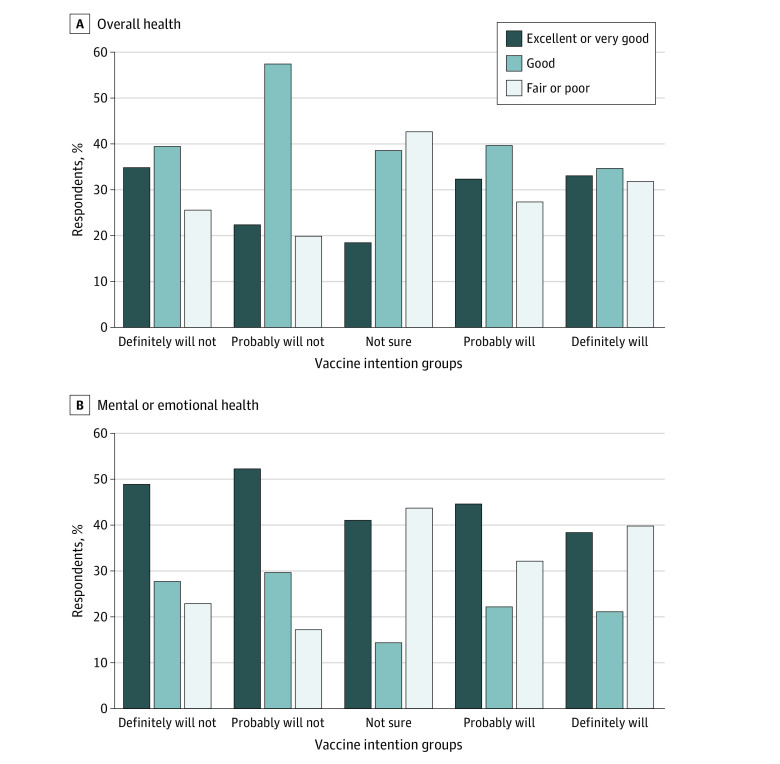
Among 1178 respondents, 974 (83%) were men, 130 (11%) were women, and 141 (12%) were transgender or nonbinary; 58 respondents (5%) were Black, 54 veterans (5%) were Hispanic or Latino, and 987 veterans (84%) were non-Hispanic White. The mean (SD) age of respondents was 66.7 (10.1) years. A total of 817 respondents (71%) self-reported being vaccinated against COVID-19. Of 339 respondents (29%) who were not vaccinated, those unsure of getting vaccinated were more likely to report fair or poor overall health (32 respondents [43%]) and mental health (33 respondents [44%]) than other nonvaccinated groups (overall health: range, 20%-32%; mental health: range, 18%-40%). Top reasons for not being vaccinated were skepticism (120 respondents [36%] were concerned about side effects; 65 respondents [20%] preferred using few medications; 63 respondents [19%] preferred gaining natural immunity), deliberation (74 respondents [22%] preferred to wait because vaccine is new), and distrust (61 respondents [18%] did not trust the health care system). Among respondents who were vaccinated, preventing oneself from getting sick (462 respondents [57%]) and contributing to the end of the COVID-19 pandemic (453 respondents [56%]) were top reasons for getting vaccinated. All veterans reported the VA as 1 of their top trusted sources of information. The proportion of respondents trusting their VA health care practitioner as a source of vaccine information was higher among those unsure about vaccination compared with those who indicated they would definitely not or probably not get vaccinated (18 respondents [26%] vs 15 respondents [15%]). There were no significant associations between vaccine intention groups and age (χ24 = 5.90; P = .21) or gender (χ22 = 3.99; P = .14).
These findings provide information needed to develop trusted messages used in conversations between VA health care practitioners and veterans addressing specific vaccine hesitancy reasons, as well as those in worse health. Conversations need to emphasize societal reasons for getting vaccinated and benefits to one's own health.
与一般人群相比,退伍军人患 COVID-19 的风险较高,并且与政府有着复杂的关系。这可能会影响他们对接受 COVID-19 疫苗的态度。
评估退伍军人对 COVID-19 疫苗的态度和接种意愿。
设计、地点和参与者:这项横断面网络调查研究使用了退伍军人事务部(VA)医疗保健体验患者退伍军人洞察小组调查的数据,于 2021 年 3 月 12 日至 28 日期间进行。在向 3420 名退伍军人发送链接以完成 58 项网络调查后,有 1178 名退伍军人(34%)完成了调查。数据于 2021 年 4 月 1 日至 8 月 25 日进行分析。
有资格接种 COVID-19 疫苗的退伍军人。
感兴趣的结果是退伍军人对 COVID-19 的体验、疫苗接种状况和接种意愿群体、接种或不接种疫苗的原因、自我报告的健康状况以及对 COVID-19 疫苗的信任和首选信息来源。不接种疫苗的原因分为疫苗审议、异议、不信任、冷漠、怀疑和政策和流程等类别。
在 1178 名受访者中,974 名(83%)是男性,130 名(11%)是女性,141 名(12%)是跨性别或非二进制性别;58 名受访者(5%)是黑人,54 名退伍军人(5%)是西班牙裔或拉丁裔,987 名退伍军人(84%)是非西班牙裔白人。受访者的平均(SD)年龄为 66.7(10.1)岁。共有 817 名受访者(71%)报告接种了 COVID-19 疫苗。在 339 名(29%)未接种疫苗的受访者中,那些不确定是否接种疫苗的人更有可能报告整体健康状况(32 名[43%])和心理健康状况(33 名[44%])不佳,而其他未接种疫苗的群体(整体健康状况:范围为 20%-32%;心理健康状况:范围为 18%-40%)。不接种疫苗的主要原因是怀疑(120 名[36%]担心副作用;65 名[20%]更喜欢使用少量药物;63 名[19%]更喜欢获得自然免疫力)、审议(74 名[22%]更喜欢等待,因为疫苗是新的)和不信任(61 名[18%]不信任医疗保健系统)。在已接种疫苗的受访者中,预防自己生病(462 名[57%])和为结束 COVID-19 大流行做出贡献(453 名[56%])是接种疫苗的主要原因。所有退伍军人都将 VA 列为他们最信任的信息来源之一。与表示肯定不会或可能不会接种疫苗的受访者相比,对疫苗接种不确定的受访者更信任他们的 VA 医疗保健从业者作为疫苗信息来源(18 名[26%]与 15 名[15%])。疫苗接种意愿群体与年龄(χ24 = 5.90;P = .21)或性别(χ22 = 3.99;P = .14)之间没有显著关联。
这些发现提供了在 VA 医疗保健从业者与退伍军人之间就特定疫苗犹豫原因以及健康状况较差的退伍军人进行对话时所需的信息。对话需要强调接种疫苗的社会原因以及对自身健康的好处。