Department of Psychology and Centre for Integrative and Applied Neuroscience, York University, 4700 Keele St., Toronto, Ontario, M3J 1P3, Canada.
Baycrest Health Sciences, Rotman Research Institute, 3560 Bathurst St, North York, ON M6A 2E1, Canada.
Ann Behav Med. 2024 Oct 18;58(11):768-777. doi: 10.1093/abm/kaae053.
Vaccine hesitancy and resistance pose significant threats to controlling pandemics and preventing infectious diseases. In a group of individuals unvaccinated against the disease caused by the SARS-CoV-2 coronavirus (COVID-19), we investigated how age, intolerance of uncertainty (IU), and their interaction affected the likelihood of having changed one's vaccination decision a year later. We hypothesized that higher IU would increase the likelihood of becoming vaccinated, particularly among individuals of younger age. We predicted that this effect would remain significant, even after controlling for delay discounting and trust in science.
The goal of this research was to understand the factors influencing changes in vaccination decisions among the vaccine hesitant.
In a larger longitudinal study, ~7,500 participants from Prolific.co completed demographic and vaccination status questions, a delay discounting task, and the Intolerance of Uncertainty Scale in June-August 2021. Approximately 3,200 participants completed a follow-up survey in July-August 2022, answering questions about vaccination status, reasons for vaccination decision, and trust in science. We analyzed data from 251 participants who initially had no intention of getting vaccinated and completed the follow-up survey; 38% reported becoming vaccinated in the intervening year.
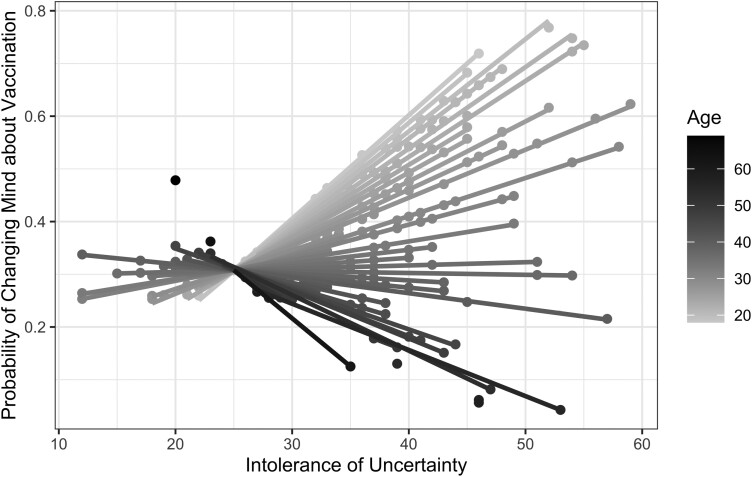
Data were analyzed using multilevel logistic regression. Over and above other factors related to vaccination decisions (delay discounting, trust in science), younger participants were more likely to change their decision and become vaccinated a year later, especially if they had higher IU, confirming our predictions. Primary reasons for becoming vaccinated were necessity and seeking protection against the virus.
These findings highlight the complex interplay between age, uncertainty, and vaccination decisions, and inform health policies by suggesting the need for tailoring interventions to specific concerns in different age groups.
疫苗犹豫和抵制对控制大流行和预防传染病构成重大威胁。在一组未接种 SARS-CoV-2 冠状病毒(COVID-19)疾病疫苗的人群中,我们研究了年龄、不确定性容忍度(IU)及其相互作用如何影响一年后改变疫苗接种决定的可能性。我们假设,较高的 IU 会增加接种疫苗的可能性,尤其是在年龄较小的人群中。我们预测,即使在控制了延迟折扣和对科学的信任之后,这种效果仍然显著。
本研究的目的是了解影响犹豫不决的疫苗接种者改变疫苗接种决定的因素。
在一项更大的纵向研究中,来自 Prolific.co 的约 7500 名参与者在 2021 年 6 月至 8 月期间完成了人口统计学和疫苗接种状况问题、延迟折扣任务和不确定性容忍度量表。大约 3200 名参与者在 2022 年 7 月至 8 月期间完成了一项后续调查,回答了有关疫苗接种状况、疫苗接种决定的原因以及对科学的信任的问题。我们分析了最初没有接种疫苗意向且完成了后续调查的 251 名参与者的数据;38%的人在这一年中报告接种了疫苗。
使用多级逻辑回归分析数据。除了与疫苗接种决策相关的其他因素(延迟折扣、对科学的信任)外,年龄较小的参与者更有可能改变他们的决定并在一年后接种疫苗,尤其是如果他们的 IU 较高,这证实了我们的预测。接种疫苗的主要原因是必要性和寻求对病毒的保护。
这些发现强调了年龄、不确定性和疫苗接种决策之间的复杂相互作用,并通过建议需要针对不同年龄组的具体关注点量身定制干预措施,为卫生政策提供了信息。