Weir Brad, Crisp David, O'Dell Christopher W, Basu Sourish, Chatterjee Abhishek, Kolassa Jana, Oda Tomohiro, Pawson Steven, Poulter Benjamin, Zhang Zhen, Ciais Philippe, Davis Steven J, Liu Zhu, Ott Lesley E
Universities Space Research Association, Columbia, MD, USA.
Global Modeling and Assimilation Office, NASA Goddard Space Flight Center, Greenbelt, MD, USA.
Sci Adv. 2021 Nov 5;7(45):eabf9415. doi: 10.1126/sciadv.abf9415. Epub 2021 Nov 3.
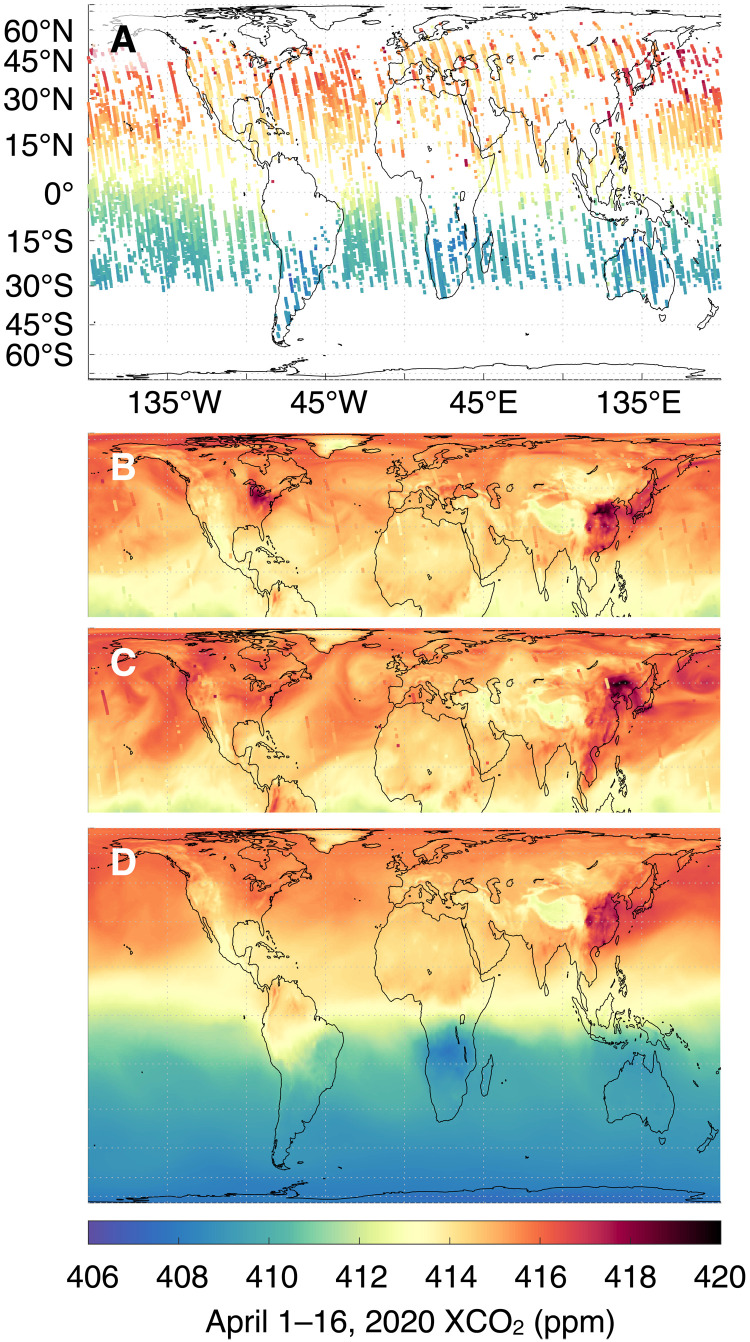
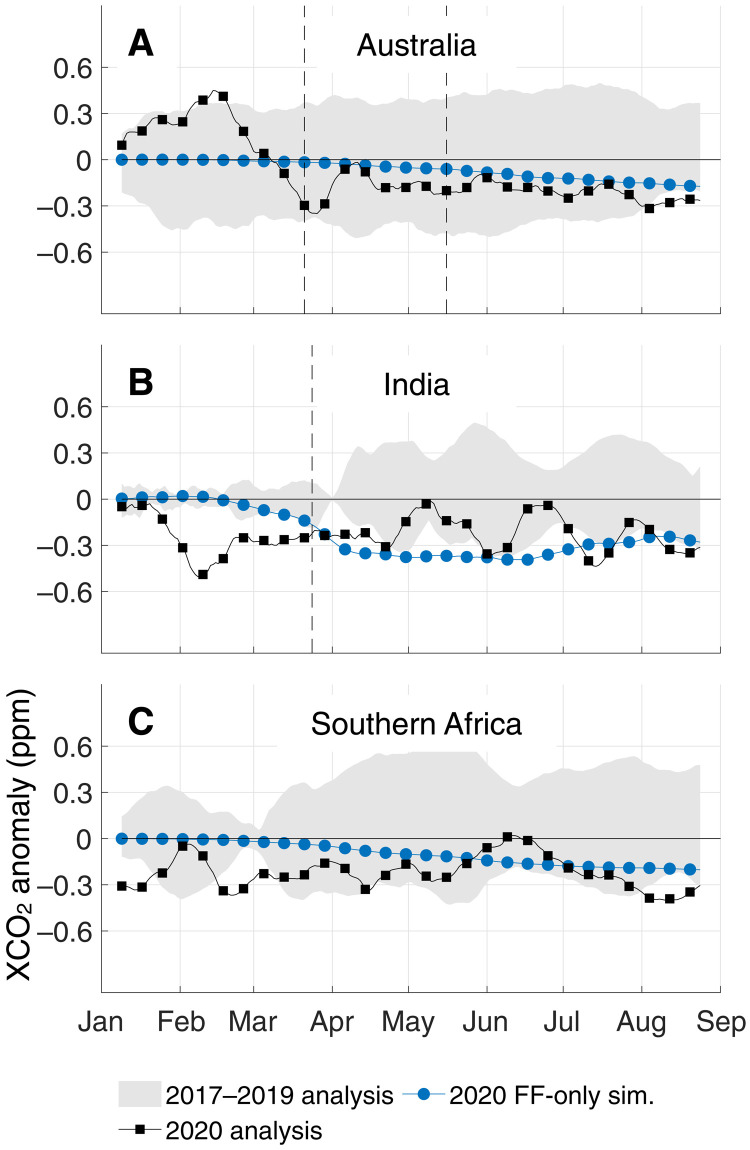
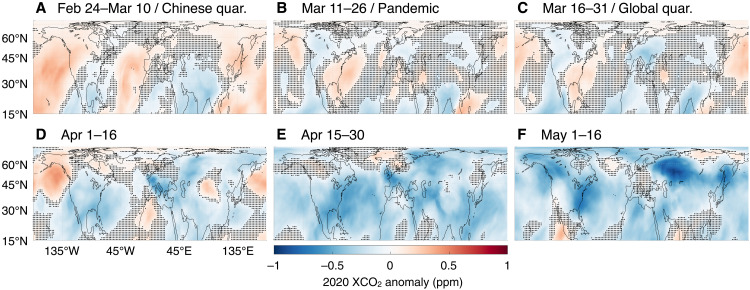
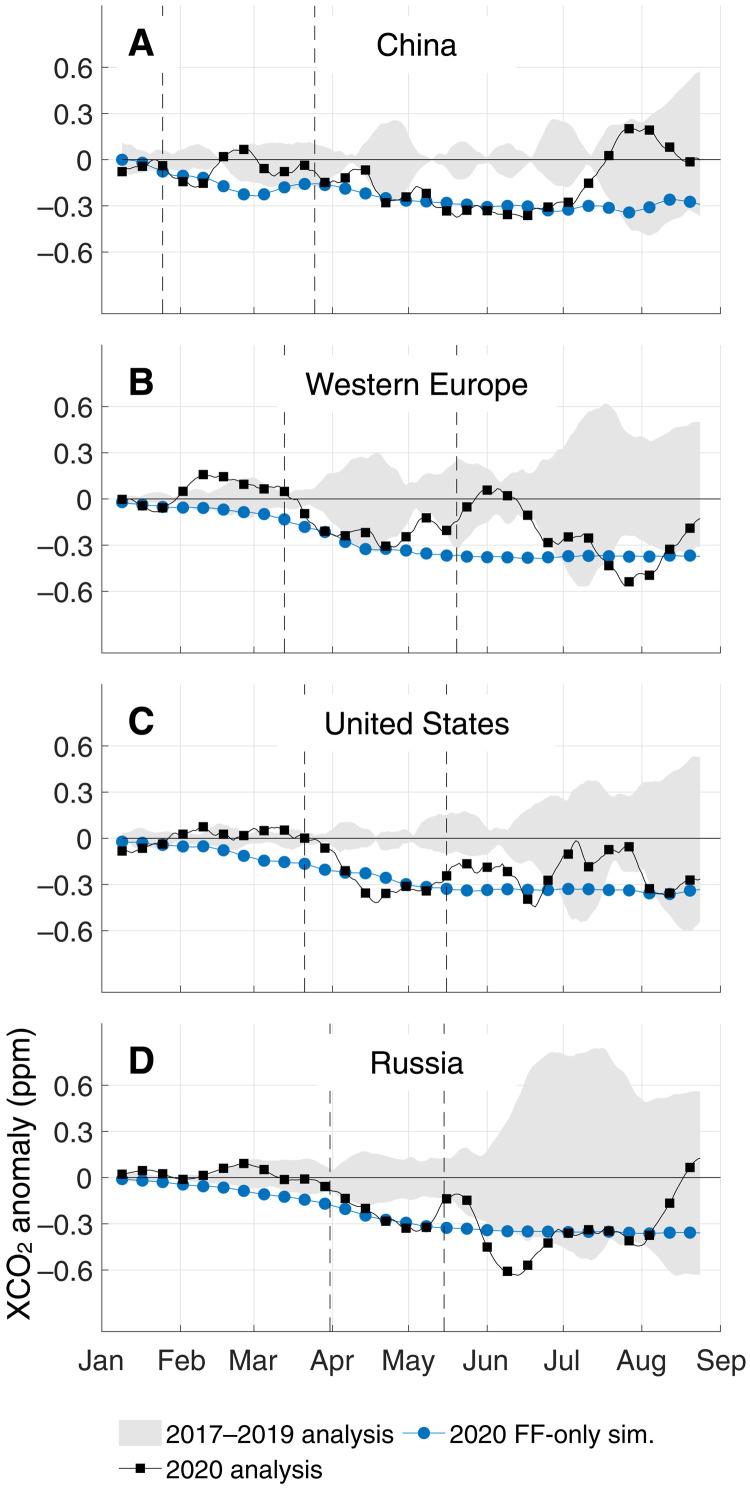
Activity reductions in early 2020 due to the coronavirus disease 2019 pandemic led to unprecedented decreases in carbon dioxide (CO) emissions. Despite their record size, the resulting atmospheric signals are smaller than and obscured by climate variability in atmospheric transport and biospheric fluxes, notably that related to the 2019–2020 Indian Ocean Dipole. Monitoring CO anomalies and distinguishing human and climatic causes thus remain a new frontier in Earth system science. We show that the impact of short-term regional changes in fossil fuel emissions on CO concentrations was observable from space. Starting in February and continuing through May, column CO over many of the world’s largest emitting regions was 0.14 to 0.62 parts per million less than expected in a pandemic-free scenario, consistent with reductions of 3 to 13% in annual global emissions. Current spaceborne technologies are therefore approaching levels of accuracy and precision needed to support climate mitigation strategies with future missions expected to meet those needs.
2020年初因2019冠状病毒病大流行导致的活动减少,致使二氧化碳(CO)排放量出现前所未有的下降。尽管这些排放量下降幅度创纪录,但由此产生的大气信号却小于大气传输和生物圈通量中的气候变率,且被后者掩盖,特别是与2019 - 2020年印度洋偶极有关的变率。因此,监测CO异常并区分人为和气候原因仍是地球系统科学的一个新前沿领域。我们表明,化石燃料排放的短期区域变化对CO浓度的影响可从太空观测到。从2月开始并持续到5月,世界许多最大排放区域的柱状CO比无疫情情况下预期的少0.14至0.62 ppm,这与全球年度排放量减少3%至13%一致。因此,当前的星载技术正接近支持气候缓解战略所需的精度水平,预计未来的任务将满足这些需求。