Schunk Fabian, Trommsdorff Gisela, Wong Natalie, Nakao Gen
Department of Psychology, University of Konstanz, Konstanz, Germany.
Department of Psychology, The Chinese University of Hong Kong, Hong Kong, China.
Front Psychol. 2021 Oct 18;12:745888. doi: 10.3389/fpsyg.2021.745888. eCollection 2021.
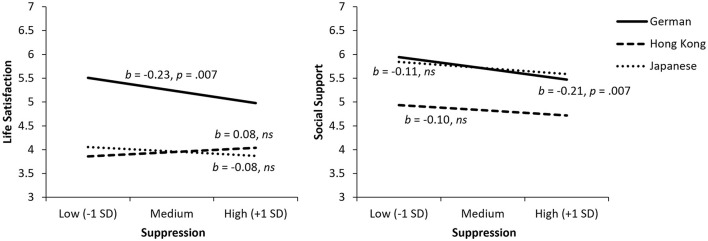
The social adaptiveness of emotion regulation (ER) may differ across cultures due to different social values for the experience and expression of emotions. Specifically, suppression might disrupt social interactions among Germans, but not among Hong Kong Chinese (HKC) and Japanese, due to an emphasis on self-expression and authenticity in Western cultures. In the present study, we examined cultural differences in associations of ER strategies with life satisfaction and social support. Extending prior research, we also test whether social support functions as a mediator for relationships between ER strategies and life satisfaction within cultural groups. University students from Germany ( = 148), Hong Kong ( = 125), and Japan ( = 127) participated in our online survey. Moderation analyses revealed that suppression was related to lower life satisfaction and less social support among Germans, but not among HKC nor Japanese. Social support completely mediated the negative relationship between suppression and life satisfaction among Germans. Furthermore, for Germans and HKC, social support partially mediated the positive relationship between reappraisal and life satisfaction, and the negative relationship between rumination and life satisfaction. Our findings suggest that cultural differences in the associations between ER and well-being might be largely explained by the differential effect of ER strategies on social functioning and adaptation in the respective cultural context.
由于不同文化中对于情感体验和表达的社会价值观不同,情绪调节(ER)的社会适应性可能因文化而异。具体而言,由于西方文化强调自我表达和真实性,抑制情绪可能会破坏德国人之间的社交互动,但不会影响中国香港人和日本人之间的社交互动。在本研究中,我们考察了情绪调节策略与生活满意度和社会支持之间关联的文化差异。在先前研究的基础上进行拓展,我们还检验了社会支持是否在文化群体中作为情绪调节策略与生活满意度之间关系的中介变量。来自德国(n = 148)、中国香港(n = 125)和日本(n = 127)的大学生参与了我们的在线调查。调节分析显示,抑制情绪与德国人较低的生活满意度和较少的社会支持相关,但在中国香港人和日本人中并非如此。社会支持完全中介了德国人中抑制情绪与生活满意度之间的负向关系。此外,对于德国人和中国香港人来说,社会支持部分中介了重新评价与生活满意度之间的正向关系,以及沉思与生活满意度之间的负向关系。我们的研究结果表明,情绪调节与幸福感之间关联的文化差异可能很大程度上是由情绪调节策略在各自文化背景下对社会功能和适应的不同影响所解释的。