Department of Internal Medicine IV, Klinikum Wels-Grieskirchen, Wels, Austria.
Paracelsus Medical University, Salzburg, Austria.
Curr Oncol Rep. 2021 Nov 4;23(12):142. doi: 10.1007/s11912-021-01136-5.
To review available data on the relationship of MDS and aging and to address the question if biological changes of (premature) aging are a prerequisite for the development of MDS.
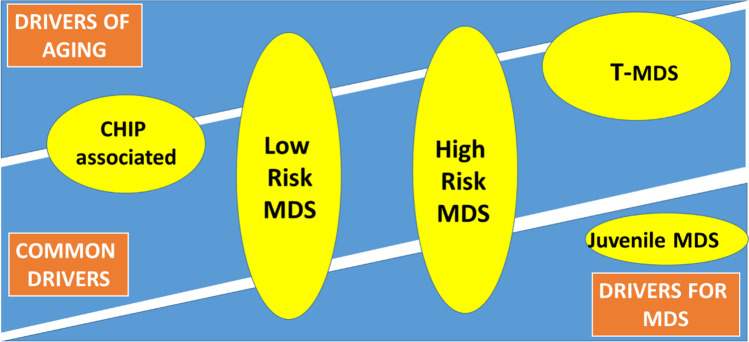
Whereas the association of MDS with advanced age and some common biologic features of aging and MDS are well established, additional evidence for both, especially on the role of stem cells, the stem cell niche, and inflammation, has been recently described. Biologically, many but not all drivers of aging also play a role in the development and propagation of MDS and vice versa. As a consequence, aging contributes to the development of MDS which can be seen as an interplay of clonal disease and normal and premature aging. The impact of aging may be different in specific MDS subtypes and risk groups.
探讨骨髓增生异常综合征(MDS)与衰老的关系,以及(过早)衰老的生物学变化是否是 MDS 发展的前提。
虽然 MDS 与高龄以及衰老和 MDS 的一些常见生物学特征有关已得到充分证实,但最近又有更多证据表明,特别是在干细胞、干细胞龛和炎症方面,情况更是如此。从生物学角度来看,许多(但不是全部)衰老驱动因素在 MDS 的发展和传播中发挥作用,反之亦然。因此,衰老导致 MDS 的发生,可以看作是克隆性疾病与正常和过早衰老相互作用的结果。衰老的影响在特定的 MDS 亚型和危险组中可能不同。