Cardiff University, Business School, Aberconway Building, Colum Dr, Cardiff, CF10 3EU, UK.
BMC Health Serv Res. 2021 Nov 5;21(1):1197. doi: 10.1186/s12913-021-07169-7.
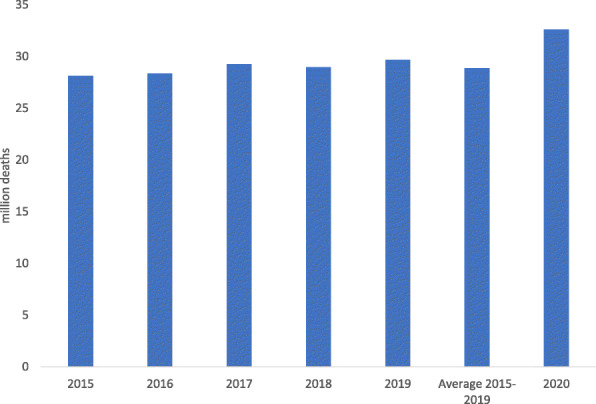
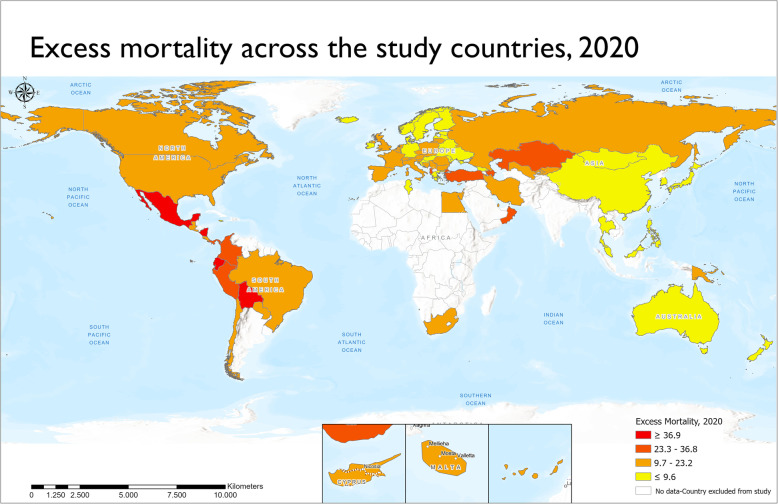
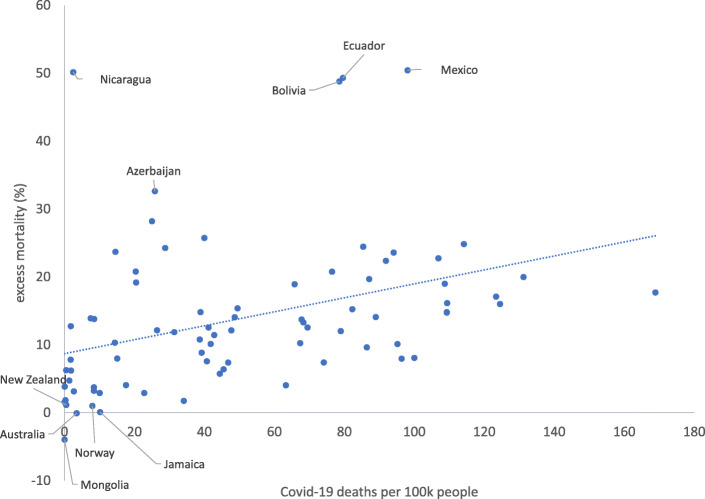
Government responses to the pandemic varied in terms of timing, duration, and stringency, seeking to protect healthcare systems, whose pre-pandemic state varied significantly. Therefore, the severity of Covid-19 and, thus, excess mortality have been unequal across counties. This paper explores the geography of excess mortality and its underlying factors in 2020, highlighting the effects of health policies pre-pandemic and strategies devised by governments to cope with Covid-19.
Excess mortality is estimated for 79 high, medium and low-income countries. The factors of excess mortality are examined employing median quantile regression analysis.
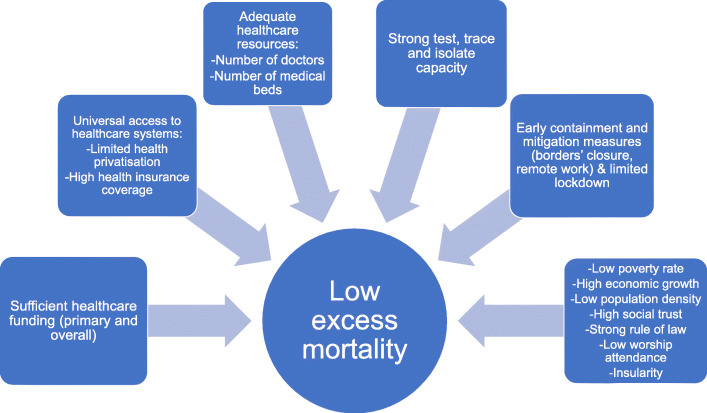
Health privatization, healthcare underfunding, and late implementation of containment and mitigation strategies were powerful drivers of excess mortality. By contrast, the results suggest a negative association of excess mortality with health expenditure, number of doctors and hospital beds, share of population covered by health insurance and test and trace capacity.
The evidence highlights the importance of sufficiently funded healthcare systems with universal access and strong primary healthcare in the battle against the pandemic. An early response to Covid-19, including borders' controls and a strong test and trace capacity, could improve epidemiological surveillance and minimize excess mortality, with stringent and lengthy lockdowns not providing a significant benefit.
各国政府在应对疫情时的反应在时机、持续时间和严格程度上存在差异,旨在保护医疗体系,而各国的医疗体系在大流行前的状况存在显著差异。因此,新冠疫情的严重程度和由此导致的超额死亡率在各国之间并不均衡。本文探讨了 2020 年超额死亡率的地理分布及其背后的因素,重点介绍了大流行前卫生政策的影响以及各国政府为应对新冠疫情而制定的策略。
对 79 个高、中、低收入国家的超额死亡率进行了估计。采用中位数分位数回归分析来检验超额死亡率的影响因素。
医疗私有化、医疗投入不足以及遏制和缓解策略的实施滞后是导致超额死亡率的主要因素。相比之下,研究结果表明,超额死亡率与卫生支出、医生和病床数量、医疗保险覆盖人口比例以及检测和追踪能力呈负相关。
这些证据凸显了拥有充足资金支持、全民覆盖和强大初级卫生保健的医疗体系在抗击大流行中的重要性。早期应对新冠疫情,包括边境管控和强大的检测和追踪能力,可以改善流行病学监测并最大限度地减少超额死亡率,而严格和长期的封锁并不能带来显著的益处。