Institute for Culture and Society, University of Navarra, Pamplona, Spain; Human Flourishing Program, Institute for Quantitative Social Science, Harvard University, Cambridge, MA, USA.
Human Flourishing Program, Institute for Quantitative Social Science, Harvard University, Cambridge, MA, USA.
J Psychiatr Res. 2022 Jun;150:237-245. doi: 10.1016/j.jpsychires.2022.03.026. Epub 2022 Apr 1.
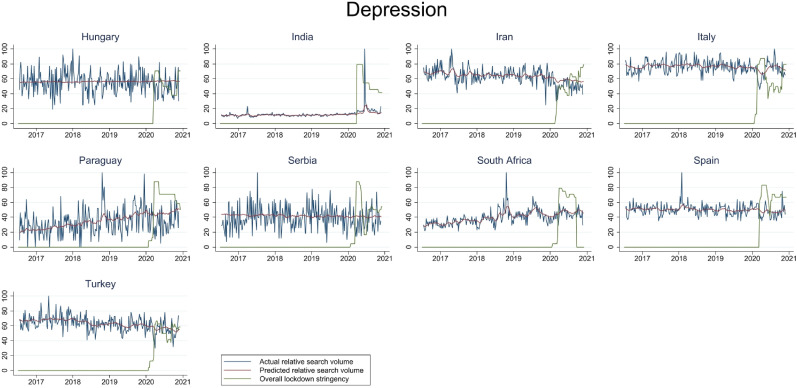
We examined the associations of lockdown stringency and duration with Google searches for four mental health concepts (i.e., "Anxiety," "Depression," "Suicide," "Mental Health") in nine countries (i.e., Hungary, India, Iran, Italy, Paraguay, Serbia, South Africa, Spain, Turkey) during the COVID-19 pandemic.
We retrieved national-level data for each country from Google Trends and the Global Panel Database of Pandemic Policies. In our primary analysis, we used data from all countries to estimate a set of multilevel regression models examining associations of overall lockdown stringency and lockdown duration with relative search volumes for each mental health term. We repeated the models after replacing overall lockdown stringency with each of the lockdown stringency components.
A negative association was found between overall lockdown stringency and "Depression." Lockdown duration and the most stringent stay-at-home requirements were negatively associated with "Anxiety." Policies that recommended or required the cancelation of public events evidenced negative associations with "Depression," whereas associations between policies that required some or all levels of schooling to close and "Depression" were positive. Policies that recommended or required workplaces to close and those that enforced quarantines on non-citizens arriving from high-risk regions or closed borders entirely were negatively associated with "Suicide."
Lockdown duration and some lockdown policies during the COVID-19 pandemic were generally associated with significantly lower, rather than higher, Google searches for selected mental health terms. These findings could be used alongside other evidence to develop future lockdown strategies that are sensitive to mental health issues during public health crises.
在 COVID-19 大流行期间,我们研究了封锁严格程度和持续时间与四个心理健康概念(即“焦虑”、“抑郁”、“自杀”、“心理健康”)在九个国家(即匈牙利、印度、伊朗、意大利、巴拉圭、塞尔维亚、南非、西班牙、土耳其)的谷歌搜索量之间的关联。
我们从谷歌趋势和大流行政策全球面板数据库中为每个国家检索了国家级数据。在我们的主要分析中,我们使用所有国家的数据来估计一组多水平回归模型,以检验总体封锁严格程度和封锁持续时间与每个心理健康术语的相对搜索量之间的关联。我们用每个封锁严格程度组成部分替换总体封锁严格程度后,重复了这些模型。
总体封锁严格程度与“抑郁”呈负相关。封锁持续时间和最严格的居家要求与“焦虑”呈负相关。建议或要求取消公共活动的政策与“抑郁”呈负相关,而要求关闭部分或全部学校与“抑郁”呈正相关的政策则相反。建议或要求关闭工作场所以及对来自高风险地区的非公民实施隔离或完全关闭边境的政策与“自杀”呈负相关。
COVID-19 大流行期间的封锁持续时间和一些封锁政策通常与选定的心理健康术语的谷歌搜索量显著降低而不是增加有关。这些发现可以与其他证据一起用于制定未来的封锁策略,这些策略在公共卫生危机期间对心理健康问题敏感。