Xuan Xiuyun, Tian Chunxia, Zhao Mengjie, Sun Yanhong, Huang Changzheng
Department of Dermatology, Union Hospital, Tongji Medical College, Huazhong University of Science and Technology, Wuhan, 430022, Hubei, China.
Department of Cardiology, Hubei Provincial Hospital of TCM, Wuhan, 430022, Hubei, China.
Cancer Cell Int. 2021 Nov 4;21(1):595. doi: 10.1186/s12935-021-02300-4.
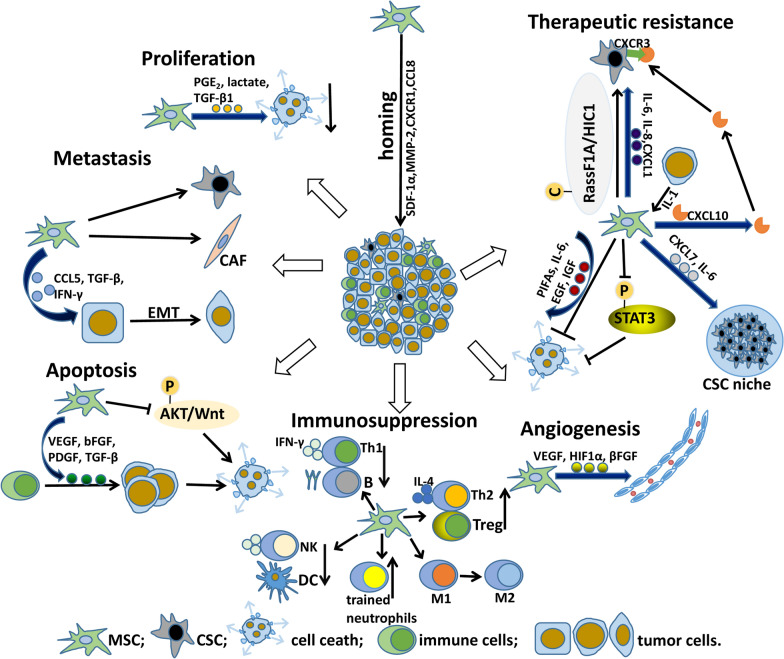
Increasing evidence indicates that the tumor microenvironment appears to play an increasingly important role in cancer progression and therapeutic resistance. Several types of cells within the tumor stroma had distinct impacts on cancer progression, either promoting or inhibiting cancer cell growth. Mesenchymal stem cells (MSCs) are a distinct type of cells that is linked to tumor development. MSCs are recognized for homing to tumor locations and promoting or inhibiting cancer cell proliferation, angiogenesis and metastasis. Moreover, emerging studies suggests that MSCs are also involved in therapeutic resistance. In this review, we analyzed the existing researches and elaborate on the functions of MSCs in cancer progression and anticancer therapeutic resistance, demonstrating that MSCs may be a viable cancer therapeutic target.
越来越多的证据表明,肿瘤微环境在癌症进展和治疗抗性中似乎发挥着越来越重要的作用。肿瘤基质中的几种细胞类型对癌症进展具有不同的影响,要么促进要么抑制癌细胞生长。间充质干细胞(MSC)是一种与肿瘤发展相关的独特细胞类型。MSC因归巢至肿瘤部位并促进或抑制癌细胞增殖、血管生成和转移而被认可。此外,新出现的研究表明,MSC也参与治疗抗性。在本综述中,我们分析了现有研究,并阐述了MSC在癌症进展和抗癌治疗抗性中的作用,证明MSC可能是一个可行的癌症治疗靶点。