Department of Radiology and Research Institute of Radiology, Asan Medical Center, University of Ulsan College of Medicine, 88 Olympic-ro, 43-gil, Songpa-gu, Seoul, 05505, Korea.
Department of Radiology and Research Institute of Radiology, University of Ulsan College of Medicine, Seoul, Korea.
Sci Rep. 2021 Nov 4;11(1):21656. doi: 10.1038/s41598-021-00161-5.
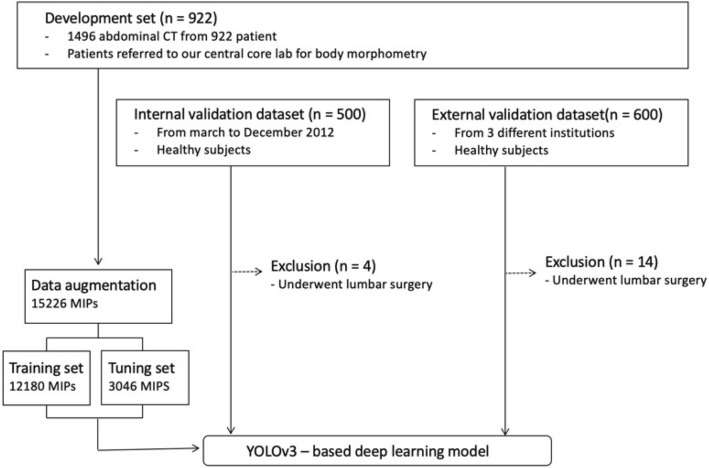
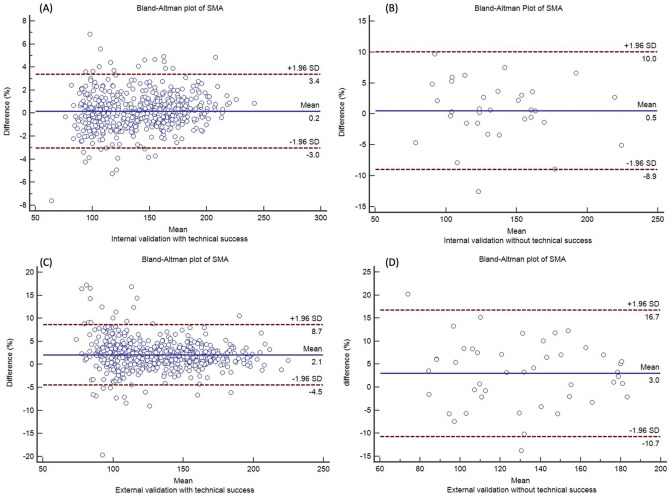
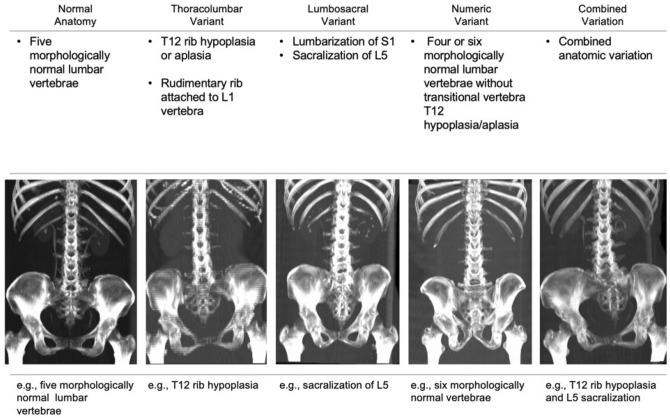
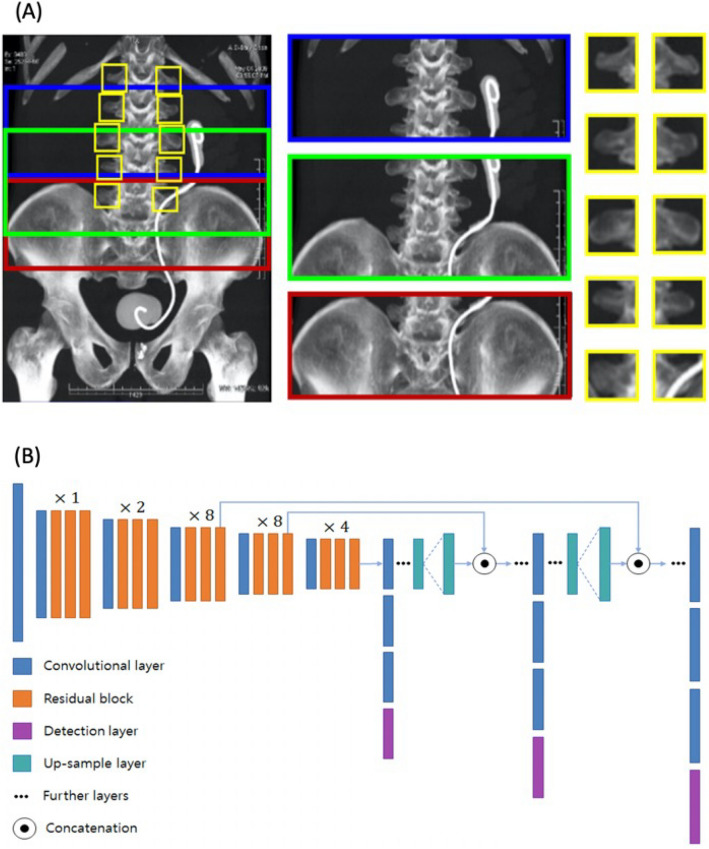
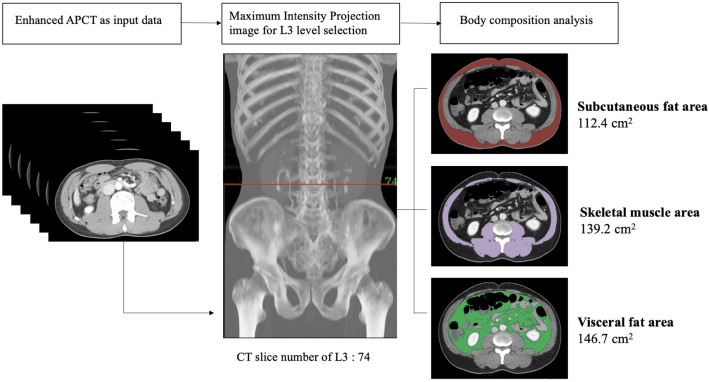
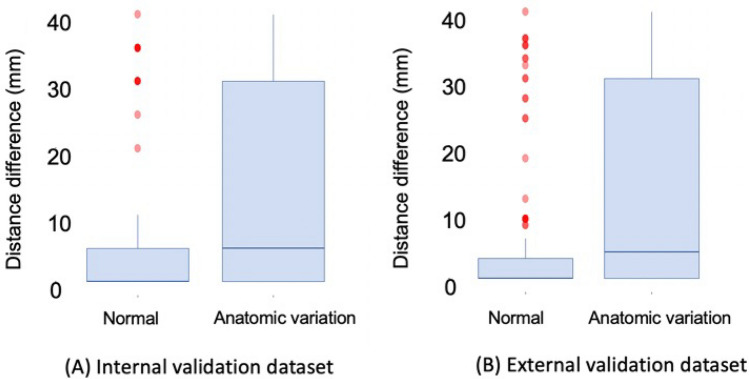
As sarcopenia research has been gaining emphasis, the need for quantification of abdominal muscle on computed tomography (CT) is increasing. Thus, a fully automated system to select L3 slice and segment muscle in an end-to-end manner is demanded. We aimed to develop a deep learning model (DLM) to select the L3 slice with consideration of anatomic variations and to segment cross-sectional areas (CSAs) of abdominal muscle and fat. Our DLM, named L3SEG-net, was composed of a YOLOv3-based algorithm for selecting the L3 slice and a fully convolutional network (FCN)-based algorithm for segmentation. The YOLOv3-based algorithm was developed via supervised learning using a training dataset (n = 922), and the FCN-based algorithm was transferred from prior work. Our L3SEG-net was validated with internal (n = 496) and external validation (n = 586) datasets. Ground truth L3 level CT slice and anatomic variation were identified by a board-certified radiologist. L3 slice selection accuracy was evaluated by the distance difference between ground truths and DLM-derived results. Technical success for L3 slice selection was defined when the distance difference was < 10 mm. Overall segmentation accuracy was evaluated by CSA error and DSC value. The influence of anatomic variations on DLM performance was evaluated. In the internal and external validation datasets, the accuracy of automatic L3 slice selection was high, with mean distance differences of 3.7 ± 8.4 mm and 4.1 ± 8.3 mm, respectively, and with technical success rates of 93.1% and 92.3%, respectively. However, in the subgroup analysis of anatomic variations, the L3 slice selection accuracy decreased, with distance differences of 12.4 ± 15.4 mm and 12.1 ± 14.6 mm, respectively, and with technical success rates of 67.2% and 67.9%, respectively. The overall segmentation accuracy of abdominal muscle areas was excellent regardless of anatomic variation, with CSA errors of 1.38-3.10 cm. A fully automatic system was developed for the selection of an exact axial CT slice at the L3 vertebral level and the segmentation of abdominal muscle areas.
随着肌肉减少症研究的日益受到重视,对 CT 上腹部肌肉定量的需求也在增加。因此,需要一种能够从头到尾自动选择 L3 层面并对肌肉进行分割的系统。我们旨在开发一种深度学习模型(DLM),以考虑解剖学变化来选择 L3 层面,并对腹部肌肉和脂肪的横截面积(CSA)进行分割。我们的 DLM 命名为 L3SEG-net,由用于选择 L3 层面的基于 YOLOv3 的算法和用于分割的全卷积网络(FCN)算法组成。基于 YOLOv3 的算法是通过使用训练数据集(n=922)进行监督学习开发的,而基于 FCN 的算法则是从之前的工作中转移过来的。我们的 L3SEG-net 通过内部(n=496)和外部验证(n=586)数据集进行验证。由经过董事会认证的放射科医师确定 L3 水平 CT 切片和解剖学变化。通过测量地面真实值和 DLM 结果之间的距离差异来评估 L3 切片选择的准确性。当距离差异小于 10mm 时,定义 L3 切片选择的技术成功。通过 CSA 误差和 DSC 值评估整体分割准确性。评估解剖学变化对 DLM 性能的影响。在内部和外部验证数据集,自动 L3 切片选择的准确性很高,平均距离差异分别为 3.7±8.4mm 和 4.1±8.3mm,技术成功率分别为 93.1%和 92.3%。然而,在解剖学变化的亚组分析中,L3 切片选择的准确性降低,距离差异分别为 12.4±15.4mm 和 12.1±14.6mm,技术成功率分别为 67.2%和 67.9%。无论解剖学变化如何,腹部肌肉区域的整体分割准确性都非常出色,CSA 误差为 1.38-3.10cm。已经开发了一种全自动系统,用于选择 L3 椎骨水平的确切轴向 CT 切片,并对腹部肌肉区域进行分割。