El-Bouri Rasheed, Taylor Thomas, Youssef Alexey, Zhu Tingting, Clifton David A
Institute of Biomedical Engineering, University of Oxford, Oxford, United Kingdom.
Prog Biomed Eng (Bristol). 2021 Apr;3(2):022002. doi: 10.1088/2516-1091/abddc5. Epub 2021 Feb 22.
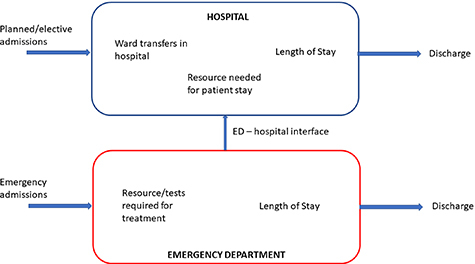
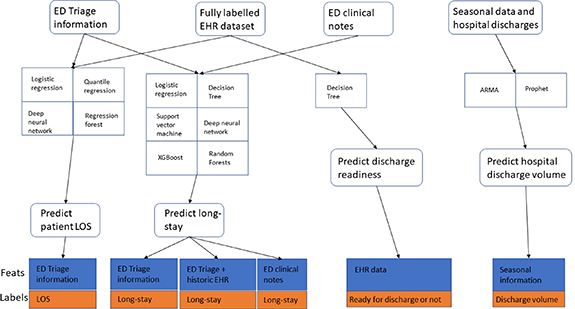
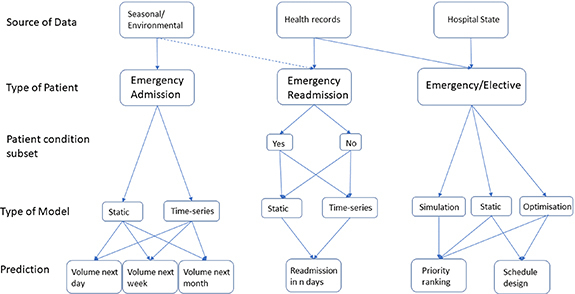
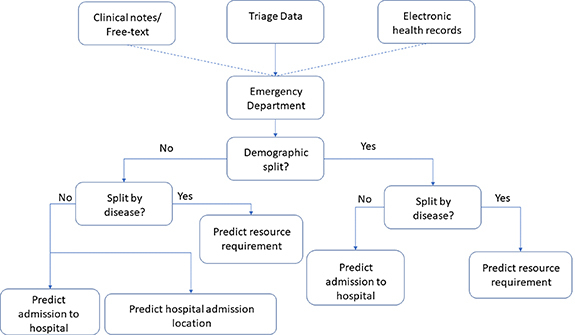
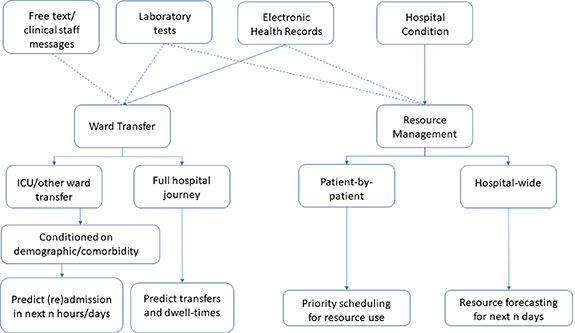
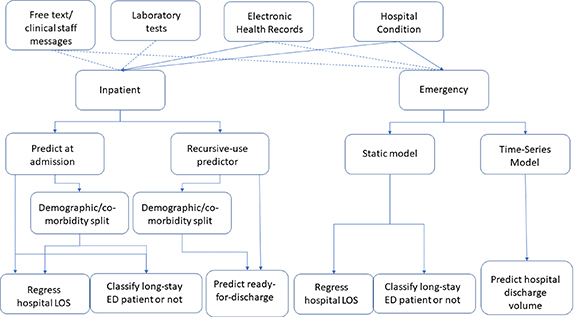
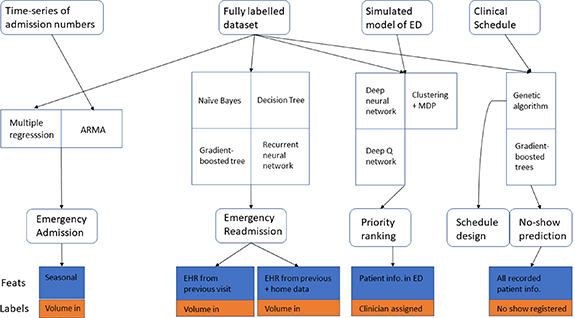
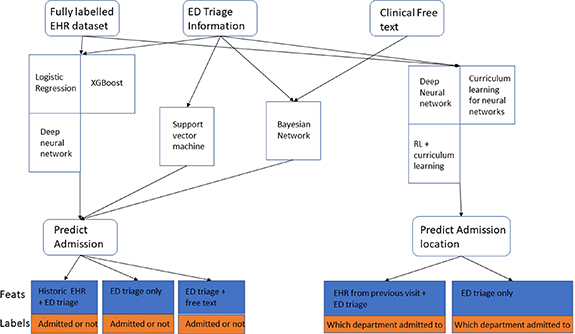
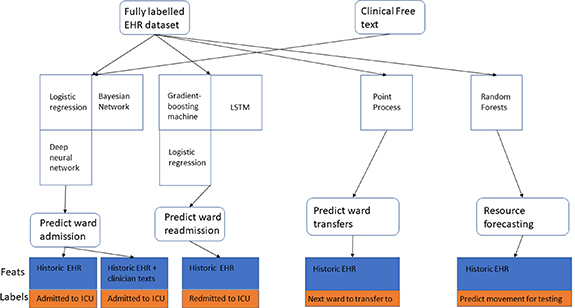
This work is a review of the ways in which machine learning has been used in order to plan, improve or aid the problem of moving patients through healthcare services. We decompose the patient flow problem into four subcategories: prediction of demand on a healthcare institution, prediction of the demand and resource required to transfer patients from the emergency department to the hospital, prediction of potential resource required for the treatment and movement of inpatients and prediction of length-of-stay and discharge timing. We argue that there are benefits to both approaches of considering the healthcare institution as a whole as well as the patient by patient case and that ideally a combination of these would be best for improving patient flow through hospitals. We also argue that it is essential for there to be a shared dataset that will allow researchers to benchmark their algorithms on and thereby allow future researchers to build on that which has already been done. We conclude that machine learning for the improvement of patient flow is still a young field with very few papers tailor-making machine learning methods for the problem being considered. Future works should consider the need to transfer algorithms trained on a dataset to multiple hospitals and allowing for dynamic algorithms which will allow real-time decision-making to help clinical staff on the shop floor.
这项工作是对机器学习在规划、改善或辅助患者在医疗服务流程中流转问题方面所采用方式的综述。我们将患者流程问题分解为四个子类别:医疗机构需求预测、患者从急诊科转至医院所需需求及资源预测、住院患者治疗和转运所需潜在资源预测以及住院时长和出院时间预测。我们认为,将医疗机构视为一个整体以及逐例考虑患者这两种方法都有其益处,理想情况下,将两者结合对于改善医院内的患者流程最为有利。我们还认为,必须要有一个共享数据集,以便研究人员在其上对其算法进行基准测试,从而使未来的研究人员能够在前人已做工作的基础上继续开展研究。我们得出结论,利用机器学习改善患者流程仍是一个新兴领域,专门针对所考虑问题量身定制机器学习方法的论文非常少。未来的工作应考虑将在一个数据集上训练的算法应用于多家医院的需求,以及开发动态算法,以实现实时决策,帮助一线临床工作人员。