Department of Health and Welfare Services, National Institute of Public Health, Wako, Saitama, Japan.
Department of Public Health, Health Management and Policy, Nara Medical University, Kashihara, Nara, Japan.
JAMA Netw Open. 2021 Nov 1;4(11):e2131884. doi: 10.1001/jamanetworkopen.2021.31884.
Although research has shown that centenarians tend to experience shorter periods of serious illness compared with other age groups, few studies have focused on the medical expenditures of centenarians as a potential indicator of the scale of medical resources used in their last year of life.
To compare Japanese centenarians' and noncentenarians' monthly medical expenditures during the year before death according to age and sex.
DESIGN, SETTING, AND PARTICIPANTS: This retrospective cohort study used linked national health and long-term care insurance data collected from April 2013 to March 2018 in Nara Prefecture, Japan, for residents aged 75 years or older who were insured under the Medical Care System for older adults and died between April 2014 and March 2018. Data were analyzed from April 2013 to March 2018.
Age of 100 years or older (centenarians) vs 75 to 99 years (noncentenarians).
The numbers of unique inpatients and outpatients and medical expenditures related to decedents' hospitalization and outpatient care were extracted and analyzed based on sex and age group. The Jonckheere-Terpstra test was used to identify trends in unadjusted medical expenditures by age group, and generalized estimating equations were used to estimate monthly median expenditures by age group with adjustment for comorbidity burden and functional status.
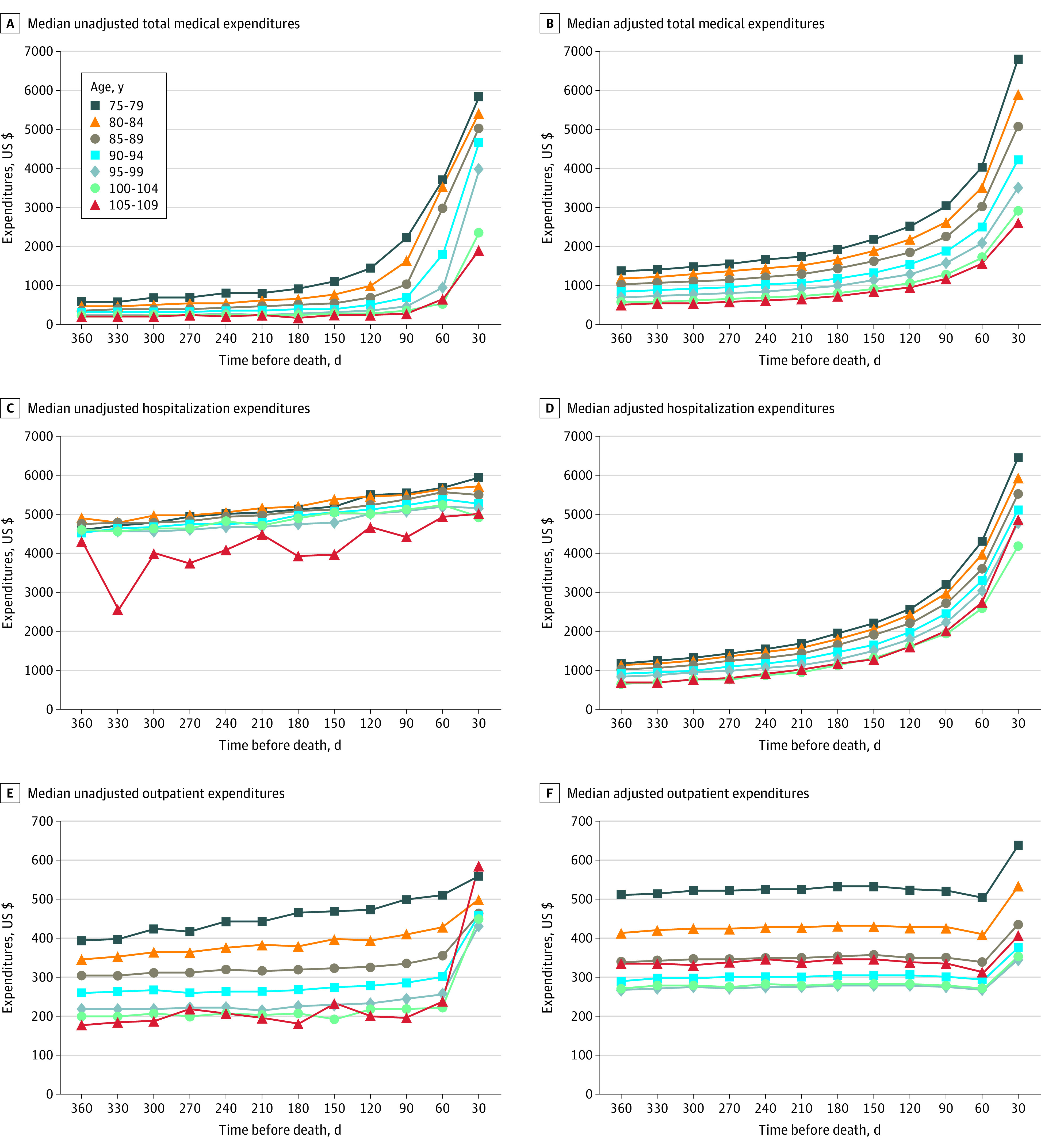
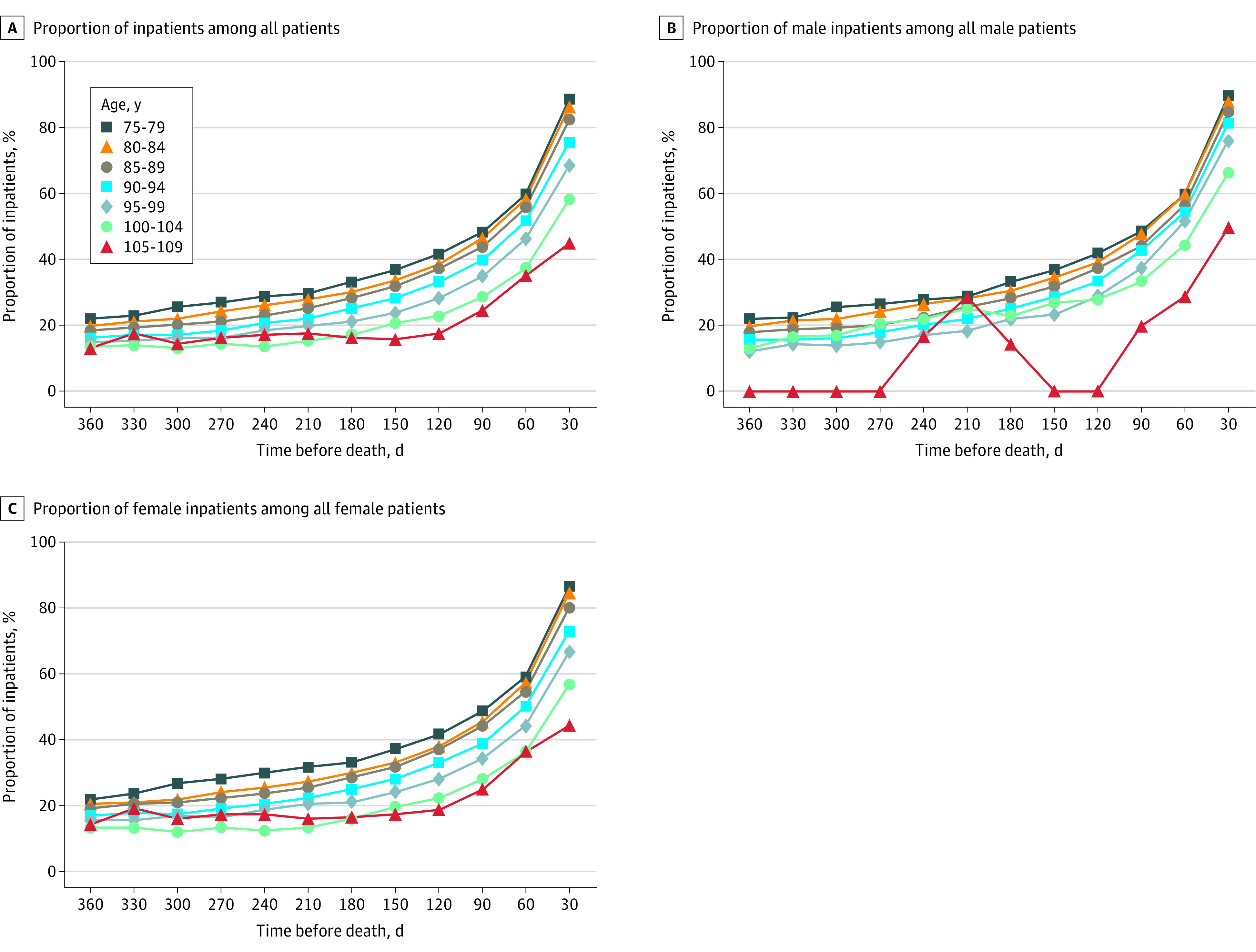
Of 34 317 patients aged 75 to 109 years (16 202 men [47.2%] and 18 115 women [52.8%]) who died between April 2014 and March 2018, 872 (2.5%) were aged 100 to 104 years (131 men [15.0%] and 741 women [85.0%]) and 78 (0.2%) were aged 105 to 109 years (fewer than 10 were men). The analysis of unadjusted medical expenditures in the last year of life showed a significant trend of lower expenditures for the older age groups; the median adjusted total expenditures during the 30 days before death by age group were $6784 (IQR, $4884-$9703) for ages 75 to 79 years, $5894 (IQR, $4292-$8536) for 80 to 84 years, $5069 (IQR, $3676-$7150) for 85 to 89 years, $4205 (IQR, $3085-$5914) for 90 to 94 years, $3522 (IQR, $2626-$4861) for 95 to 99 years, $2898 (IQR, $2241-$3835) for 100 to 104 years, and $2626 (IQR, $1938-$3527) for 105 to 109 years. The proportion of inpatients among all patients in the year before death also decreased with increasing age: 4311 of all 4551 patients aged 75 to 79 years (94.7%); 43 of all 78 patients aged 105 to 109 years (55.1%); 2831 of 2956 men aged 75 to 79 years (95.8%); 50.0% of men aged 105 to 109 years (the number is not reported owing to the small sample size); 1480 of 1595 women aged 75 to 79 years (92.8%); and 55.7% of women aged 105 to 109 years (the number of women is not reported to prevent back-calculation of the number of men). Specifically, 274 of 872 patients aged 100 to 104 years (31.4%) and 35 of 78 patients aged 105 to 109 years (44.9%) had not been admitted to a hospital in the year before death.
This cohort study found that medical expenditures in the last year of life tended to be lower for centenarians than for noncentenarians aged 75 years or older in Japan. The proportion of inpatients also decreased with increasing age. These findings may inform future health care services coverage and policies for centenarians.
重要性:尽管研究表明,与其他年龄组相比,百岁老人在严重疾病期间的时间往往较短,但很少有研究关注百岁老人作为其生命最后一年使用医疗资源规模的潜在指标的医疗支出。
目的:根据年龄和性别比较日本百岁老人和非百岁老人在死亡前一年每月的医疗支出。
设计、设置和参与者:本回顾性队列研究使用了 2013 年 4 月至 2018 年 3 月期间在奈良县收集的全国健康和长期护理保险数据,该研究针对年龄在 75 岁或以上、受老年人医疗保险制度保障且在 2014 年 4 月至 2018 年 3 月期间死亡的居民。数据从 2013 年 4 月分析至 2018 年 3 月。
暴露:年龄 100 岁或以上(百岁老人)与 75 至 99 岁(非百岁老人)。
主要结果和措施:根据性别和年龄组提取并分析了与死者住院和门诊护理相关的独特住院人数和门诊人数以及医疗支出。使用 Jonckheere-Terpstra 检验识别按年龄组调整的未调整医疗支出趋势,使用广义估计方程估计按年龄组调整共病负担和功能状态后的每月中位数支出。
结果:在 2014 年 4 月至 2018 年 3 月期间死亡的 75 至 109 岁患者(16202 名男性[47.2%]和 18115 名女性[52.8%])中,有 872 名(2.5%)年龄在 100 至 104 岁(131 名男性[15.0%]和 741 名女性[85.0%]),78 名(0.2%)年龄在 105 至 109 岁(不到 10 名男性)。对生命最后一年未调整医疗支出的分析显示,年龄较大的组支出呈明显下降趋势;按年龄组划分的死亡前 30 天的调整总支出中位数为:75 至 79 岁年龄组为 6784 美元(IQR,4884 美元至 9703 美元),80 至 84 岁年龄组为 5894 美元(IQR,4292 美元至 8536 美元),85 至 89 岁年龄组为 5069 美元(IQR,3676 美元至 7150 美元),90 至 94 岁年龄组为 4205 美元(IQR,3085 美元至 5914 美元),95 至 99 岁年龄组为 3522 美元(IQR,2626 美元至 4861 美元),100 至 104 岁年龄组为 2898 美元(IQR,2241 美元至 3835 美元),105 至 109 岁年龄组为 2626 美元(IQR,1938 美元至 3527 美元)。在死亡前一年所有患者中,住院患者的比例也随年龄增长而下降:75 至 79 岁年龄组的所有 4551 名患者中,有 4311 名(94.7%)住院;105 至 109 岁年龄组的所有 78 名患者中,有 43 名(55.1%)住院;75 至 79 岁年龄组的所有 2956 名男性患者中,有 2831 名(95.8%)住院;105 至 109 岁年龄组的男性患者中,50.0%(由于样本量小,未报告人数)住院;75 至 79 岁年龄组的所有 1595 名女性患者中,有 1480 名(92.8%)住院;105 至 109 岁年龄组的女性患者中,55.7%(由于无法防止回溯计算男性人数,未报告女性人数)住院。具体而言,100 至 104 岁年龄组的 872 名患者中有 274 名(31.4%)和 105 至 109 岁年龄组的 78 名患者中有 35 名(44.9%)在生命的最后一年未住院治疗。
结论和相关性:本队列研究发现,与 75 岁或以上的非百岁老人相比,日本百岁老人在生命的最后一年的医疗支出往往较低。住院患者的比例也随年龄增长而下降。这些发现可能为百岁老人的未来医疗保健服务覆盖范围和政策提供信息。