Department of Ophthalmology, Ribera Povisa Hospital, Vigo, Spain.
Department of Ophthalmology, Alava University Hospital, Vitoria, Spain.
Sci Rep. 2021 Nov 5;11(1):21748. doi: 10.1038/s41598-021-00923-1.
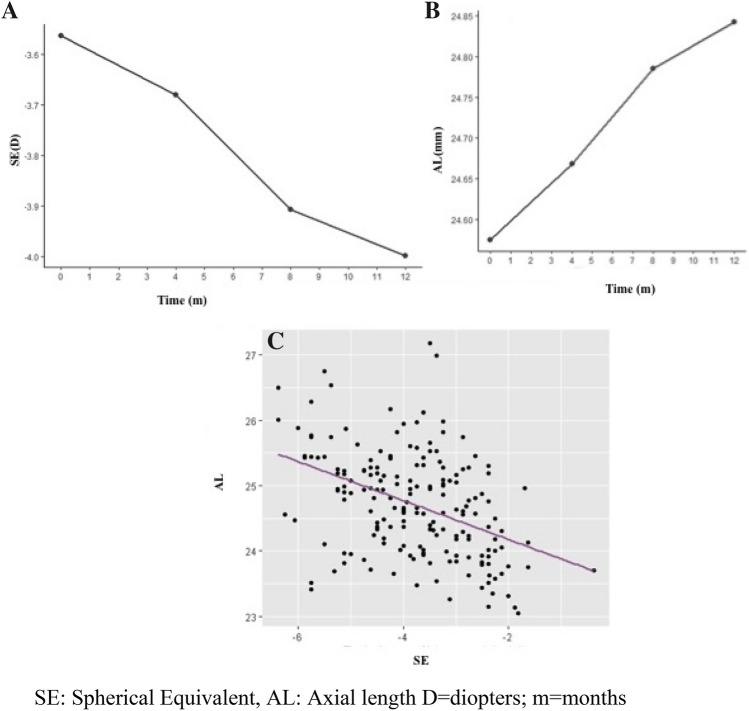
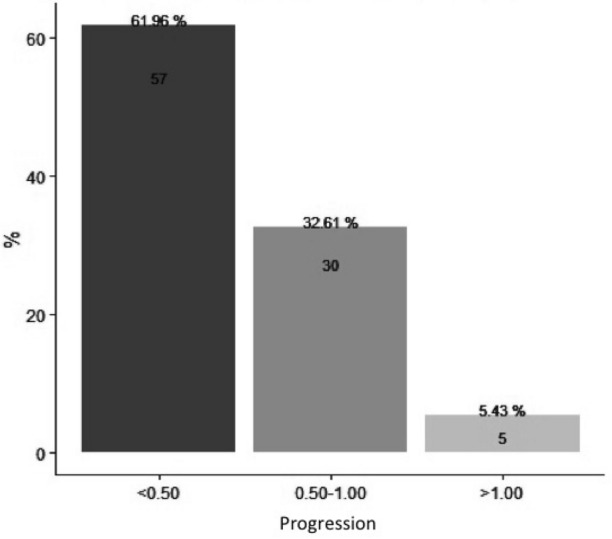
To evaluate the efficacy and safety of atropine 0.01% eye drops for myopia control in a multicentric pediatric Spanish cohort. An interventional, prospective, multicenter study was designed. Children aged between 6 and 14 years, with myopia between - 2.00 D to - 6.00 D, astigmatism < 1.50 D and documented previous annual progression greater than - 0.5 D (cycloplegic spherical equivalent, SE) were included. Once nightly atropine 0.01% eye drops in each eye were prescribed to all participants for 12 months. Age, gender, ethnicity and iris color were registered. All patients underwent the same follow-up protocol in every center: baseline visit, telephone consultation 2 weeks later and office controls at 4, 8 and 12 months. At each visit, best-corrected visual acuity, and cycloplegic autorefraction were assessed. Axial length (AL), anterior chamber depth and pupil diameter were measured on an IOL Master (Carl Zeiss Meditec, Inc, Dublin, CA). Adverse effects were registered in a specific questionnaire. Mean changes in cycloplegic SE and AL in the 12 months follow-up were analyzed. SE progression during treatment was compared with the SE progression in the year before enrollment for each patient. Correlation between SE and AL, and annual progression distribution were evaluated. Progression risk factors were analyzed by multivariate logistic regression analyses. Of the 105 recruited children, 92 completed the treatment. Mean SE and AL changes were - 0.44 ± 0.41 D and 0.27 ± 0.20 mm respectively. Mean SE progression was lower than the year before treatment (- 0.44 ± 0.41 D versus - 1.01 ± 0.38 D; p < 0.0001). An inverse correlation between SE progression and AL progression (r: - 0.42; p < 0.0001) was found. Fifty-seven patients (62%) had a SE progression less than - 0.50 D. No risk factors associated with progression could be identified in multivariate analyses. Mean pupil diameter increment at 12-months visit was 0.74 ± 1.76 mm. The adverse effects were mild and infrequent, and decreased over the time. Atropine 0.01% is effective and safe for myopia progression control in a multicentric Spanish children cohort. We believe this efficacy might be extensible to the myopic pediatric population from Western countries with similar social and demographic features. More studies about myopia progression risk factors among atropine treated patients are needed.
评估阿托品 0.01%滴眼液在西班牙多中心儿科人群中控制近视的疗效和安全性。这是一项干预性、前瞻性、多中心研究。纳入年龄在 6 至 14 岁之间、近视屈光度在-2.00 D 至-6.00 D 之间、散光 < 1.50 D 且有记录的每年进展大于-0.5 D(睫状肌麻痹球镜等效,SE)的儿童。所有参与者均每晚在双眼滴用阿托品 0.01%滴眼液,持续 12 个月。记录年龄、性别、种族和虹膜颜色。所有患者在每个中心接受相同的随访方案:基线访视、2 周后电话咨询和 4、8 和 12 个月时的门诊检查。每次就诊时,均评估最佳矫正视力和睫状肌自动折射。使用 IOL Master(Carl Zeiss Meditec,Inc,Dublin,CA)测量眼轴(AL)、前房深度和瞳孔直径。在专门的问卷中记录不良反应。分析 12 个月随访期间 SE 和 AL 的平均变化。将每个患者治疗期间的 SE 进展与入组前一年的 SE 进展进行比较。评估 SE 和 AL 之间的相关性以及年度进展分布。通过多元逻辑回归分析评估进展的危险因素。在招募的 105 名儿童中,92 名完成了治疗。SE 和 AL 的平均变化分别为-0.44 ± 0.41 D 和 0.27 ± 0.20 mm。SE 进展低于治疗前一年(-0.44 ± 0.41 D 与-1.01 ± 0.38 D;p < 0.0001)。发现 SE 进展与 AL 进展之间呈负相关(r:-0.42;p < 0.0001)。57 名患者(62%)的 SE 进展小于-0.50 D。多元分析未发现与进展相关的危险因素。12 个月时平均瞳孔直径增加 0.74 ± 1.76 mm。不良反应轻微且不频繁,且随时间推移而减少。阿托品 0.01% 可有效且安全地控制西班牙多中心儿科人群的近视进展。我们认为这种疗效可能适用于具有相似社会和人口统计学特征的来自西方国家的近视儿童人群。需要更多关于阿托品治疗患者近视进展危险因素的研究。