Institute of Medical Technology, Peking University Health Science Center, Beijing, China.
Department of Ophthalmology & Clinical Center of Optometry, Peking University People's Hospital, Beijing, China.
Front Public Health. 2022 Aug 15;10:981573. doi: 10.3389/fpubh.2022.981573. eCollection 2022.
To investigate the reasons for wasting orthokeratology (OK) lenses due to breakage or loss, provide more comprehensive guidelines for the clinical care of lenses and minimize time and costs for patients due to excessive broken and lost lenses.
A survey was administered to clinic outpatients who had broken or lost their OK lenses before the regularly scheduled replacement cycle (1-1.5 years). The association between the frequency of OK lens breakage and daily care was assessed using Fisher's exact test and multivariable ordered logistic regression analysis.
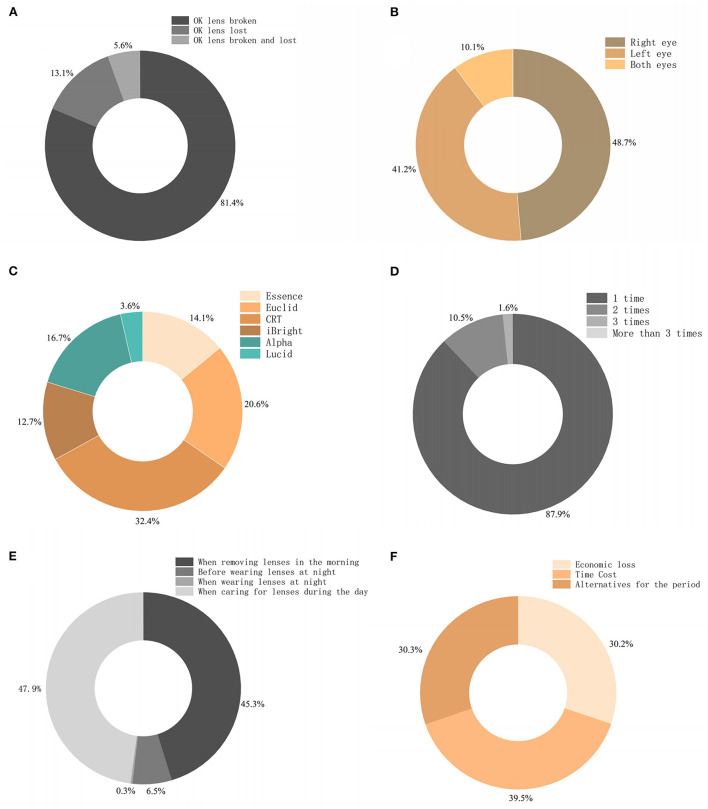
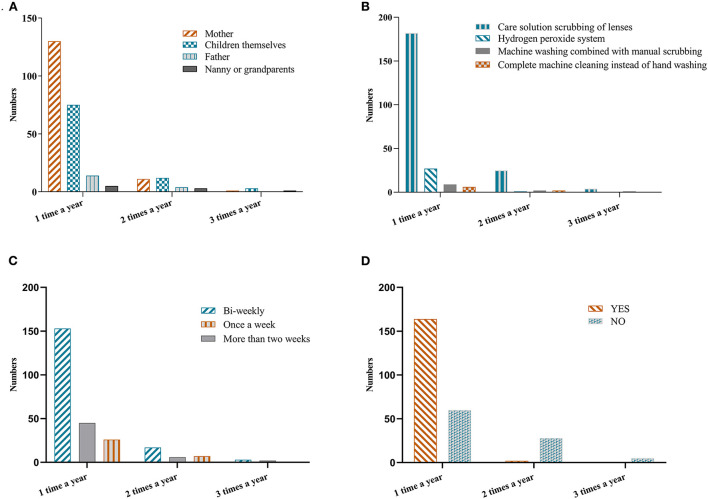
A total of 306 valid questionnaires were collected. Among the subjects, 141 were male, and 165 were female, with a mean age of 10.57 ± 2.00 years (range: 6-18 years). In the investigation of the causes of OK lens waste, 81.4% of the patients reported lens breakage, 13.1% lost their lenses, and 5.6% of patients experienced both fragmentation and lens loss. More than half of the patients (52.90%) used incorrect lens cleaning techniques. In further analysis of the relationship between the frequency of OK lens fragmentation within a year and daily care habits, a significant difference was observed between the caregiver ( = 0.03) and whether the lenses were cleaned promptly after removal ( < 0.001). Mothers as daily caregivers of OK lenses had a lower frequency of fragmentation in a year compared to nanny or grandparents ( = 0.014, OR = 0.33, 95% CI = 0.13, 0.80). The failure to clean the lenses according to eye care practitioners' guidance was a risk factor for the frequent breakage of OK lenses ( < 0.001. OR = 5.29, 95% CI = 3.15, 8.89).
The causes of OK lens waste were mainly attributed to caregivers, care practices and some unexpected situations that can be avoided through optometrists' reminders. Regardless of the reasons for noncompliant behavior leading to breakage or loss of OK lenses, all of the complications can probably be addressed by better and more frequent reinforcement of care procedures by practitioners. Better clinical guidance measures and more frequent reminders could prevent a large proportion of abnormal waste of OK lenses.
探讨角膜塑形术(OK)镜片破损或丢失的原因,为镜片的临床护理提供更全面的指导,减少因过多破损和丢失镜片而导致的患者时间和成本的浪费。
对定期更换周期(1-1.5 年)前因破损或丢失 OK 镜片而就诊的门诊患者进行问卷调查。采用 Fisher 确切检验和多变量有序逻辑回归分析评估 OK 镜片破损频率与日常护理之间的关系。
共收集 306 份有效问卷。其中,男性 141 例,女性 165 例,平均年龄 10.57±2.00 岁(6-18 岁)。在调查 OK 镜片浪费的原因时,81.4%的患者报告镜片破损,13.1%的患者丢失镜片,5.6%的患者同时出现镜片破碎和丢失。超过一半的患者(52.90%)使用了不正确的镜片清洁技术。进一步分析一年内 OK 镜片破碎频率与日常护理习惯之间的关系,发现护理人员( = 0.03)和镜片是否在取出后及时清洁( < 0.001)之间存在显著差异。作为 OK 镜片日常护理人员的母亲,一年内镜片破碎的频率低于保姆或祖父母( = 0.014,OR = 0.33,95%CI = 0.13,0.80)。未按眼科医生的指导清洁镜片是 OK 镜片频繁破碎的危险因素( < 0.001,OR = 5.29,95%CI = 3.15,8.89)。
OK 镜片浪费的主要原因是护理人员、护理操作以及一些可以通过提醒视光师避免的意外情况。无论导致 OK 镜片破损或丢失的不依从行为的原因是什么,通过视光师更好、更频繁地强化护理程序,都可能解决所有并发症。更好的临床指导措施和更频繁的提醒可以防止大量异常浪费 OK 镜片。